GHOSTS
Real scans, photographic echoes, fictional memories, old fashioned film, compulsive transparencies, ethereal landscapes
One size does not fit all: Context matters greatly, for Conscientious Extended, July 2012.
“We all know that all photography is fiction: as a photographer you make choices, which influence the photograph enough for it to be more of a fiction than a fact. That’s photography for you. That’s just the way it is. But the photojournalist’s task, no actually the photojournalist’s duty is to minimize the amount of fiction that enters her/his photography. We are quite aware of the problem in the news context – this is, after all, the context where the problems with image manipulation come up regularly – so we expect photographs in this context to be as truthful as they can be. The problem with InstaHip in this particular context is it adds a huge amount of fiction to photography, simply by its aesthetic.”
—Joerge Colbert
— via fette
Masters of photography – Diane Arbus (documentary, 1972)
Someone must have sent me this or linked to it recently, because it was in my “watch later” list on the Youtubes.
I listened to it three times today already whilst working, I might listen to it again.
“Everybody has that thing when they need to look one way but they come out looking another way and that is what people observe.
You see someone on the street and essentially what you notice about them is the flaw.
It’s just extraordinary that we should be given these peculiarities and not content with what we were given we create a whole other set. Our whole guise is like giving a sign to the world to think of us a certain way.
But there’s a point between what you want people to know about you and what you can’t help people knowing about you, and that has to do with. what I have always called, the gap between intention and effect.”
Etienne-Jules Marey and his Chronophotographic Gun

“A polymorphic scientific, Etienne Jules Marey explored numerous techniques and disciplines, obsessed by one unique concept: movement. First interested in flight, he studied birds and imagined mechanical devices capable of flying. From 1878, he focused on movement within human beings and, inspired by Edward Muybridge he had met in 1881, used photography to document his research. He thus imagined, in 1882, a camera entitled photographic gun that enabled him to capture a moving subject in twelve poses. Etienne Jules Marey thus decomposed the gestures of men practicing sports, animals in motion, everyday tasks precisely observed and even the migration of air. He also invented the chonophotography that would be the precursor of cinema. Photography in its early days was the ultimate accomplice of reality but with Etienne Jules Marey (and Edward Muybridge), photography suddenly also captured the invisible.”

“Marey started by studying blood circulation in the human body. Then he shifted to analyzing heart beats, respiration, muscles (myography), and movement of the body. To aid his studies he developed many instruments for precise measurements. For example, in 1859, in collaboration with the physiologist Auguste Chauveau and the watch manufacturer Breguet, he developed a wearable Sphygmograph to measure the pulse. This sphygmograph was an improvement on an earlier and more cumbersome design by the German physiologist Karl von Vierordt.[3] In 1869 Marey constructed a very delicate artificial insect to show how an insect flies and to demonstrate the figure-8 shape it produced during movement of its wings. Then he became fascinated by movements of air and started to study bigger flying animals, like birds. He adopted and further developed animated photography into a separate field of chronophotography in the 1880s. His revolutionary idea was to record several phases of movement on one photographic surface. In 1890 he published a substantial volume entitled Le Vol des Oiseaux (The Flight of Birds), richly illustrated with photographs, drawings, and diagrams. He also created stunningly precise sculptures of various flying birds.”

”
“Marey studied other animals too. He published La Machine animale in 1873 (translated as “Animal Mechanism”). The English photographer Eadweard Muybridge carried out his “Photographic Investigation” in Palo Alto, California, to prove[dubious – discuss] that Marey was right when he wrote that a galloping horse for a brief moment had all four hooves off the ground. Muybridge published his photos in 1879 and received some public attention.”
“Marey’s chronophotographic gun was made in 1882, this instrument was capable of taking 12 consecutive frames a second, with all the frames recorded on the same picture. Using these pictures he studied horses, birds, dogs, sheep, donkeys, elephants, fish, microscopic creatures, molluscs, insects, reptiles, etc. Some call it Marey’s “animated zoo”. Marey also conducted the famous study about cats always landing on their feet. He conducted very similar studies with a chicken and a dog and found that they could do almost the same. Marey also studied human locomotion. He published another book Le Mouvement in 1894.”

On Painting Machines

Reblogged from ekstasis:
“Anton Perich
Everything has history. Call the above proto-glitch. Here’s Perich describing his artistic process, in this case building a machine to do his painting for him in 1977:
I dreamed of a machine that would paint. No more hand made paintings, but machine made, with sharp electric lines, on and off, like Morse code, short and long. So in 1977/78 I built such a machine, using surplus materials from Canal Street stores. I wired some photocells to the airbrushes on the motorized scanning unit that swept an area of about 10×12 feet, hung a piece of canvas, and made my first digital painting. In his Diaries Warhol said he was terribly jealous. This machine was an early precursor of ink jet printer/scanner. This was the time long before computer and digital art. I had my first show of electric paintings at Tony Shafrazy Gallery in 1979. I am still painting with this machine every day. It keeps breaking and I keep fixing it all the time.
Not “computer generated,” but computer aided. Not mechanistic, but nevertheless mediated by technology, by the digital. “Glitched,” before such a thing was.
The wonderful Joanne McNeil is in charge of Rhizome’s frontpage these days. Compare Perich’s painting from the 70’s to her post, from 2011:
Today’s information and mass media society have brought about a diffused ‘aestheticization’ where artists are mixing political and war images with those proceeding from adds, commercial cinema and entertainment. Be it by hiding images behind layers, making them transparent or pixilated, applying faded colors and thick paint, there is a slowing down of the experience of viewing an image through a hand made, physical rendering. But, besides this ‘slowness’ and physicality that we traditionally associate with painting, the painting medium is also paradoxically going through an ‘acceleration’ process through its newfound relationship with iPhones, scanners, Photoshop, Facebook, satellites, digital cameras, and 3-D programs.
— The Museum voor Moderne Kunst Arnhem (MMKA) description of exhibition The End of History…and The Return of History Painting (via Bruce Sterling)
…Not “computer generated,” but mediated. That “slowness” is the same as Perich’s, a layer between theory and practice. Perich built a piece of bleeding-edge technology inspired by century old Morse code, by a dream, that always breaks and needs repair. It could be contemporary and would still seem avant garde.
The tools have changed, of course, which changes the context. A modified inkjet printer is a throwback now, a modern process made real by an allegedly dying technology, but the principle remains the same. That’s “the end of history,” simultaneously hurtling forward and artificially slowing ourselves, if only so we can make sense of things. Reaching into the past only to find what we thought was new, revolutionary and not being entirely surprised.”
Floris Neusüss (1937)

“Neusüss’s frames are very large, and reproduce the human body in life size, but also other objects. They look like ghosts, ectoplasms, magical light creatures. And they constitute a different point of view on bodies and things. The German artist says: “In the frame the observer distinguishes the fragmentariness of the object as a citation of reality”.”
The Earth together with the Moon, as seen from the Messenger spacecraft to Mercury, May 2010.

via Bruce Sterling
Las Polaroid de Tarkovsky
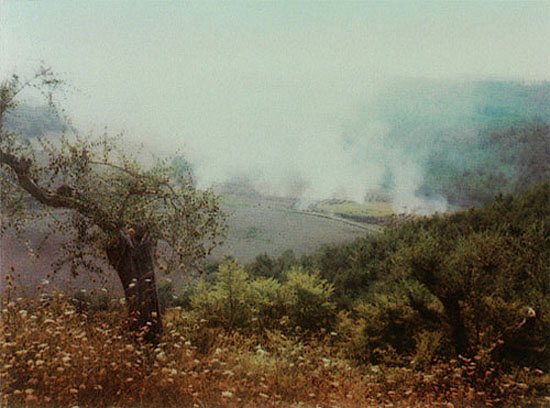
“No es muy conocido que Tarkovsky, cuyas películas parecen estar compuestas a veces por un montaje de fotografías estáticas, se dedicó durante algún tiempo, efectivamente, a tomar fotos con una Polaroid. Estas fotos, a pesar de sus imperfecciones técnicas, atestiguan la misma forma de mirar y el mismo mundo visual de sus grandes films.”
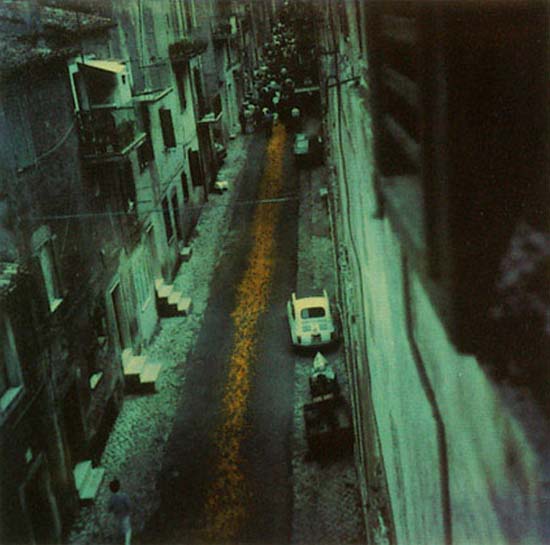
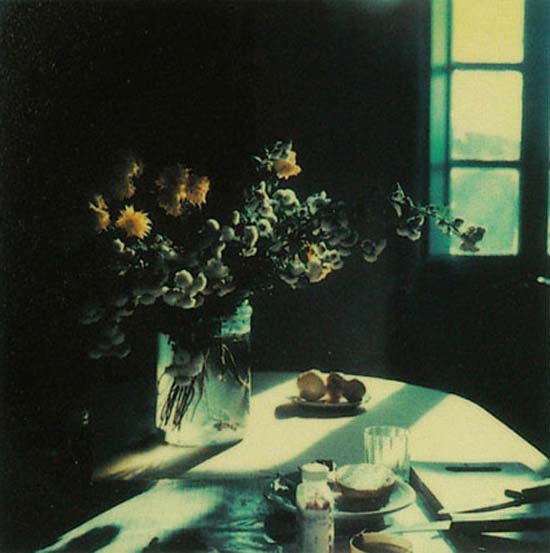
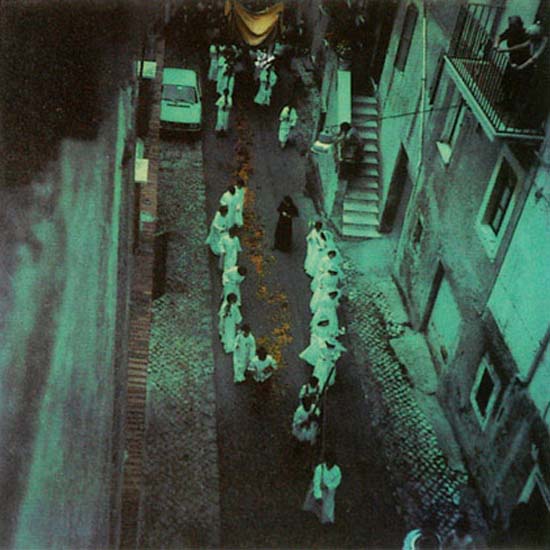
more at: Poemas del río Wang
Dora Maar by Man Ray, 1936

“Henriette Theodora Markovitch (22 November 1907 – 16 July 1997), known as Dora Maar, was a French photographer, painter, and poet.”
“Man Ray (born Emmanuel Radnitzky; August 27, 1890 – November 18, 1976) was an American visual artist who spent most of his career in France. He was a significant contributor to the Dada and Surrealist movements, although his ties to each were informal. He produced major works in a variety of media but considered himself a painter above all. He was best known for his photography, and he was a renowned fashion and portrait photographer. Man Ray is also noted for his work with photograms, which he called “rayographs” in reference to himself.”
“the young women serious face, lit up by pale blue eyes which looked all the paler because of her thick eyebrows; a sensitive uneasy face, with light and shade passing alternately over it. She kept driving a small pointed pen-knife between her fingers into the wood of the table. Sometimes she missed and a drop of blood appeared between the roses embroidered on her black gloves… Picasso would ask Dora to give him the gloves and would lock them up in the showcase he kept for his mementos.”
 Paul Greer