
IMAGINED
IMAGINED-SPACES: (/ɪˈmadʒɪn/) (speɪs/) (noun)
Autodesk Maya, Arnold, Unity, virtual realities, imagined realities, 360 Video, computer graphics, rendering, augmented environments, realtime processing.
“The tree which moves some to tears of joy is in the eyes of others only a green thing that stands in the way. Some see nature all ridicule and deformity… and some scarce see nature at all. But to the eyes of the man of imagination, nature is imagination itself.”
– William Blake
thy fearful symmetry
“I must create a system, or be enslaved by another man’s. I will not reason and compare: my business is to create.”
via britticisms
Freddie
“Does it mean this, does it mean that, that’s all anybody wants to know. I’d say what any decent poet would say if anyone dared ask him to analyze his work: if you see it, darling, then it’s there!”
Good vs. Bad Art
“Don’t think about making art, just get it done. Let everyone else decide whether it’s good or bad, whether they love it or hate it. While they’re deciding, make even more art.”
What are you looking for?
“Inspiration exists, but it has to find us working.”
Jack Kerouac’s 30 Beliefs and Techniques For Writing Modern Prose
- Scribbled secret notebooks, and wild typewritten pages, for yr own joy
- Submissive to everything, open, listening
- Try never get drunk outside yr own house
- Be in love with yr life
- Something that you feel will find its own form
- Be crazy dumbsaint of the mind
- Blow as deep as you want to blow
- Write what you want bottomless from bottom of the mind
- The unspeakable visions of the individual
- No time for poetry but exactly what is
- Visionary tics shivering in the chest
- In tranced fixation dreaming upon object before you
- Remove literary, grammatical and syntactical inhibition
- Like Proust be an old teahead of time
- Telling the true story of the world in interior monolog
- The jewel center of interest is the eye within the eye
- Write in recollection and amazement for yourself
- Work from pithy middle eye out, swimming in language sea
- Accept loss forever
- Believe in the holy contour of life
- Struggle to sketch the flow that already exists intact in mind
- Dont think of words when you stop but to see picture better
- Keep track of every day the date emblazoned in yr morning
- No fear or shame in the dignity of yr experience, language & knowledge
- Write for the world to read and see yr exact pictures of it
- Bookmovie is the movie in words, the visual American form
- In praise of Character in the Bleak inhuman Loneliness
- Composing wild, undisciplined, pure, coming in from under, crazier the better
- You’re a Genius all the time
- Writer-Director of Earthly movies Sponsored & Angeled in Heaven”
Walton Ford
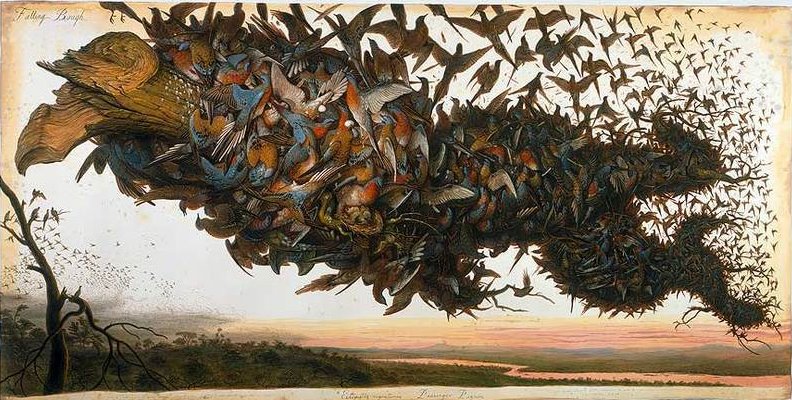
‘An enthusiast of the watercolors of Audubon, Ford celebrates the myth surrounding the renowned naturalist-painter while simultaneously repositioning him as an infamous anti-hero who, in reality, killed more animals than he ever painted. Each of Ford’s animal portraits doubles as a complex, symbolic system, which the artist layers with clues, jokes, and erudite lessons in colonial literature and folktales.’
— via Ingoing
Theory of the Dérive
“One of the basic situationist practices is the dérive [literally: “drifting”], a technique of rapid passage through varied ambiances. Dérives involve playful-constructive behavior and awareness of psychogeographical effects, and are thus quite different from the classic notions of journey or stroll. In a dérive one or more persons during a certain period drop their relations, their work and leisure activities, and all their other usual motives for movement and action, and let themselves be drawn by the attractions of the terrain and the encounters they find there. Chance is a less important factor in this activity than one might think: from a dérive point of view cities have psychogeographical contours, with constant currents, fixed points and vortexes that strongly discourage entry into or exit from certain zones. But the dérive includes both this letting-go and its necessary contradiction: the domination of psychogeographical variations by the knowledge and calculation of their possibilities.”
Authenticity is invaluable; originality is nonexistent.
“Nothing is original. Steal from anywhere that resonates with inspiration or fuels your imagination. Devour old films, new films, music, books, paintings, photographs, poems, dreams, random conversations, architecture, bridges, street signs, trees, clouds, bodies of water, light and shadows. Select only things to steal from that speak directly to your soul. If you do this, your work (and theft) will be authentic. Authenticity is invaluable; originality is nonexistent. And don’t bother concealing your thievery—celebrate it if you feel like it. In any case, always remember what Jean-Luc Godard said: “It’s not where you take things from—it’s where you take them to.”
 Paul Greer