“Every August, as Japanese spirits return en masse from the otherworld, Tokyo’s Zenshoan temple (map) exhibits a spine-chilling collection of 19th-century ghost scroll paintings.”
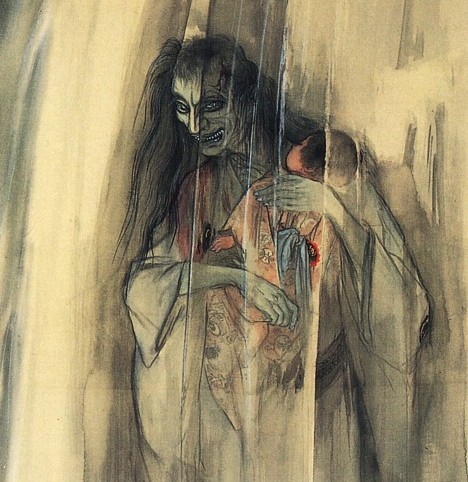
Kaidan Chibusa Enoki: The Ghostly Tale of the Wet Nurse Tree
“This painting by Ito Seiu, the godfather of Japanese bondage (kinbaku), depicts a scene from Kaidan Chibusa Enoki, an old horror story in which the ghost of a dead painter returns to protect his baby from his murderer, a wandering samurai who fell in love with his wife while he was away painting. This scroll shows the ghost holding the baby while standing under a waterfall at Juniso (where Tokyo’s Shinjuku Chuo Park is now located).”
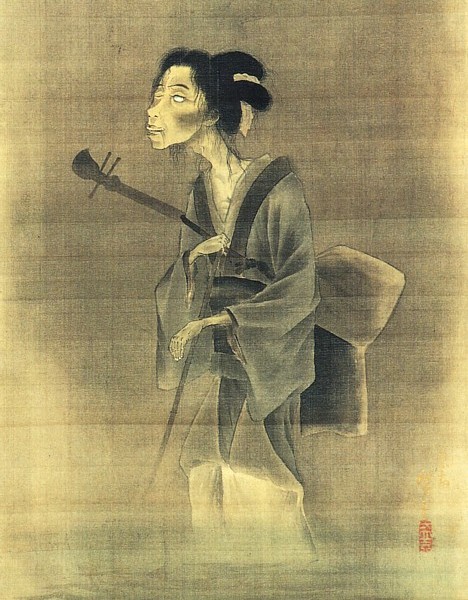
The Ghost of a Blind Female Street Singer
“Utagawa Hiroshige’s “Ghost of a Blind Female Street Singer” portrays the restless spirit of a street performer, one white unseeing eye wide open, carrying a shamisen as she drifts above the surface of a river on the way to her next performance.”
Ogata Gekko (1859 – 1920) Urashima Leaving the Palace Under the Sea, from Gekko’s Miscellaneous Drawings, 1894. Oban.
“Urashima Taro was a fisherman of the fifteenth century who rescued a young turtle from some bullying children. The following day a huge turtle approaches him and tells him he has saved the daughter of the Emperor of the Sea. As a reward the fisherman is gifted magical gills and taken to the palace beneath the waves. Whilst there he is given a beautiful box and told never to open it.
On his return three days later he finds that three hundred years have elapsed and everyone he knew has died. In distress he opens the box and instantly withers and dies in a pile of dust, the voice of the sea princess saying to him: “I said never to open the box; inside it is your old age”. Incidentally, the hair of the turtle is actually a long fronded algae that grows on the backs of turtles’ shells off the coast of Japan.”


 Paul Greer