
see also:
Alternative Comics, Sequential visual narrative, photo stories, cave paintings. Little comics everywhere.
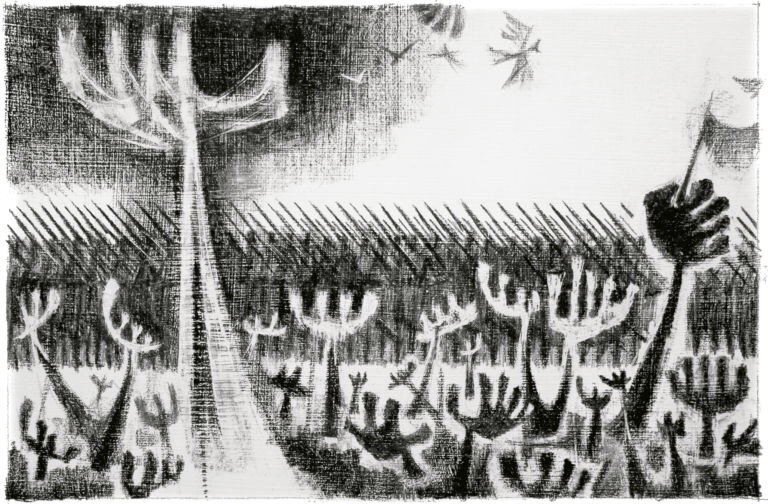
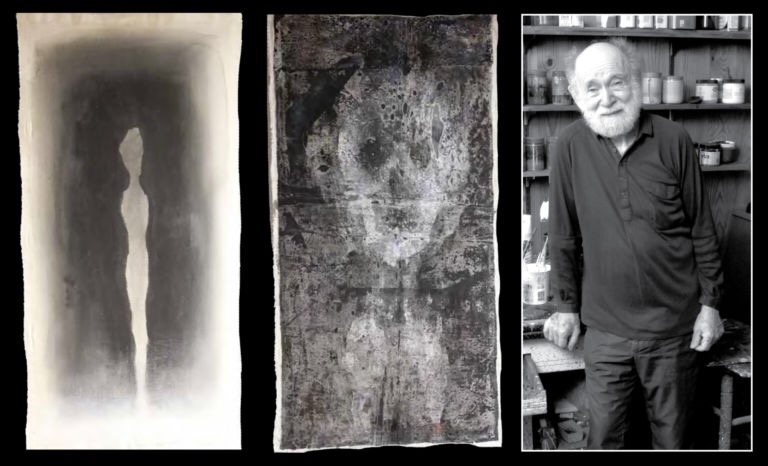
“The Parade” is a modernist dirge of a book that still packs an emotional wallop, telling the story of mankind’s recurring and deadly war fever. Einstein wrote Si a fan letter after seeing the drawings in 1951, saying, “Our time needs you and your work!” It doesn’t take a genius to see that this is still true today, so Si and I collaborated on an expanded “director’s cut” version of “The Parade,” remastered from the original art and published, this month, as a long accordion-fold book.


“Original drawings by the Brazilian artist, Henrique Alvim Corrêa, from the Belgium first edition of H. G. Wells’ classic science-fiction novel, War of the Worlds, published in 1906.”
“Whenever I’ve had to write prose I always find writing the description is really frustrating, because I think I could just draw this. And also there’s always so much more content to a drawing than to a prose description. I feel like there’s always so much more to be done with that. Plus when you’re writing prose you’re competing against Tolstoy and Dostoevsky and it’s very difficult to do anything that would be ultimately satisfying in terms of really differentiating yourself. At best I could write a halfway decent novel. That’s all I could ever hope for and that would be quite an accomplishment.”
“It sometimes seems like that’s the overriding trend in comics right now, beautiful drawings and empty stories.
I can’t tell if that’s just the result of a generation of kids who are raised with this different form of receiving media. Is it that or is it just that they’re coming out of the art world more than they used to? I don’t know, but there is something very strange about that. It doesn’t seem to be attracting people who just want to create stories and aren’t that visually oriented. You would sort of think that would be a part of the comics world that was opening up. At least I haven’t really seen that. Or they could just be doing stories I’m not very interested in.”


The Van Gogh Museum:
“From the moment they were printed, the series of woodcuts with the title Intimités was considered to be a prestigious project. When the avant-garde publication La Revue blanche printed the series in an exclusive edition of 25 in 1898, the modern art of printmaking was more popular than ever in the Paris art world. Among his fellow printmakers, Félix Vallotton was one of the most renowned artists. He was recognized as an innovator of the medium of the woodcut and his prints dating from 1896 to 1898 are the culmination of his career.
“Intimités has always been recognized as his most impressive work and even in his own time they were already more appreciated than his paintings. With these ten dark woodcuts, their black surfaces cut through by a few white lines, Vallotton probed the emotional lives of the Paris bourgeoisie. He portrayed the eternal struggle between man and woman by means of theatrical scenes and suggestive titles, such as The Lie, The Money and The Irreparable. Vallotton brought to the surface his cynical view on love. Women are portrayed as superficial, calculating creatures: cruel, insatiable and triumphing.”
reblogged from austinkleon
Two things coming up recently regarding powerful rich “artists” making kudos and money from the hard work of whom they can only consider to be lesser mortals.
First you should know that Richard Prince has been “re-photographing” since the 1970s. He takes pictures of photos in magazines, advertisements, books or actors’ headshots, then alters them to varying degrees. Often, they look nearly identical to the originals. This has of course, led to legal trouble. In 2008, French photographer Patrick Cariou sued Prince aft..er he re-photographed Cariou’s images of Jamaica’s Rastafarian community. Although Cariou won at first, on appeal, the court ruled that Prince had not committed copyright infringement because his works were “transformative.”
– A reminder that your Instagram photos aren’t really yours: Someone else can sell them for $90,000
..and then Dan Clowes on that Shia Lebeouf thing:
“Speaking of grudges: Have you forgiven Shia LaBeouf?”
“I don’t know. No, not really. I mean, I don’t hold a grudge. I don’t think about it that much. But I don’t think what he did was really forgivable. I don’t know that it matters that much if he’s apologizing or whatever. I just hate the idea of anybody doing that to some young artist who couldn’t hire legal representation. I’m sort of the one guy who could deal with something like that, and it would be really possible for somebody with his amount of money and power to just crush some poor young artist if that happened to them, and I would hate to see that. So I don’t think it’s something that needs to be forgiven; I think it’s something that always needs to be thought of as just a horrible thing to do.”
– Comics Legend Daniel Clowes on Hate Mail, Jim Belushi, and Not Forgiving Shia LaBeouf
Difficult for me to comment on this without falling into ranting, which is how I am supposed to react.
Let’s cleanse ourselves by reading about the true artists who Lichenstein “homaged”, in Deconstructing Lichtenstein.
Finally an article addressing a parallel issue of the popular misconceptions around the creation of CGI for big budget features:
As the debate surrounding what visual effects are worth rages on, it is clear that the studios themselves have an interest in perpetuating the myth that VFX are the product of clinical assembly lines and the results are equally lifeless and mechanical. Blaming computers for the dumbing down of movies has become a journalistic trope that is bandied about to squeeze the one part of the Hollywood machine that has no union or organizational skill to push back.
by spikedrewthis:
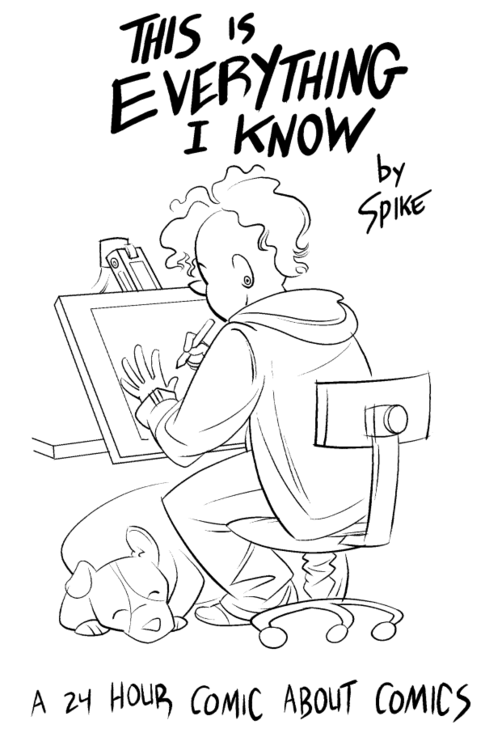
“Hey, all. This is a comic I started on 24 Hour Comic Day, but I only managed to complete 12 pages on that day. That makes it a technical failure, but I decided it was worth finishing regardless of that.
“I sold copies at APE, but I didn’t anticipate the demand and ran out of them pretty quickly. So, I promised to re-post the mini on tumblr when i got home, and here it is.
“Some further reading, if this kinda thing is up your alley.
- Kevin Kelly’s original essay on 1000 True Fans. He also links to associated articles dealing with the theory, even one that disagrees with it. Interesting reading.
- If you don’t know about Kickstarter and what its done for indie comics, get out from under that rock already. Lots of small press and micro publishers now pre-order ALL their projects on KS, myself included.
- Patreon is the new kid on the block; not quite up to scratch as of yet, but full of possibilities. Search “comics” to find a number of creators using it to draw a page rate from their fanbase.
“I hope someone finds this helpful. I may put a print-rez PDF up for sale, if any interest is expressed.
Enjoy!”

reblogging 2000adonline:
“We are very saddened to hear of the death of artist Brett Ewins.
“Throughout his years of working for 2000 AD, Brett was responsible for some truly unmissable art – from Judge Dredd and Anderson Psi Division to Rogue Trooper and his incredible work on Bad Company with Peter Milligan and Jim McCarthy.
“He was also a hugely influential figure in British comics thanks to his founding of Deadline with Steve Dillon in 1988, something that changed the face of the industry forever.
“Our thoughts and deepest condolences are with Brett’s family and friends.”
Brett’s work had a huge influence on me in the way I saw comic story telling. I actually wrote an essay on this very issue containing ‘The Haunting of Sector House 9’ when I was studying.







 Paul Greer