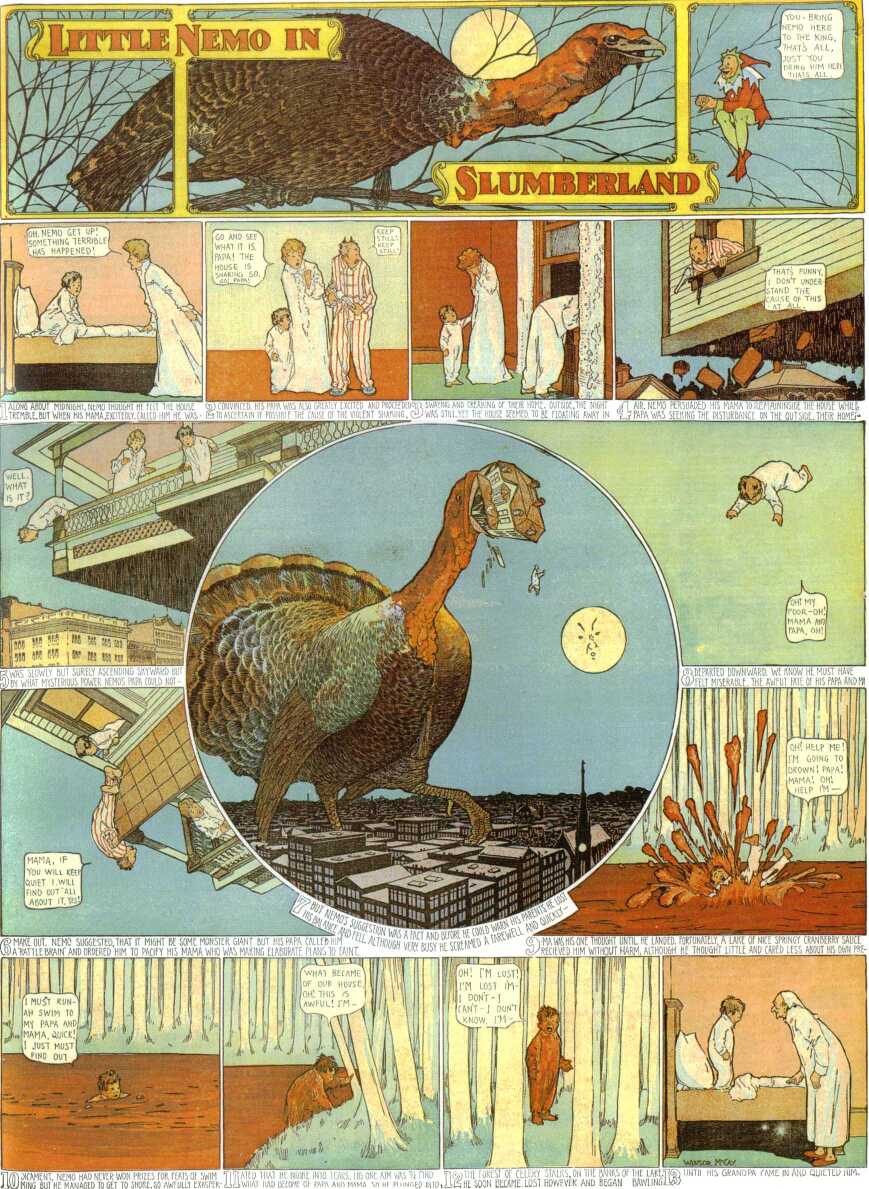
On What Comics Can Do

“If Art Spiegelman’s MAUS had been filmed first, it would have had an audience of maybe three people at Sundance. Because the moment everyone trooped on wearing their mouse masks, any larger audience would have lost it and left giggling. Only in the space of cartooning could that conceit work. Not least because we’re already aware, when we come to cartooning, that we’re looking at someone’s processed and hermetic perception of the world. The great success of MAUS is that the mouse faces make us let our guard down, and so we’re hit by the horrible truth of that book from an unprotected angle.”

“..a curling, snarling Peter Kuper piece can sear the page with its anger in a way that no photorealistic artist will ever be able to communicate. A room drawn by Eddie Campbell will be more real than any snapshot, because his line is almost like handwriting, and has human breath upon it. Dash Shaw’s work may look rough on first look, but stay with it, look at how he conveys the essence of an idea in every panel, and you’ll realise how hard he sometimes works to evoke an entire world with so few elements.”

“This is a field that combines, on the one hand, the novel and the poem and the slogan and the news story, and on the other hand every stop from pointillism to cave painting. Understand comics as the marriage of word and picture, as simple as that, and you’ll get a sense of how broad the medium’s reach really is.”

Warren Ellis

Top of Mt. Vesuvius – (Campi Phlegraei)


Top of Mt. Vesuvius

Sir William Hamilton (1730-1803), perhaps best-known today as the husband of Emma Hamilton, mistress of Admiral Lord Nelson, was in his own right a skilled diplomatist, a celebrated connoisseur and collector, and a respected natural historian. In his own time he was honoured in particular for his contributions to the study of volcanoes, acquiring the title ‘the modern Pliny’ for his studies of Vesuvius.”

vi BibliOdyssey

Gustav Klimt. Philosophy (1899).

Klimt University of Vienna Ceiling Paintings

Philosophy was the first of the three pictures presented to the Austrian Government at the seventh Vienna Secession exhibition in March 1900. It had been awarded a gold medal at the World Exhibition in Paris, but was attacked by those in his own country. Klimt described the painting as follows: “On the left a group of figures, the beginning of life, fruition, decay. On the right, the globe as mystery. Emerging below, a figure of light: knowledge.” Critics were disturbed by its depiction of men and women drifting in an aimless trance. The original proposal for the theme of the painting was “The Victory of Light over Darkness”, but what Klimt presented instead was a dreamlike mass of humanity, referring neither to optimism nor rationalism, but to a “viscous void””

“Klimt came under attack for ‘pornography’ and ‘perverted excess’ in the paintings. None of the paintings would go on display in the university.
In May 1945, it is contended that all three paintings were destroyed by retreating SS forces.”

via

On Ditko and Abstraction


The script is dominant, the story is what matters, images are subservient. This is what I would call–to borrow a term from deconstruction–the logocentric view of comics. “Logocentric” as centered upon the logos, which means not only “speech” or “discourse,” but also meaning, as in a verbalizable meaning.”


“Obviously, I’m a proponent of an anti-logocentric view of comics. Ditko and Kirby, in this view, only achieve their heights of artistry when they reverse that hierarchy, when the script becomes subservient to the art, rather than the reverse. Is this such a novel view of art? Not at all. As a matter of fact, the reversal has happened repeatedly in one of our most popular arts, or forms of entertainment, which most of the time is enjoyed precisely from this perspective: specifically, music.”

Andre Molotiu