Illus. and design by Oskar Garvens, book cover, Germany, 1925
“This massive book features a thousand images, and it was not easy to select only twenty-five. Graphic design titans like Jan Tschichold, George Salter, Herbert Bayer, and Herbert Matter rub shoulders with Hans Bellmer, John Heartfield, Hanna Hoch, and a gaggle of Expressionists and Dadaists. It’s an overwhelming visual feast summed up by new favorite German word “Blickfang”: “eye catcher.””
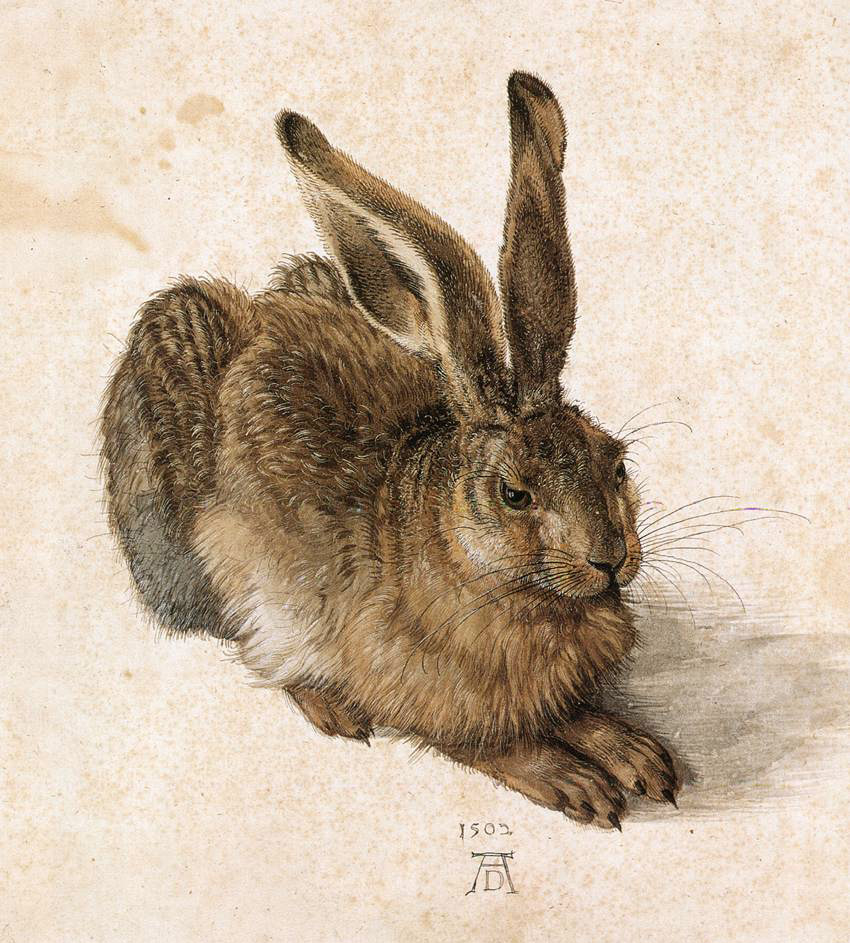
“There is some debate over how Dürer accurately captured the image of the hare: he may have sketched a hare in the wild and filled in the individual details from a dead animal, or captured one and held it alive in his studio while he worked on the painting. A reflection of the window frame in the hare’s eye is often cited as evidence for the theory that Dürer copied the hare from life in his workshop, but this cross-barred reflection is a technique that Dürer frequently used to add vitality to the eyes of his subjects.”
Frans Masereel (1919) Passionate Journey—arriving on the train
“Passionate Journey, or My Book of Hours (French: Mon livre d’heures), is a wordless novel of 1919 by Flemish artist Frans Masereel. The story is told in 167 captionless prints, and is the longest and best-selling of the wordless novels Masereel made. It tells of the experiences of an early 20th-century everyman in a modern city.”
Mon livre d’heures – three panels
Masereel’s medium is the woodcut, and the images are in an emotional, allegorical style inspired by Expressionism. The book followed Masereel’s first wordless novel, 25 Images of a Man’s Passion (1918); both were published in Switzerland, where Masereel spent much of World War I. German publisher Kurt Wolff released an inexpensive “people’s edition” of the book in Germany with an introduction by German novelist Thomas Mann, and the book went on to sell over 100,000 copies in Europe. Its success encouraged other publishers to print wordless novels, and the genre flourished in the interwar years.
“The story follows the life of a prototypical early 20th-century everyman after he enters a city. It is by turns comic and tragic: the man is rejected by a prostitute with whom he has fallen in love. He also takes trips to different locales around the world. In the end, the man leaves the city for the woods, raises his arms in praise of nature, and dies. His spirit rises from him, stomps on the heart of his dead body, and waves to the reader as it sets off across the universe.”
“Look at these powerful black-and-white figures, their features etched in light and shadow. You will be captivated from beginning to end: from the first pictured showing the train plunging through the dense smoke and bearing the hero toward life, to the very last picture showing the skeleton-faced figure among the stars. Has not this passionate journey had an incomparably deeper and purer impact on you than you have ever felt before?”
“What you do with comics, essentially, is take pieces of experience and freeze them in time,” Ware says. “The moments are inert, lying there on the page in the same way that sheet music lies on the printed page. In music you breathe life into the composition by playing it. In comics you make the strip come alive by reading it, by experiencing it beat by beat as you would playing music…”
Karoo Ashevak (1940 – October 19, 1974) was an Inuit sculptor who lived a nomadic hunting life in the Kitimeot, central Arctic region before moving into Spence Bay in 1960. His career as an artist started in 1968 by participating in a government-funded carving program. Working with the primary medium of fossilized whalebone, Ashevak created approximately 250 sculptures in his lifetime, and explored themes of shamanism and Inuit spirituality through playful depictions of human figures, shamans, spirits, and arctic wildlife



_Passionate_Journey_urination_page.jpg)
_Passionate_Journey%E2%80%94final_panel.jpg)

![[dragons]](https://78.media.tumblr.com/ZS10409bwmolxrjj82McK74fo1_540.jpg)


 Paul Greer