Marilyn Monroe’s 1955 New Year’s resolution list,


“Must make effort to do
Must have the dicipline to do the following –

z – go to class – my own always – without fail

x – go as often as possible to observe Strassberg’s other private classes

g – never miss actor’s studio sessions

v – work whenever possible – on class assignments – and always keep working on the acting exercises

u – start attending Clurman lectures – also Lee Strassberg’s directors lectures at theater wing – enquire about both

l – keep looking around me – only much more so – observing – but not only myself but others and everything – take things (it) for what they (it’s) are worth

y – must make strong effort to work on current problems and phobias that out of my past has arisen – making much much much more more more more more effort in my analisis. And be there always on time – no excuses for being ever late.

w – if possible – take at least one class at university – in literature –

o – follow RCA thing through.

p – try to find someone to take dancing from – body work (creative)

t – take care of my instrument – personally & bodily (exercise)

try to enjoy myself when I can – I’ll be miserable enough as it is.”

— via ListsOfNote

Silva rerum

Silva Rerum of Krassowscy (Ślepowron coat of arms) family from Ziemia Drohicka in Podlasie

In historical Poland [silva rerum] was written by members of the Polish nobility as a diary or memoir for the entire family, recording family traditions, among other matters; they were not intended for a wider audience of printing (although there were a few exceptions); some were also lent to friends of the family, who were allowed to add their comments to them. It was added to by many generations, and contained various information: diary-type entires on current events, memoirs, letters, political speeches, copies of legal documents, gossips, jokes and anecdotes, financial documents, economic information (price of grain, etc.), philosophical musings, poems, genealogical trees, advice (agricultural, medical, moral) for the descendants and others – the wealth of information in silva is staggering, they contain anything that their authors wished to record for future generations).”

via

3 x notes on notes and sketch pages

Lynda Barry:


Notes on notes and sketch pages

Guillermo Del Toro:

Among Guillermo del Toro’s most prized possessions is a leather-bound journal that he carries with him at all times. It is where he sketches and writes down his ideas and muses for future films. In this particular notebook was four years worth of ruminations that would eventually become Pan’s Labyrinth. The movie almost never came to be, as del Toro had exited a London cab one evening and neglected to take with him his notebook. The cab driver found the notebook, as well as a scrap of paper with a hotel logo on it. Recognising the logo, the cab driver returned the notebook and del Toro was so elated with its return that he rewarded the cab driver $900.
Among Guillermo del Toro’s most prized possessions is a leather-bound journal that he carries with him at all times. It is where he sketches and writes down his ideas and muses for future films. In this particular notebook was four years worth of ruminations that would eventually become Pan’s Labyrinth. The movie almost never came to be, as del Toro had exited a London cab one evening and neglected to take with him his notebook. The cab driver found the notebook, as well as a scrap of paper with a hotel logo on it. Recognising the logo, the cab driver returned the notebook and del Toro was so elated with its return that he rewarded the cab driver $900. via


Joan Didion:


Joan Didion


Why did I write it down? In order to remember, of course, but exactly what was it I wanted to remember? How much of it actually happened? Did any of it? Why do I keep a notebook at all? It is easy to deceive oneself on all those scores. The impulse to write things down is a peculiarly compulsive one, inexplicable to those who do not share it, useful only accidentally, only secondarily, in the way that any compulsion tries to justify itself. I suppose that it begins or does not begin in the cradle. Although I have felt compelled to write things down since I was five years old, I doubt that my daughter ever will, for she is a singularly blessed and accepting child, delighted with life exactly as life presents itself to her, unafraid to go to sleep and unafraid to wake up. Keepers of private notebooks are a different breed altogether, lonely and resistant rearrangers of things, anxious malcontents, children afflicted apparently at birth with some presentiment of loss.”

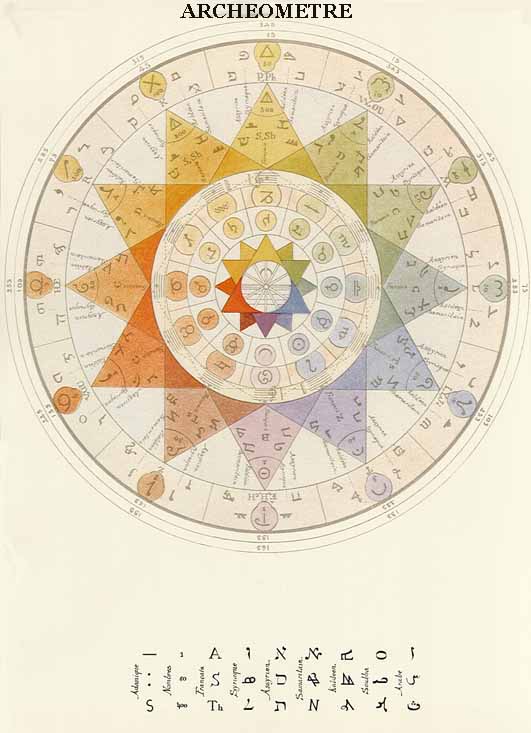
Archeometre by Alexandre Saint-Yves d’Alveydre


HTML tutorial

The term “Archeometre” originates from the Greek and means “the measure of the principle”. The system refers also to a series of symbols and meanings, which refer to the federal drawer.

‘Archeometre’ is it the measurement of the ‘Archee’ (Universal Cosmic Force) of which the Hermetists speaks. Is it a process, a ‘key’ which makes it possible to penetrate the Mysteries of the Word. It is a measuring instrument of the first (primary) principles of the manifested universe.

Alexandre Saint Yves d’Alveydre’s Archeometre shows the original Atlantean alphabet translates into the material the word, form, color, smell, sound and taste, the key to all religions and the sciences of antiquity.

Edo Period (1603-1868). Anatomical illustrations, late 17th century.


Anatomical illustrations, late 17th century [+]

“These illustrations are from a late 17th-century document based on the work of Majima Seigan, a 14th-century monk-turned-doctor. According to legend, Seigan had a powerful dream one night that the Buddha would bless him with knowledge to heal eye diseases. The following morning, next to a Buddha statue at the temple, Seigan found a mysterious book packed with medical information. The book allegedly enabled Seigan to become a great eye doctor, and his work contributed greatly to the development of ophthalmology in Japan in the 16th and 17th centuries.”

Anatomical illustrations, late 17th century [+]

More on Pink Tentacle.

Via