‘Ezo-shi’ by Arai Hakuseki (1720)


'Ezo-shi' by Arai Hakuseki (1720)

The Ainu are generally considered to be the indigenous population of Japan. But, like all cultures on earth, the history of the Ainu is much more complex than any one label. The 20,000 to 60,000 people who presently identify themselves as Ainu are concentrated on Japan’s northern island of Hokkaido, but the Ainu culture once stretched up to the southern part of Sakhalin Island and the Kurile Islands (now part of Russia).”

from BibliOdyssey

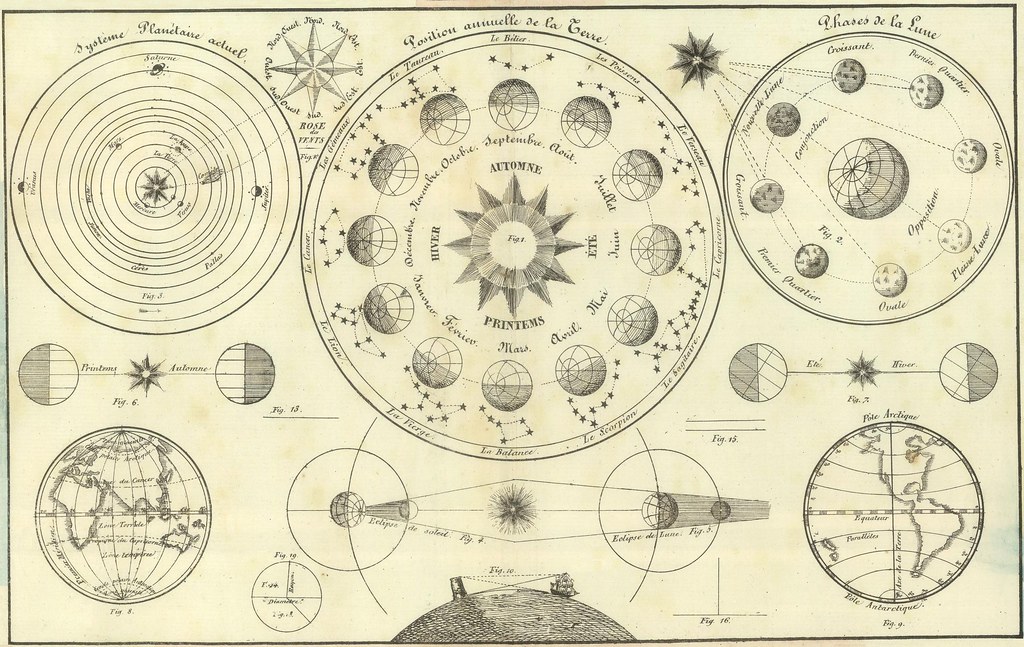
Tableau d’Astronomie et de Sphère

H'Atlas Universel d'Histoire et de Geographie Anciennes et Modernes, de Mythologie, des Religions, d'Astronomie, de Physique, de Geologie, de Histoire Naturelle, de Grammaire, de Rhetorique..' by Henri Duval, 1834; published in Paris by L Houbloup.
H’Atlas Universel d’Histoire et de Geographie Anciennes et Modernes, de Mythologie, des Religions, d’Astronomie, de Physique, de Geologie, de Histoire Naturelle, de Grammaire, de Rhetorique..’ by Henri Duval, 1834; published in Paris by L Houbloup.

'General Atlas Of The World: Containing Upwards Of Seventy Maps. Engraved On Steel, In The First Style Of Art, By Sidney Hall, William Hughes, F.R.G.S., &c. New Edition. Embracing All The Latest Discoveries Obtained From Government Surveys And Expeditions, Books Of Recent Travel, And Other Sources, Including The North-West Passage Discovered By H.M. Ship Investigator. With Introductory Chapters On The Geography And Statistics Of The Various Countries Of The World, And A Complete Index Of 65,000 Names' by Adam & Charles Black, Sidney Hall and William Hughes, 1854; published in Edinburgh by A & C Black.
‘General Atlas Of The World: Containing Upwards Of Seventy Maps. Engraved On Steel, In The First Style Of Art, By Sidney Hall, William Hughes, F.R.G.S., &c. New Edition. Embracing All The Latest Discoveries Obtained From Government Surveys And Expeditions, Books Of Recent Travel, And Other Sources, Including The North-West Passage Discovered By H.M. Ship Investigator. With Introductory Chapters On The Geography And Statistics Of The Various Countries Of The World, And A Complete Index Of 65,000 Names’ by Adam & Charles Black, Sidney Hall and William Hughes, 1854; published in Edinburgh by A & C Black.

A time table indicating the difference in time between the principal cities of the World and also showing their air-line distance from Washington. - 'Mitchell's New General Atlas, Containing Maps Of The Various Countries Of The World, Plans Of Cities, Etc., Embraced In Ninety-Three Quarto Maps, Forming A Series Of One Hundred and Forty-seven Maps and Plans, Together With Valuable Statistical Tables..' by Samuel Augustus Mitchell Jr, 1883; published in Philadelphia by WM Bradley.
A time table indicating the difference in time between the principal cities of the World and also showing their air-line distance from Washington. – ‘Mitchell’s New General Atlas, Containing Maps Of The Various Countries Of The World, Plans Of Cities, Etc., Embraced In Ninety-Three Quarto Maps, Forming A Series Of One Hundred and Forty-seven Maps and Plans, Together With Valuable Statistical Tables..’ by Samuel Augustus Mitchell Jr, 1883; published in Philadelphia by WM Bradley.

From BliOdyssey

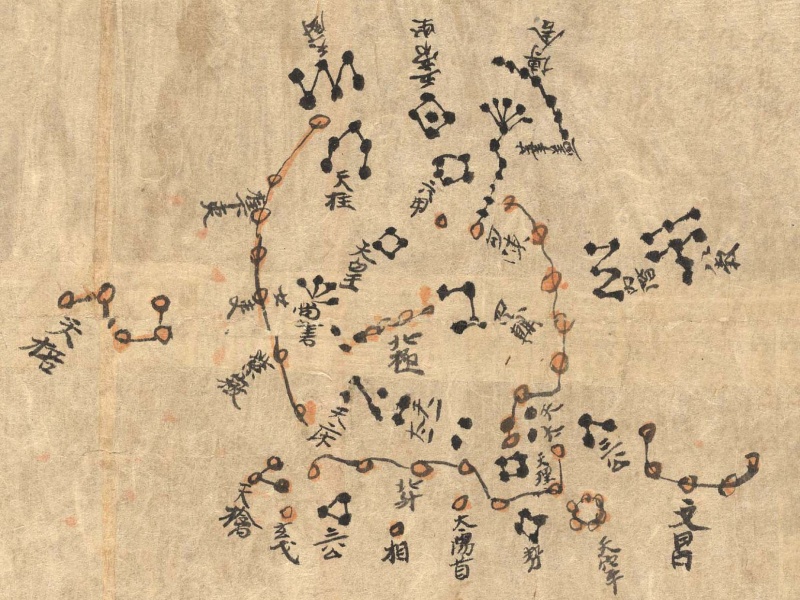
Dunhuang Star Atlas


Dunhuang Star Atlas

“This ancient Chinese map of planet Earth’s northern sky is part of the Dunhuang Star Atlas, one of the most impressive documents in the history of astronomy. The oldest complete star atlas known, it dates to the years 649 to 684, discovered at the Silk Road town of Dunhuang in 1907. A recent analysis that examines the accuracy and projections used to make it notes the atlas marks positions of over 1,300 stars and outlines 257 Chinese star groups or asterisms. The star positions in the hand drawn atlas were found to be accurate to within a few degrees. In this example showing the north polar region, a very recognizable Big Dipper, part of the modern constellation Ursa Major, lies along the bottom of the chart. An additional 12 charts depicting equatorial regions in 30 degree sections also includes a group resembling the modern constellation Orion. The atlas is on display at the British Library in London to celebrate the International Year of Astronomy.”

Newton’s colour circle

“In a mixture of primary colours, the quantity and quality of each being given, to know the colour of the compound.”


Newton's colour circle

from wiki – Throughout Opticks, Newton compared colours in the spectrum to a run of musical notes. To this purpose, he used a Dorian mode, similar to a white-note scale on the piano, starting at D. He divided his colour wheel in musical proportions round the circumference, in the arcs from DE to CD. Each segment was given a spectral colour, starting from red at DE, through orange, yellow, green, blew [sic], indigo, to violet in CD. (The colours are commonly known as ROY G BIV.)

The middle of the colours—their ‘centres of gravity’—are shown by p, q, r, s, t, u, and x. The centre of the circle, at O, was presumed to be white. Newton went on to describe how a non-spectral colour, such as z, could be described by its distance from O and the corresponding spectral colour, Y.