‘Ein Im[m]erwährender Natürlich-Magischer Calender, Welcher die Beschauung der Allertiefesten und Geheimesten Sachen, Ingleichen die Erkäntnüs der gantzen Philosophie in sich faßet’, 1582. SLUB Dresden


Magical Calendar.01


Magical Calendar.02


Magical Calendar.03

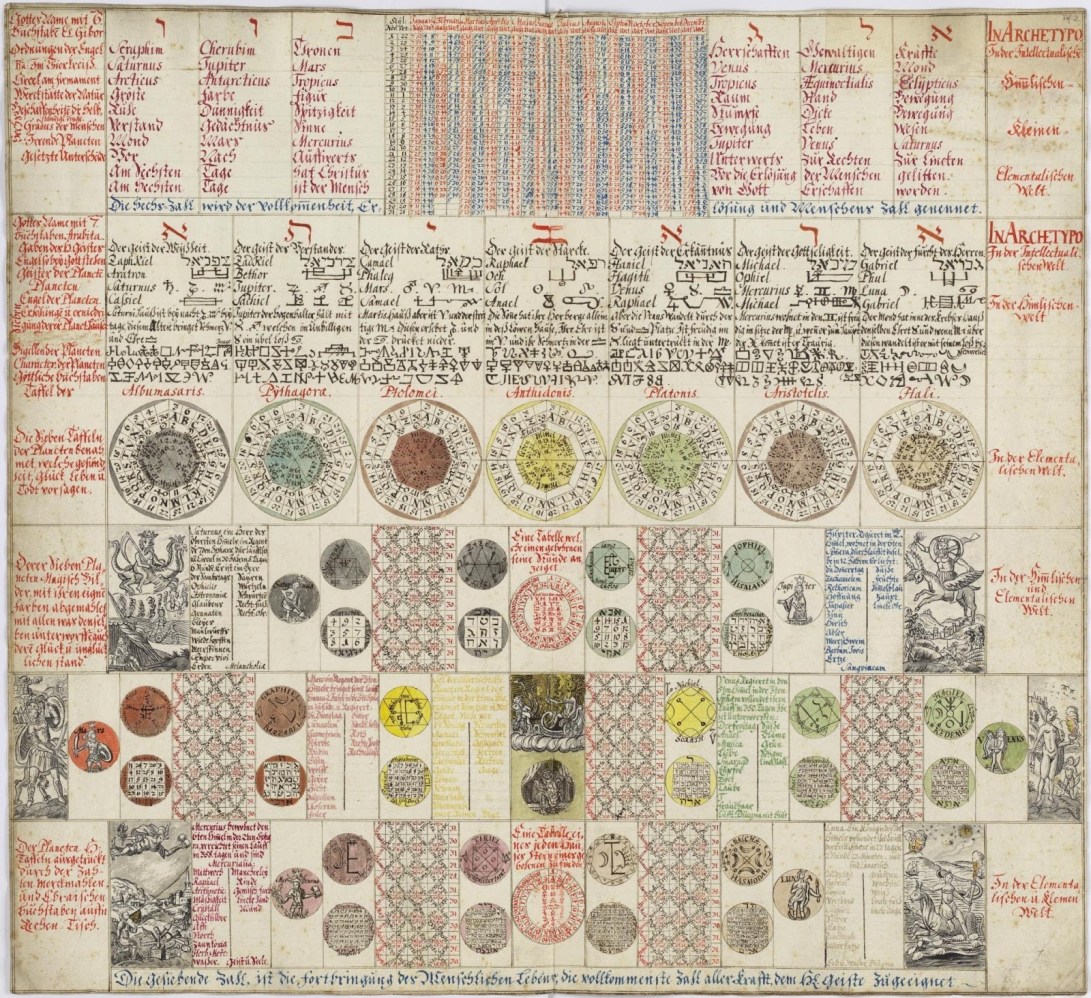
“The Magical Calendar is one of the most amazing pieces of art and information available in Western Hermeticism.

Published in 1620, the Magical Calendar contains tables of correspondences arranged by number from one to twelve. They are based in part on extensive tables in Agrippa, book 2, chapters 4-14 but go well beyond anything in Agrippa, especially sigils. The engraving was executed by the brilliant Johannes Theodorus de Bry who illustrated other important occult works such as those of Robert Fludd. The author was Johann Baptista Großchedel. Carlos Gilly has identified the original manuscript on which the printed Magical Calendar was based as British Library manuscript Harley 3420.”

studies-vartejaru

via theremina

The Wizarding Way

“DRAW FROM LIFE.  All the time.  Draw naked people.  Draw clothed people.  Draw pets and buildings and teacups and trees and draw all of it all the time.  Put it in a book that you keep in your pocket.  Steal life from the realm of the living so that the worlds you create might also live.”

Jake Wyatt

H.P. Lovecraft’s Monster Drawings: Cthulhu and “an open slice of howling fear”


lovecraft 01

On March 23rd, the manuscript continued, Wilcox failed to appear; and inquiries at his quarters revealed that he had been stricken with an obscure sort of fever and taken to the home of his family in Waterman Street. He had cried out in the night, arousing several other artists in the building, and had manifested since then only alternations of unconsciousness and delirium.”

via nearsightedmonkey


lovecraft 02

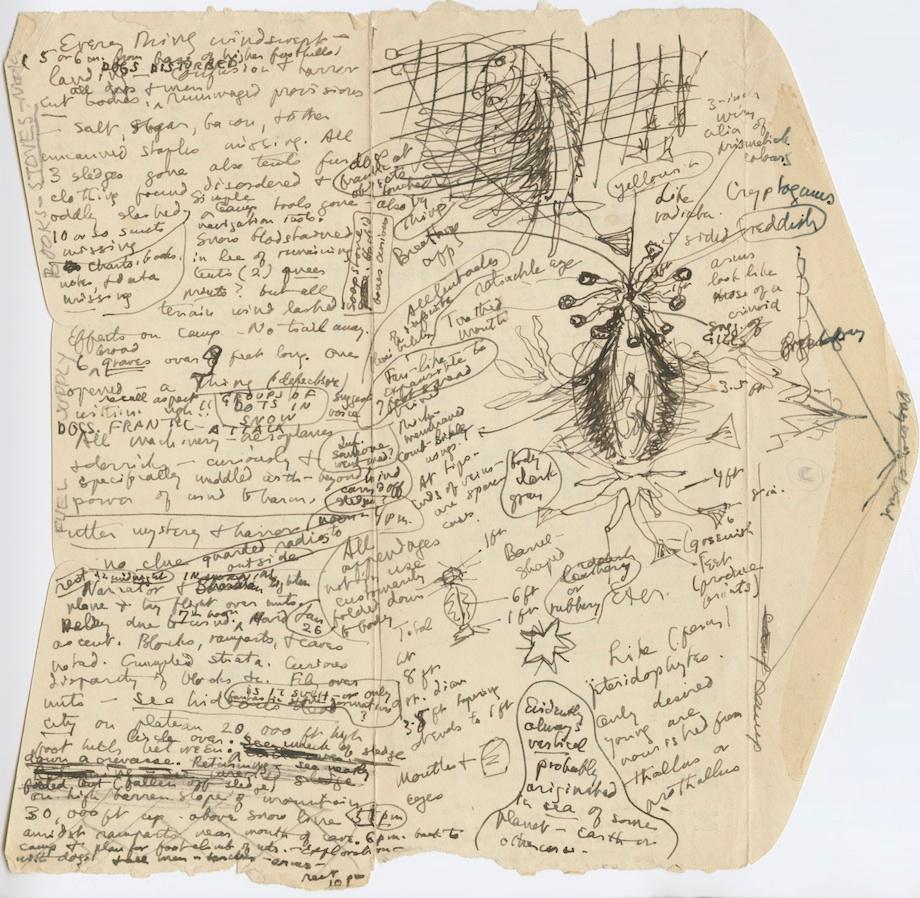
Mountains featured several species of forgotten, intelligent beings, including the ‘Elder Things.’ The sketch on the right side of this page of notes (click here to view it in a larger format), with its annotations (‘body dark grey’; ‘all appendages not in use customarily folded down to body’; ‘leathery or rubbery’) represents Lovecraft working out the specifics of an Elder Thing’s anatomy.” That such things lurked in Lovecraft’s imagination have made his state of mind a subject of decades and decades of rich discussion among his enthusiasts. But just the body count racked up by Cthulhu, the Elder Things, and the other denizens of this unfathomable realm should make us thankful that Lovecraft saw them in his mind’s eye so we wouldn’t have to.”

from openculture

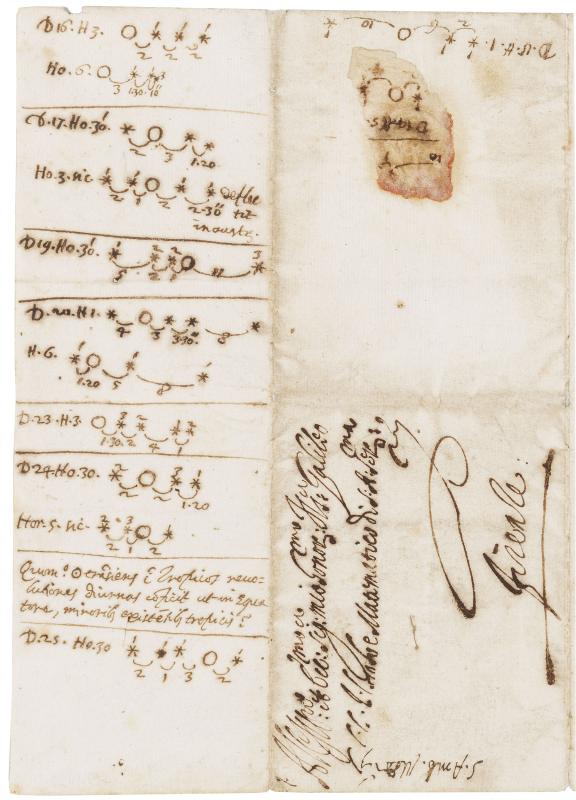
Galileo GALILEI. Autograph notes on the satellites of Jupiter, 14–25 January 1611


Galilei, Galileo, 1564-1642.

On this scrap of paper (an unfolded envelope), Galileo recorded the positions of four satellites of Jupiter over a period of several nights. He had observed the moons with the aid of his newly constructed telescope and published his findings in his revolutionary book The Starry Messenger (1610). He then worked to define more precisely the periods of the orbits of the Jovian moons, setting up his telescope night after night and making notes such as these. In a radical departure from his university training, Galileo insisted that scientific theory be grounded in observation and physical evidence rather than reliance on ancient authority.”

On Mind Maps and Dyslexia

Why do I need mind-maps?

“There are a few things you need to know:

First, I am lucky enough to have a number of positive impacts of dyslexia. One of those is that once I have acquired new information I can process it very rapidly and often have multiple thoughts at once. That often means that I can solve the most complex problems faster than others.

Second, I have a problem writing and thinking at the same time. I believe it is to do with short-term memory. However, the bottom line is that I keep forgetting where I am in the overall flow of the thing that I am writing. As a result, my writing meanders and needs to be edited (by me) again and again until it finally expresses what I mean.

Thirdly, I see patterns in things – often before others. I use that to form and then set out compelling arguments and explanations that become very clear to readers.

Finally, I have a fairly precise use of language and so – whilst not finding it easy to write – am a fierce critic of my own work. So that means the editing can take a very long time.”

from MindMaps are the answer…. what’s the question?

Ancient Egyptian music notation


Ancient Egyptian music notation

“From a set of 6 parchments described by German musicologist Hans Hickmann in his 1956 book Musicologie Pharaonique, or Music under the Pharaohs, as dating from the 5th to 7th centuries C.E. Colors are presumed to indicate pitch and size to indicate duration. Writings on the parchment are in Coptic with indications like “Spiritual Harmony” and “Holy Hymn Singer”. This manuscript had a profound influence on Egyptian composer Halim El-Dabh’s music notation and paintings when he discovered a reproduction in Vogue magazine in 1952.

Note: I wasn’t able to locate these manuscripts and couldn’t find any reference to them online, but they are presumably in NY’s Metropolitan Museum collections. This image comes from Theresa Sauer’s book Notations 21, Mark Batty Publisher, USA, 2009.”

reblogged from continuo-docs