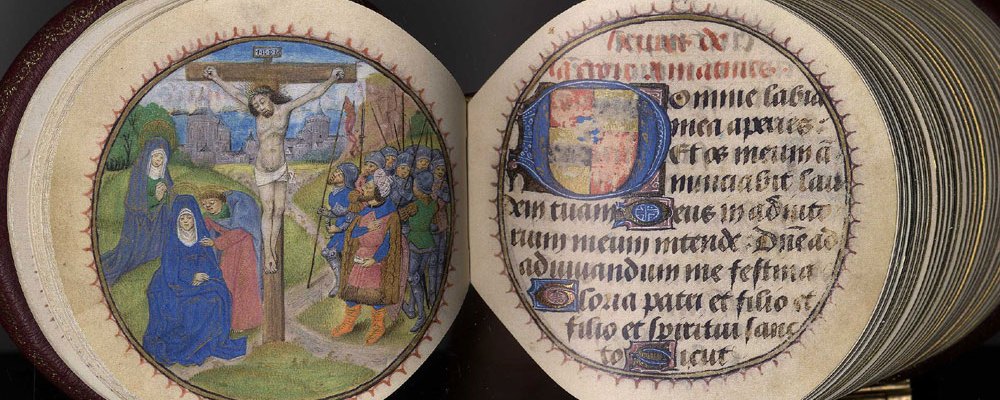
The Codex Rotundus

Great Post on the Codex Rotundus from Book Addiction UK:

Jessica's avatarBookAddiction

Codex Rotundus 3 fac

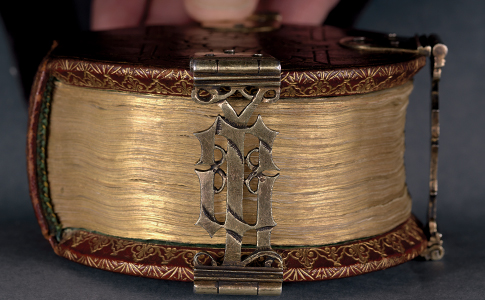
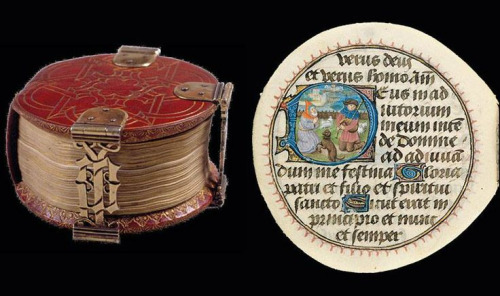
The manuscripts and codices which survive from the late 15th century are often large and lavish affairs and usually conform to certain norms in terms of shape. But this curious and unusual little gem, which takes its name ‘Codex Rotundus’ from its unique shape, measures just over 9 centimeters across and is circular.  Its 266 pages are bound along a spine just 3cm long, so small that three clasps are needed to help keep it closed.  Thought to have been rebound in the 17th century, the original clasps which help hold the tiny codex together, were reused. As so many of the manuscripts from this period, it is a devotional text -a lavishly illuminated Book of Hours in Latin and French.
Codex Rotundus 1 fac

Remnants of a coat of arms, which a subsequent owner appears seems to have tried to obliterate, in the first initial ‘D’ suggests that it was created for Adolf of Cleves…

View original post 253 more words

This is a Volvelle a Medieval Computer…


Volvelle

“This is a volvelle, a medieval device that allowed you to calculate the phases of the moon and the latter’s position in relation to the sun. The dials, with their charming depictions of moon and sun, tell you what you need to know. What’s most remarkable about the device is not so much its crafty nature – it consists of complex layers of rotating disks – but that it is usually fitted inside a medieval book. Some are so bulky that they pierce the adjacent pages. What a surprise it must have been for the medieval reader who thumbed through such a book for the first time. Turning a page, he or she was confronted with an ingenious piece of machinery. A medieval computer.”

Erik Kwakkel

Chansons d’Amour : (Thott 291 8º ) : 37 verso


Chansons d’Amour  : (Thott 291 8º )  : 37 verso

via

This Chansonnier, named by Knud Jeppesen as the perhaps most interesting and valuable medieval music handwriting in the Royal Library, occupies a special position among the relatively few manuscripts that surrender the French-Burgundian Chansons repertoire from the late 1400s. The script contains text and nodes for 33 three-star songs. A song – “Iactens secours” – was added in the 16th century. In conclusion, there are a number of “modulation exercises.”‘

Bellicorum Instrumentorum Liber

The First Italian Technology Manuscript

A generation before the extraordinary machine drawings of Leonardo da Vinci, the first technology manuscript of the Italian Renaissance was produced by a Venetian scholar who had familiarised himself with the handful of books on the mechanical arts from the Greek and Arabic traditions.”

 The First Italian Technology Manuscript
The First Italian Technology Manuscript

Giovanni da Fontana (?1395-1455) obtained degrees in arts and medicine in Padua and was appointed physician to the Venetian army in Brescia. He had a wide range of interests and studied historical works on optics, astrology/alchemy (intrinsic medical studies back then), pneumatic and hydraulic mechanics, military machines and the art of memory.”

–from Bibliodyssey

Urashima Leaving the Palace Under the Sea

Ogata Gekko (1859 – 1920) Urashima Leaving the Palace Under the Sea, from Gekko’s Miscellaneous Drawings, 1894. Oban.

“Urashima Taro was a fisherman of the fifteenth century who rescued a young turtle from some bullying children. The following day a huge turtle approaches him and tells him he has saved the daughter of the Emperor of the Sea. As a reward the fisherman is gifted magical gills and taken to the palace beneath the waves. Whilst there he is given a beautiful box and told never to open it.
On his return three days later he finds that three hundred years have elapsed and everyone he knew has died. In distress he opens the box and instantly withers and dies in a pile of dust, the voice of the sea princess saying to him: “I said never to open the box; inside it is your old age”. Incidentally, the hair of the turtle is actually a long fronded algae that grows on the backs of turtles’ shells off the coast of Japan.”