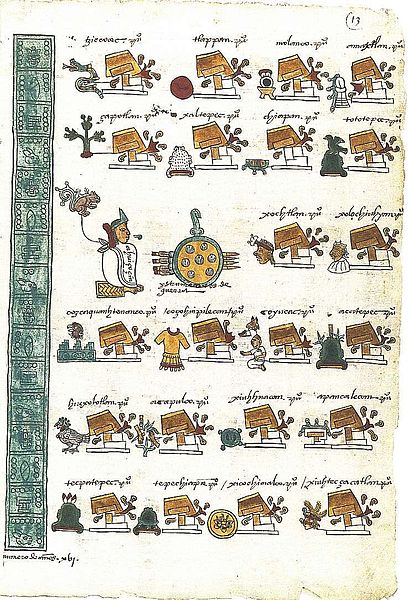
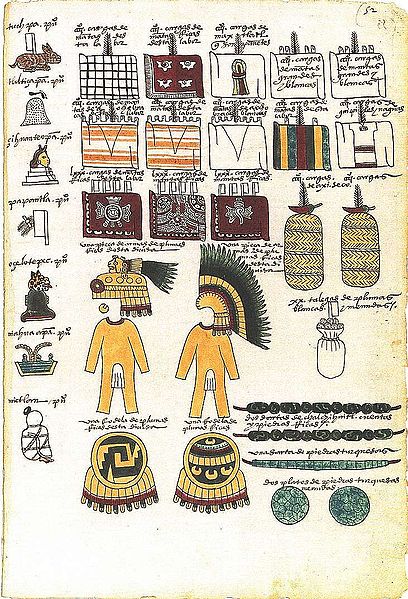
Codex Mendoza (1542)


Codex Mendoza (1542)


Codex Mendoza (1542)

Codex Mendoza (1542)

Codex Mendoza (1542)


Codex Mendoza (1542)


Codex Mendoza (1542)

“The Codex Mendoza is an Aztec codex, created about twenty years after the Spanish conquest of Mexico with the intent that it be seen by Charles V, the Holy Roman Emperor and King of Spain. It contains a history of the Aztec rulers and their conquests, a list of the tribute paid by the conquered, and a description of daily Aztec life, in traditional Aztec pictograms with Spanish explanations and commentary. It is named after Antonio de Mendoza, then the viceroy of New Spain, who may have commissioned it. After creation in Mexico City, it was sent by ship to Spain. The fleet, however, was attacked by French privateers, and the codex, along with the rest of the booty, was taken to France. There it came into the possession of André Thévet, cosmographer to King Henry II of France. Thévet wrote his name in five places on the codex, twice with the date 1553. It was later bought by the Englishman Richard Hakluyt for 20 French francs. Some time after 1616 it was passed to Samuel Purchase, then to his son, and then to John Selden. The codex was deposited into the Bodleian Library at Oxford University in 1659, 5 years after Selden’s death, where it remained in obscurity until 1831, when it was rediscovered by Viscount Kingsborough and brought to the attention of scholars.”

from Wikipedia and ThePublicDomainReview

via Radimus


“The Amphitheater of Eternal Knowledge,” Hamburg, 1595.


“The Amphitheater of Eternal Knowledge,” Hamburg, 1595.


“The Amphitheater of Eternal Knowledge,” Hamburg, 1595.


“The Amphitheater of Eternal Knowledge,” Hamburg, 1595.


“The Amphitheater of Eternal Knowledge,” Hamburg, 1595.

“The images, in other words, invite the viewer to engage in a meditation on the nature of the universe and on the links between the earthly and the divine, the corporeal and the spiritual. Of course, such a statement would be equally true of many other instances of early modern alchemical and Hermetic symbolism. I suspect that a lot of the meaning in these images and the text that accompanies them has actually been lost, due to the fact that alchemical practice depended upon face-to-face interactions (like the one between John Dee and Khunrath) which were never recorded. And this was precisely what was intended – the true secrets of early modern alchemy were intended for a small number of the “elect” and were elaborately concealed in complex and often inscrutable language when they were allowed into printed works.”

Benjamin Breen

see more on his excellent blog post.

The Vallard Atlas

'Terra Java' (east coast of Australia?)
‘Terra Java’ (east coast of Australia?)

From BibliOdyssey:

  •  “It was (anonymously) produced by the Dieppe school (France) in 1547 and was either copied from Portuguese maps or was completed with the input of (a) Portuguese cartographer(s)
  • The maps are known as portolan (navigational) charts [previously]
  • Unusually, north is shown at the bottom of the maps in the style of Muslim cartographers (very rare in European Christian mapping)
  • Allegedly, this atlas shows the first ever European record of Australian coastline — some 250 years ahead of Capt. Cook and 60-odd years before the earliest official European discovery/sighting/mapping of any Australian coastline by William Janszoon in 1606 [see: Landing List].<
  • The miniatures and marginalia depict 16th century native and colonisation scenes
  • The first[?] use of the name “Canada” in a map 


North America, East Coast


Aegean Sea
Aegean Sea

See lots more at BibliOdyssey.


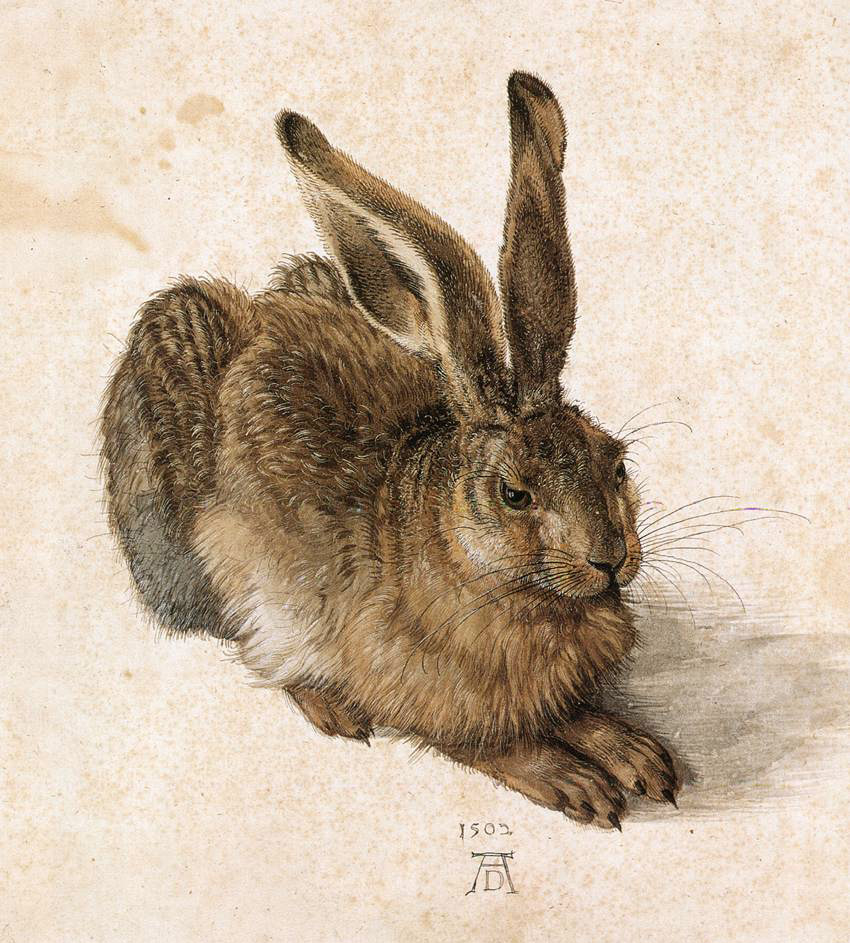
Albrecht Dürer, Young Hare, 1502


Albrecht Dürer, Young Hare, 1502

There is some debate over how Dürer accurately captured the image of the hare: he may have sketched a hare in the wild and filled in the individual details from a dead animal, or captured one and held it alive in his studio while he worked on the painting. A reflection of the window frame in the hare’s eye is often cited as evidence for the theory that Dürer copied the hare from life in his workshop, but this cross-barred reflection is a technique that Dürer frequently used to add vitality to the eyes of his subjects.”

via

“He wrote his plays to make money. “

1.  Everyone – all levels of society – went to see Shakespeare’s plays.  There weren’t many other forms of entertainment: no TV; no cable; no DVDs; no videos, hand-held electronic game players, or personal CD players; no CDs; no movies; and only the rudiments of a newspaper.  People went to the bear-baiting or bull-baiting ring for a thrill, they went to a public execution or two – and they went to the theatre.

2.  Shakespeare wrote his sonnets to be applauded and remembered as a writer.  He wrote his plays to make money.  And he made lots of it.

3.  He wrote 37 plays, and some of them were real dogs.

4.  Shakespeare’s wife was pregnant when they got married.

5.  Shakespeare and his wife had three children before he left them all in Stratford-upon-Avon for the big-time, big-city life in London.

6.  Shakespeare never went to college.

7.  Reading Shakespeare is hard.  Shakespeare’s plays were written to be performed – acted and seen on a stage.  About half of Shakespeare’s plays weren’t even published until after his death.

8.  In Shakespeare’s time, a woman’s value depended solely on who her husband was, and how valuable he was.

9.  Experiencing a play in the Globe Theatre in 1603 was sort of a cross between going to an Oscar de la Hoya fight and an N Sync concert.

10.  In Shakespeare’s plays, you can find drunks, ghosts, teenagers running away from home, boy who gets girl, boy who loses girl, king who loses everything, woman caressing her lover’s body that is minus its head, woman caressing her lover’s head that is minus its body, weddings and celebrations, and murder by stabbing, suffocation, poison, decapitation, and drowning in a vat of wine.

Peggy O’Brien, from the “Acknowledgments” section of The Shakespeare Book of Lists by Michael LoMonico

via