
17C
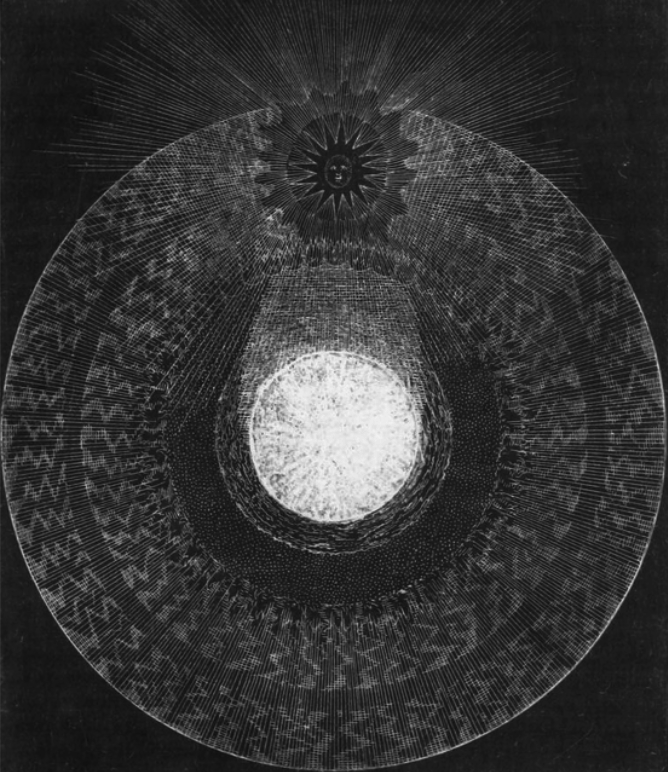
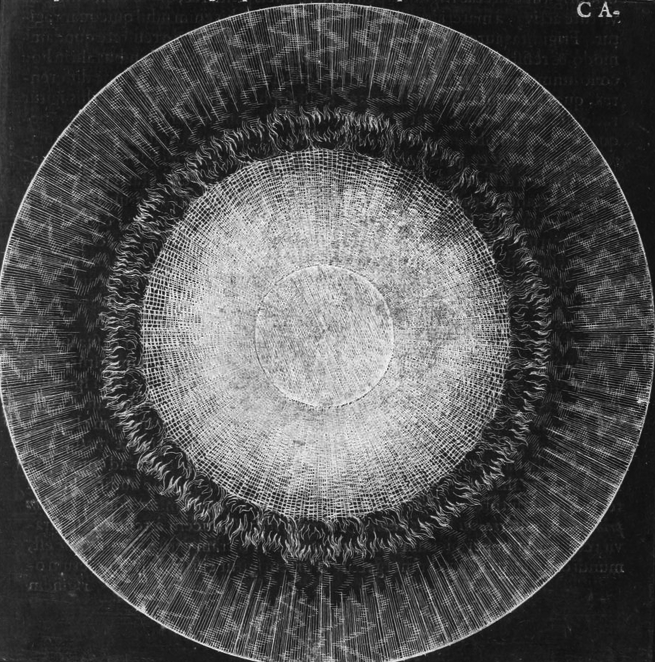
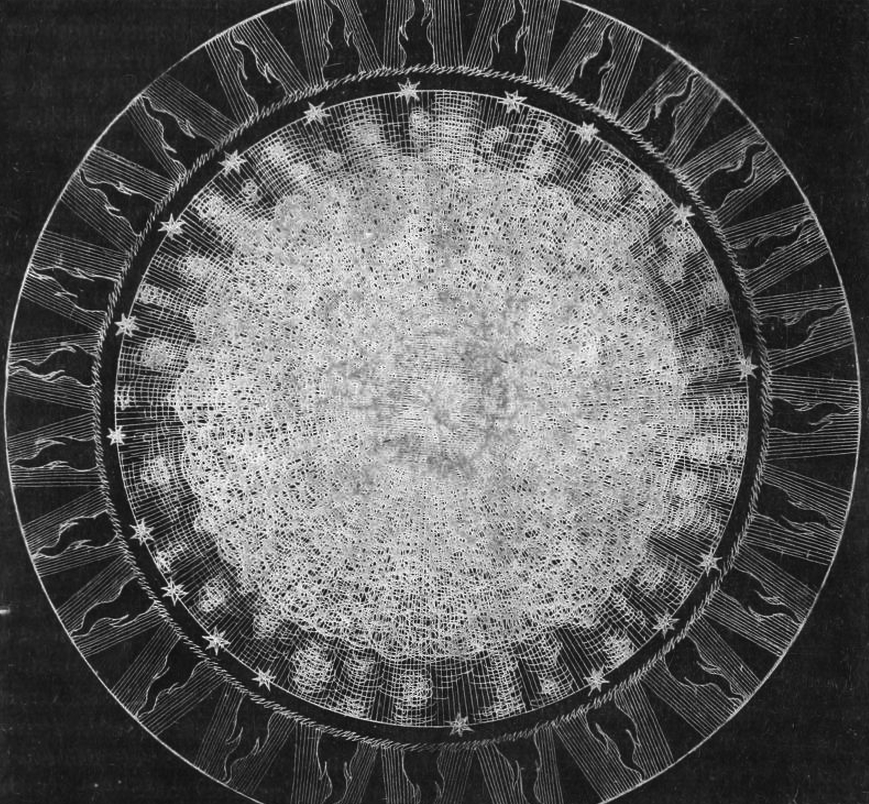
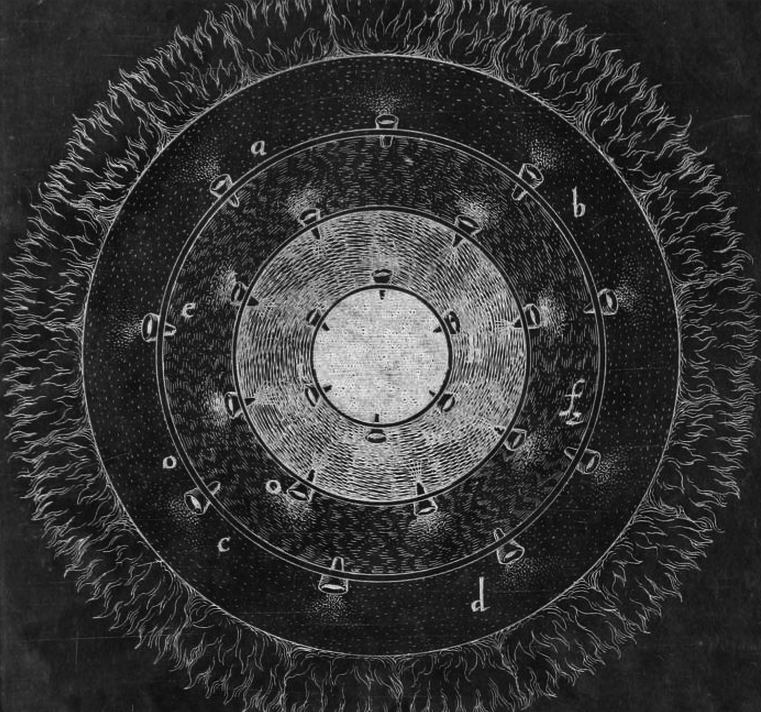
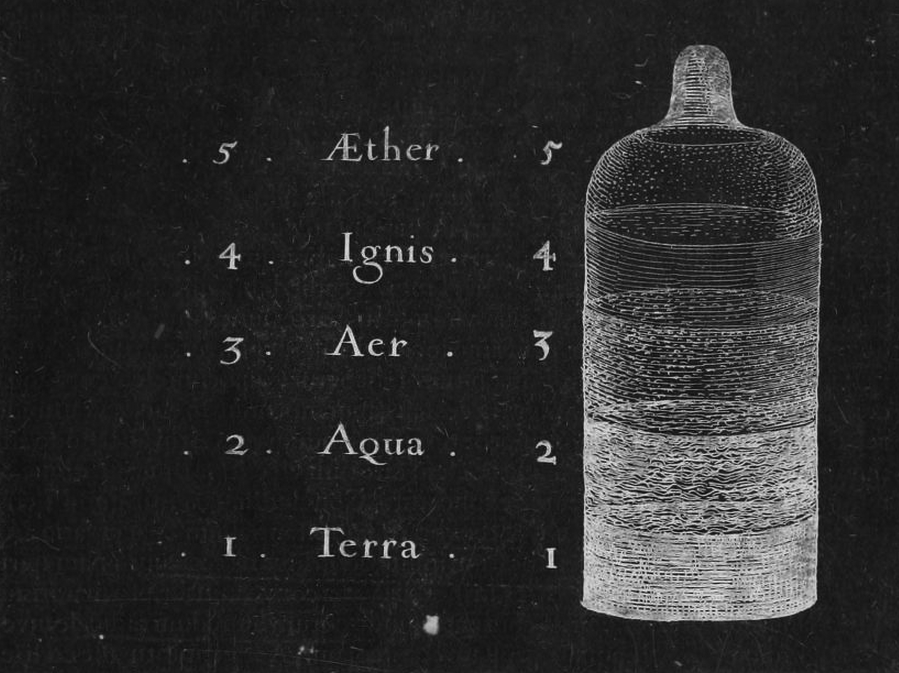
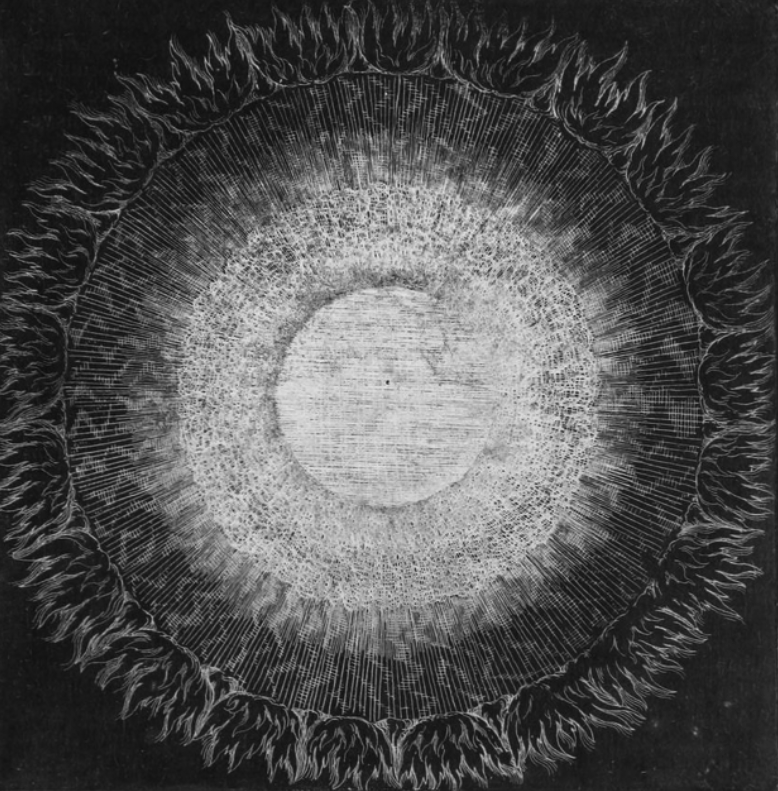
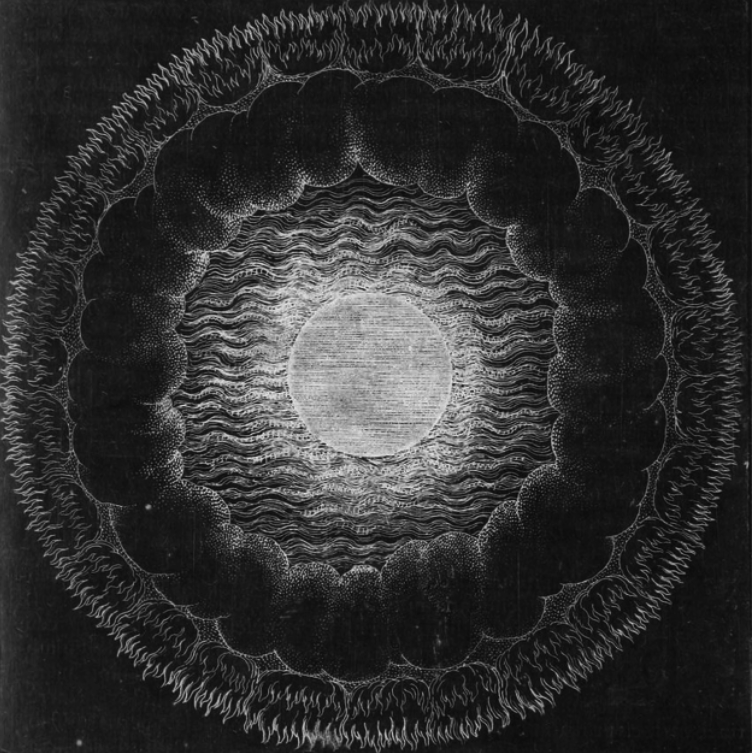
Robert Fludd – Utriusque Cosmi Maioris Scilicet et Minoris Metaphysica, 1617

via bloodmilk
“Robert Fludd was a respected English physician (of Welsh origins) employed at the court of King James I of England. He was a prolific writer of vast, multi-volume encyclopaedias in which he discussed a universal range of topics from magical practices such as alchemy, astrology, kabbalism and fortune-telling, to radical theological thinking concerning the inter-relation of God with the natural and human worlds. However, he also proudly displayed his grasp of practical knowledge, such as mechanics, architecture, military fortifications, armaments, military manoeuvres, hydrology, musical theory and musical instruments, mathematics, geometry, optics and the art of drawing, as well as chemistry and medicine. Fludd used the common metaphor for the arts as being the “ape of Nature,” a microcosmic form of the manner in which the universe itself functioned.
“Fludd’s most famous work is the History of the Two Worlds (Utriusque Cosmi … Historia, 1617-21) published in five volumes by Theodore de Bry in Oppenheim. The two worlds under discussion are those of the Microcosm of human life on earth and the Macrocosm of the universe (which included the spiritual realm of the Divine).”
Shakespearean notepad stuns Antiques Roadshow expert

Nüshu

reblogging notational:
“Nüshu (literally “women’s writing” in Chinese) is a syllabic script created and used exclusively by women in the Jiangyong County in Hunan province of southern China. Up until the late Qing Dynasty (1644-1912) women were forbidden access to formal education, and so Nüshu was developed in secrecy as a means to communicate. Since its discovery in 1982, Nüshu remains to be the only gender-specific writing system in the world.”
Athanasius Kircher’s Mundus Subterraneus, 1665.

“Athanasius Kircher’s diagrams of the interconnectedness of fire (above) and water (below) in Earth. The diagrams are just a piece of his large, multi-volume work Mundus Subterraneus, published in 1665.”

“On a visit to southern Italy in 1638, the ever-curious Kircher was lowered into the crater of Vesuvius, then on the brink of eruption, to examine its interior. He was also intrigued by the subterranean rumbling which he heard at the Strait of Messina. His geological and geographical investigations culminated in his Mundus Subterraneus of 1664, in which he suggested that the tides were caused by water moving to and from a subterranean ocean.
“Kircher was also puzzled by fossils. He understood that fossils were the remains of animals. He ascribed large bones to giant races of humans.[24] Not all the objects which he was attempting to explain were in fact fossils, hence the diversity of explanations. He interpreted mountain ranges as the Earth’s skeletal structures exposed by weathering.
“Kircher’s map of Atlantis, oriented with south at the top, from Mundus Subterraneus.
Mundus Subterraneus includes several pages about the legendary island of Atlantis including a map with the Latin caption “Situs Insulae Atlantidis, a Mari olim absorpte ex mente Egyptiorum et Platonis descriptio.” translating as “Site of the island of Atlantis, in the sea, from Egyptian sources and Plato’s description.”
‘Ein Im[m]erwährender Natürlich-Magischer Calender, Welcher die Beschauung der Allertiefesten und Geheimesten Sachen, Ingleichen die Erkäntnüs der gantzen Philosophie in sich faßet’, 1582. SLUB Dresden

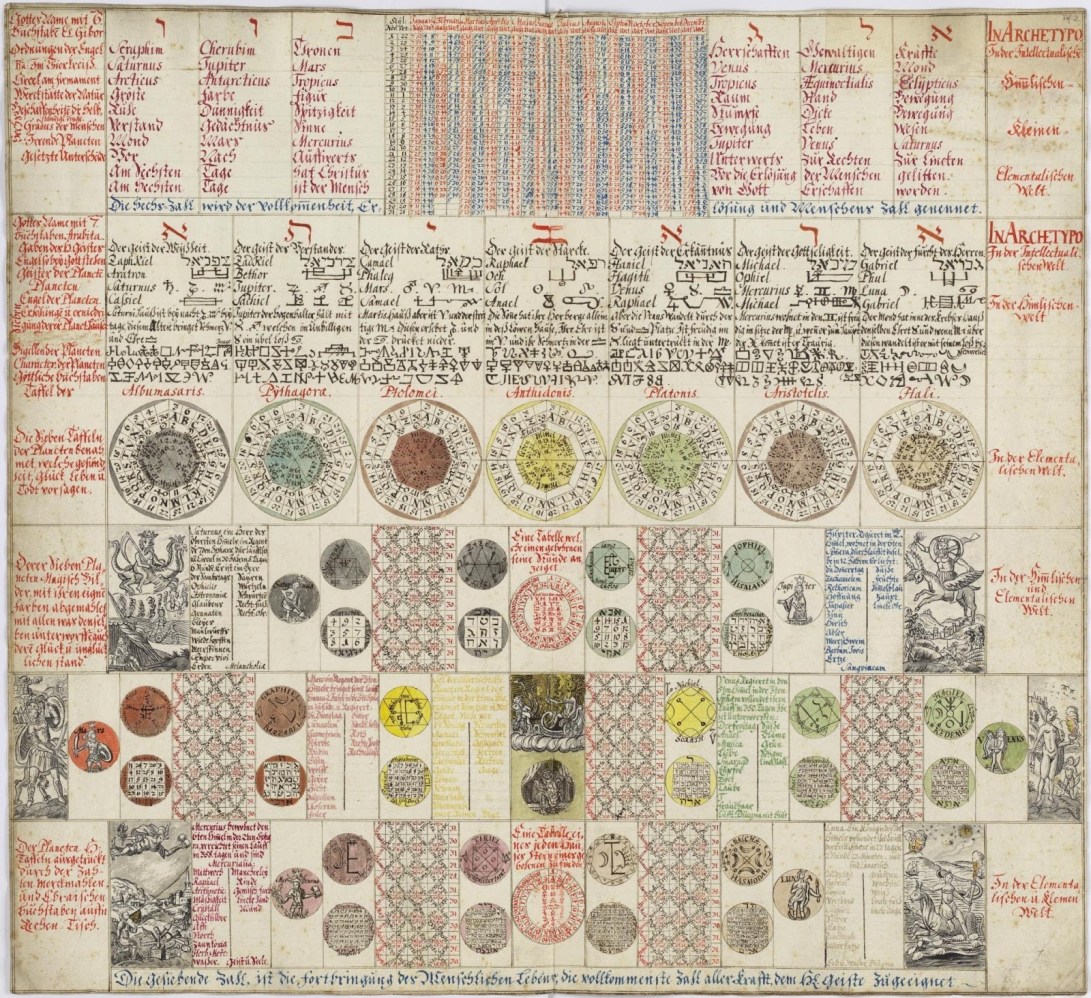

“The Magical Calendar is one of the most amazing pieces of art and information available in Western Hermeticism.
Published in 1620, the Magical Calendar contains tables of correspondences arranged by number from one to twelve. They are based in part on extensive tables in Agrippa, book 2, chapters 4-14 but go well beyond anything in Agrippa, especially sigils. The engraving was executed by the brilliant Johannes Theodorus de Bry who illustrated other important occult works such as those of Robert Fludd. The author was Johann Baptista Großchedel. Carlos Gilly has identified the original manuscript on which the printed Magical Calendar was based as British Library manuscript Harley 3420.”
via theremina
Table of Physiological Colors Both Mixt and Simple by Richard Waller, 1686
![Richard Waller Tabula colorum physiologica … [Table of physiological colors] Philosophical Transactions of the Royal Society of London, 1686](https://library.si.edu/sites/default/files/39088018207936-1000.jpg)
“This table is one of the earliest known color charts. Waller created it as a tool for describing plants and animals. Collectors and scientists could compare their specimens to this table and use the names provided to identify the colors of leaves, bark, flowers, feathers, plants, and animals.”
Galileo Galilei, Sunspot Observations, 3 May 1612

Edo Period (1603-1868). Anatomical illustrations, late 17th century.
![Anatomical illustrations, late 17th century [+]](https://i0.wp.com/pinktentacle.com/images/10/med_illustration_3.jpg)
“These illustrations are from a late 17th-century document based on the work of Majima Seigan, a 14th-century monk-turned-doctor. According to legend, Seigan had a powerful dream one night that the Buddha would bless him with knowledge to heal eye diseases. The following morning, next to a Buddha statue at the temple, Seigan found a mysterious book packed with medical information. The book allegedly enabled Seigan to become a great eye doctor, and his work contributed greatly to the development of ophthalmology in Japan in the 16th and 17th centuries.”
![Anatomical illustrations, late 17th century [+]](https://i0.wp.com/pinktentacle.com/images/10/med_illustration_4.jpg)
More on Pink Tentacle.
 Paul Greer