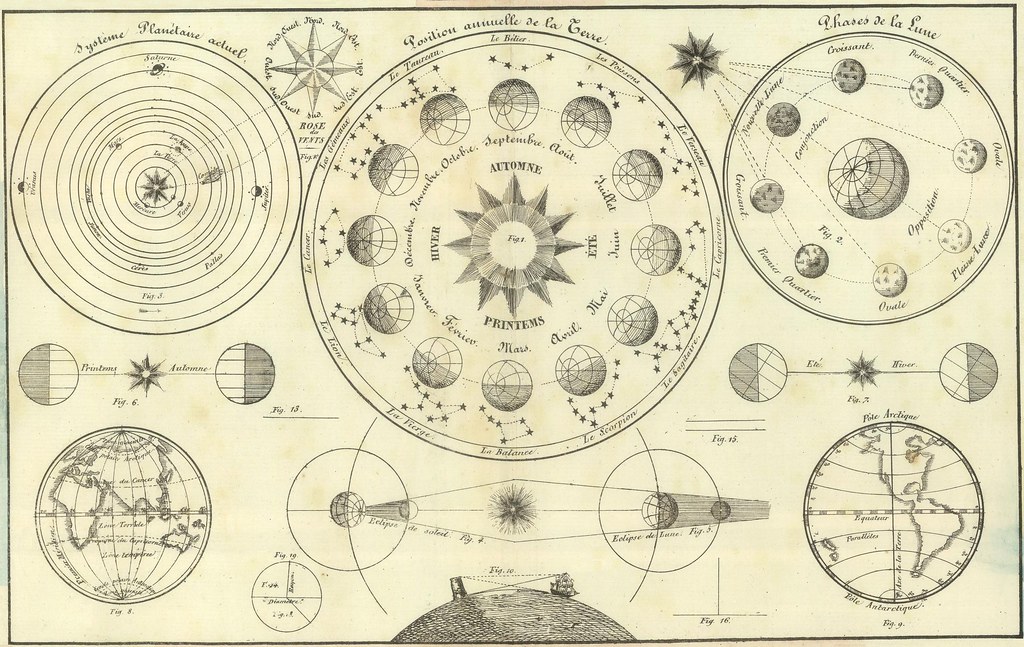
H’Atlas Universel d’Histoire et de Geographie Anciennes et Modernes, de Mythologie, des Religions, d’Astronomie, de Physique, de Geologie, de Histoire Naturelle, de Grammaire, de Rhetorique..’ by Henri Duval, 1834; published in Paris by L Houbloup.
‘General Atlas Of The World: Containing Upwards Of Seventy Maps. Engraved On Steel, In The First Style Of Art, By Sidney Hall, William Hughes, F.R.G.S., &c. New Edition. Embracing All The Latest Discoveries Obtained From Government Surveys And Expeditions, Books Of Recent Travel, And Other Sources, Including The North-West Passage Discovered By H.M. Ship Investigator. With Introductory Chapters On The Geography And Statistics Of The Various Countries Of The World, And A Complete Index Of 65,000 Names’ by Adam & Charles Black, Sidney Hall and William Hughes, 1854; published in Edinburgh by A & C Black.
A time table indicating the difference in time between the principal cities of the World and also showing their air-line distance from Washington. – ‘Mitchell’s New General Atlas, Containing Maps Of The Various Countries Of The World, Plans Of Cities, Etc., Embraced In Ninety-Three Quarto Maps, Forming A Series Of One Hundred and Forty-seven Maps and Plans, Together With Valuable Statistical Tables..’ by Samuel Augustus Mitchell Jr, 1883; published in Philadelphia by WM Bradley.
“Attersee (also known as the Kammersee or Lake Attersee) is the largest lake of the Salzkammergut area of Austria. It extends for about 20 km from north to south and 4 km from east to west. Its water comes from the Seeache, which flows out of another lake, the Mondsee.”
“The Hokusai Manga (北斎漫画, “Hokusai’s Sketches”) is a collection of sketches of various subjects by the Japanese artist Hokusai. Subjects of the sketches include landscapes, flora and fauna, everyday life and the supernatural. The word manga in the title does not refer to the contemporary story-telling manga, as the sketches in the work are not connected to each other. Block-printed in three colours (black, gray and pale flesh), the Manga comprise literally thousands of images in 15 volumes, the first published in 1814, when the artist was 55. The final three volumes were published posthumously, two of them assembled by their publisher from previously unpublished material. The final volume was made up of previously published works, some not even by Hokusai, and is not considered authentic by art historians.”
“The first volume of ‘Manga‘ (Defined by Hokusai as ‘Brush gone wild’), was an art instruction book published to aid his troubled finances. Shortly after he removed the text and republished it.The Manga evidence a dedication to artistic realism in portrayal of people and the natural world. The work was an immediate success, and the subsequent volumes soon followed. The work became known to the West since Philipp Franz von Siebold’s lithographed paraphrases of some of the sketches appeared in his Nippon: Archiv Zur Beschreibung von Japon in 1831. The work began to circulate in the West soon after Matthew C. Perry’s entry into Japan in 1854.”
“The model was an American expatriate, ((a young socialite named Virginie Amélie Avegno Gautreau)) who married a French banker, and became notorious in Parisian high society for her beauty and rumored infidelities. She wore lavender powder and prided herself on her appearance. The English-language term “professional beauty” was used to refer to her and to a woman in general who uses personal skills to advance herself socially.[4] Her unconventional beauty made her an object of fascination for artists; the American painter Edward Simmons claimed that he “could not stop stalking her as one does a deer.” Sargent was also impressed, and anticipated that a portrait of Gautreau would garner much attention at the upcoming Paris Salon, and increase interest in portrait commissions.”
“While the work was in progress, Gautreau was enthusiastic; she believed that Sargent was painting a masterpiece. When the painting first appeared at the Paris Salon under the title Portrait de Mme *** in 1884, people were shocked and scandalized; the attempt to preserve the subject’s anonymity was unsuccessful, and the sitter’s mother requested that Sargent withdraw the painting from the exhibition. Sargent refused, saying he had painted her “exactly as she was dressed, that nothing could be said of the canvas worse than had been said in print of her appearance”. Later, Sargent overpainted the shoulder strap to raise it up and make it look more securely fastened. He also changed the title, from the original Portrait de Mme ***, to Madame X – a name more assertive, dramatic and mysterious, and, by accenting the impersonal, giving the illusion of the woman archetype.The poor public and critical reception was a disappointment to both artist and model. Gautreau was humiliated by the affair, and Sargent would soon leave Paris and move to London permanently.”
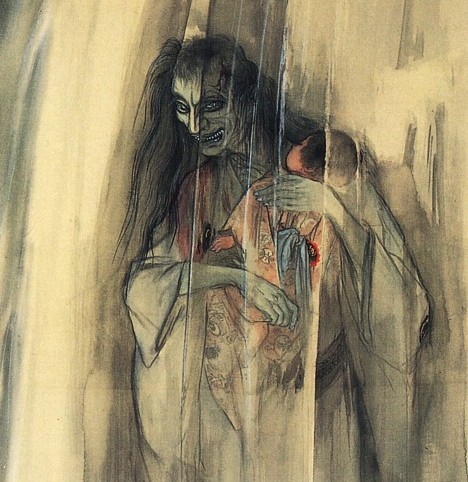
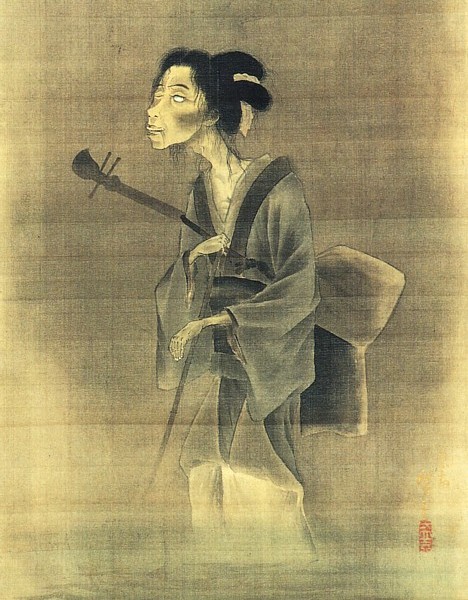
“Every August, as Japanese spirits return en masse from the otherworld, Tokyo’s Zenshoan temple (map) exhibits a spine-chilling collection of 19th-century ghost scroll paintings.”
Kaidan Chibusa Enoki: The Ghostly Tale of the Wet Nurse Tree
“This painting by Ito Seiu, the godfather of Japanese bondage (kinbaku), depicts a scene from Kaidan Chibusa Enoki, an old horror story in which the ghost of a dead painter returns to protect his baby from his murderer, a wandering samurai who fell in love with his wife while he was away painting. This scroll shows the ghost holding the baby while standing under a waterfall at Juniso (where Tokyo’s Shinjuku Chuo Park is now located).”
The Ghost of a Blind Female Street Singer
“Utagawa Hiroshige’s “Ghost of a Blind Female Street Singer” portrays the restless spirit of a street performer, one white unseeing eye wide open, carrying a shamisen as she drifts above the surface of a river on the way to her next performance.”




 Paul Greer