![Wing of a European Roller (also known as Wing of a Blue Roller) is a nature study watercolor by Albrecht Dürer.[1] Dürer painted it from a dead specimen in 1500 or 1512. Watercolor and body color on vellum](https://upload.wikimedia.org/wikipedia/commons/9/98/Duerer_wing_of_a_blue_roller.jpg)
albrecht durer
The Netherlands diary

Entry from ‘Albrecht Dürer and his Legacy’ BM exh. cat. 2002, no.103:
‘This woodcut design for ornament is one of six ‘knots’, as Dürer referred to them in his Netherlands diary (see Goris and Marlier, p. 81) copied after six engravings of c. 1490-1500 thought to be designed by Leonardo da Vinci
albrecht durer, arm of eve 1507

(via)
Albrecht Dürer, Young Hare, 1502
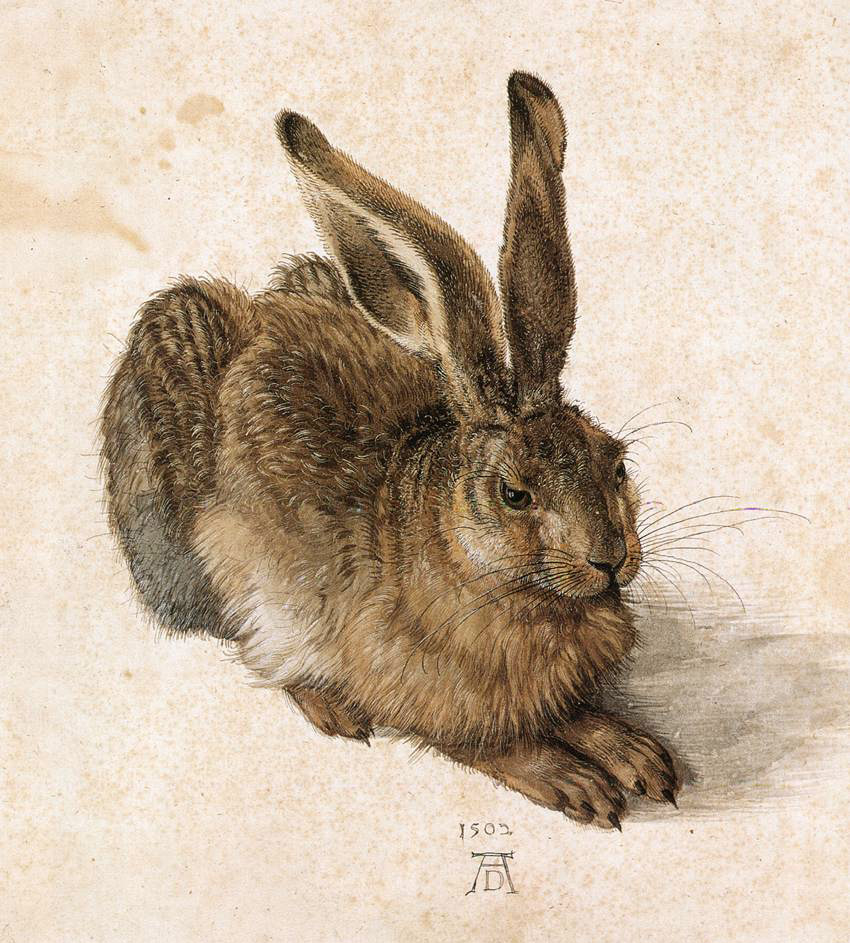
“There is some debate over how Dürer accurately captured the image of the hare: he may have sketched a hare in the wild and filled in the individual details from a dead animal, or captured one and held it alive in his studio while he worked on the painting. A reflection of the window frame in the hare’s eye is often cited as evidence for the theory that Dürer copied the hare from life in his workshop, but this cross-barred reflection is a technique that Dürer frequently used to add vitality to the eyes of his subjects.”
 Paul Greer