Venus, The Rose and the Heart


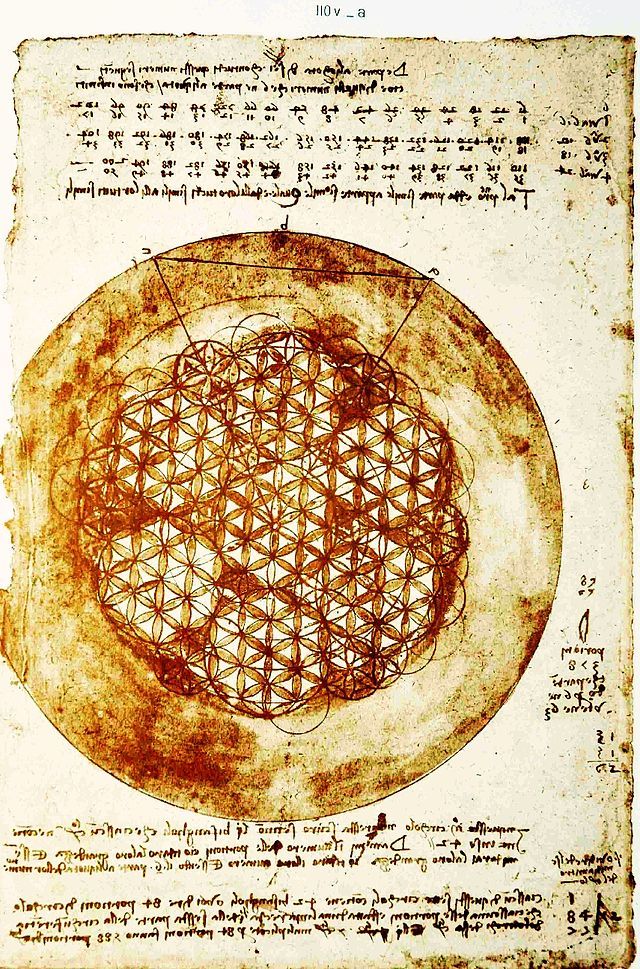
This is the ‘dance’ of Venus, as viewed from earth.

“Venus has an eight-year rhythm, which formed the subject of the world’s oldest astrological text, a Venus-tablet from Nineveh. It was part of a series called Enuma Anu Enlil, the ‘Book of the Gods of Heaven and Earth’, and was dated to the 17th century BC. It effectively recorded the five synodic periods of Venus, giving a series of ten omens over the eight-year cycle through the pattern of Venus’s appearance and disappearance from view.

“To the astronomer Johannes Kepler, the musical interval generated by Venus and Earth was a ‘sixth’, given by dividing a string in the fraction 5/8.  He said the relation was a ‘marital’ one and varied between the ‘masculine sixth’ G# – E and the ‘feminine’ one of Gb – E. This ratio of 5 to 8 is the key to the pattern traced by Venus against the stars.

“Venus traces a pentagon shape in the sky over ten meetings with the Sun; it does this by moving, between each ‘inferior’ conjunction, exactly 1.6 times around the zodiac, and the time it takes to do this, 584 days, is its synodic period. The pentagon shape is traced around the zodiac in five such synodic periods, which is 7.993 years or 8 years to a fraction of a day. Venus returns to the same portion of the zodiac after ten solar conjunctions, over a period of exactly 8 years.

“The rotation rate of Venus on its own axis was not discovered until 1967 by means of radar. This was able to peer through the dense mists surrounding the planet, and find a rotation period of precisely two-thirds of an Earth-year, or 243 days. Strangely enough, it was in the opposite direction to its rotation around the Sun. This meant that, in an eight-year period, Venus revolves exactly twelve times on its own axis. The numbers 5, 8 and 12 are here interacting. “

Nick Kollerstrom

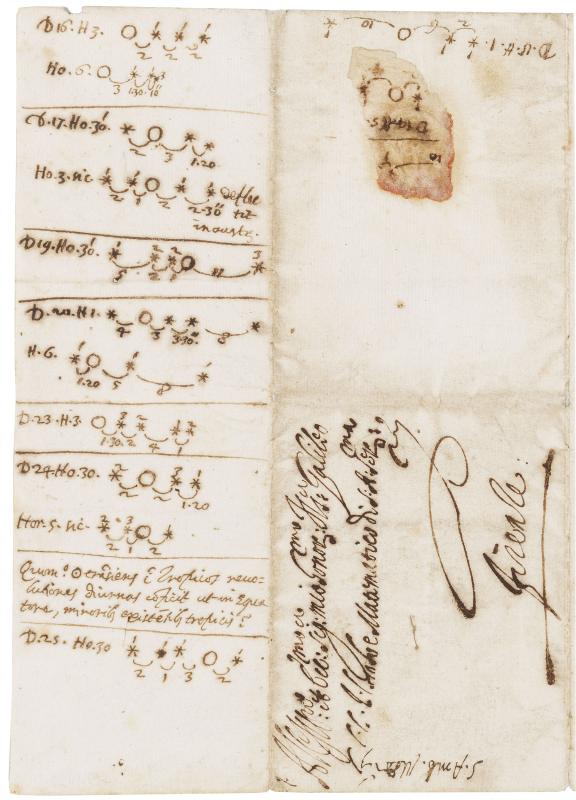
Galileo GALILEI. Autograph notes on the satellites of Jupiter, 14–25 January 1611


Galilei, Galileo, 1564-1642.

On this scrap of paper (an unfolded envelope), Galileo recorded the positions of four satellites of Jupiter over a period of several nights. He had observed the moons with the aid of his newly constructed telescope and published his findings in his revolutionary book The Starry Messenger (1610). He then worked to define more precisely the periods of the orbits of the Jovian moons, setting up his telescope night after night and making notes such as these. In a radical departure from his university training, Galileo insisted that scientific theory be grounded in observation and physical evidence rather than reliance on ancient authority.”

Etienne-Jules Marey and his Chronophotographic Gun


Marey, Etienne-Jules (1830 - 1904)

A polymorphic scientific, Etienne Jules Marey explored numerous techniques and disciplines, obsessed by one unique concept: movement. First interested in flight, he studied birds and imagined mechanical devices capable of flying. From 1878, he focused on movement within human beings and, inspired by Edward Muybridge he had met in 1881, used photography to document his research. He thus imagined, in 1882, a camera entitled photographic gun that enabled him to capture a moving subject in twelve poses. Etienne Jules Marey thus decomposed the gestures of men practicing sports, animals in motion, everyday tasks precisely observed and even the migration of air. He also invented the chonophotography that would be the precursor of cinema. Photography in its early days was the ultimate accomplice of reality but with Etienne Jules Marey (and Edward Muybridge), photography suddenly also captured the invisible.”


Marey, Etienne-Jules (1830 - 1904)

Marey started by studying blood circulation in the human body. Then he shifted to analyzing heart beats, respiration, muscles (myography), and movement of the body. To aid his studies he developed many instruments for precise measurements. For example, in 1859, in collaboration with the physiologist Auguste Chauveau and the watch manufacturer Breguet, he developed a wearable Sphygmograph to measure the pulse. This sphygmograph was an improvement on an earlier and more cumbersome design by the German physiologist Karl von Vierordt.[3] In 1869 Marey constructed a very delicate artificial insect to show how an insect flies and to demonstrate the figure-8 shape it produced during movement of its wings. Then he became fascinated by movements of air and started to study bigger flying animals, like birds. He adopted and further developed animated photography into a separate field of chronophotography in the 1880s. His revolutionary idea was to record several phases of movement on one photographic surface. In 1890 he published a substantial volume entitled Le Vol des Oiseaux (The Flight of Birds), richly illustrated with photographs, drawings, and diagrams. He also created stunningly precise sculptures of various flying birds.”


Marey, Etienne-Jules (1830 - 1904)

Marey studied other animals too. He published La Machine animale in 1873 (translated as “Animal Mechanism”). The English photographer Eadweard Muybridge carried out his “Photographic Investigation” in Palo Alto, California, to prove[dubious – discuss] that Marey was right when he wrote that a galloping horse for a brief moment had all four hooves off the ground. Muybridge published his photos in 1879 and received some public attention.”


Marey, Etienne-Jules (1830 - 1904)

Marey’s chronophotographic gun was made in 1882, this instrument was capable of taking 12 consecutive frames a second, with all the frames recorded on the same picture. Using these pictures he studied horses, birds, dogs, sheep, donkeys, elephants, fish, microscopic creatures, molluscs, insects, reptiles, etc. Some call it Marey’s “animated zoo”. Marey also conducted the famous study about cats always landing on their feet. He conducted very similar studies with a chicken and a dog and found that they could do almost the same. Marey also studied human locomotion. He published another book Le Mouvement in 1894.”