The Vallard Atlas

'Terra Java' (east coast of Australia?)
‘Terra Java’ (east coast of Australia?)

From BibliOdyssey:

  •  “It was (anonymously) produced by the Dieppe school (France) in 1547 and was either copied from Portuguese maps or was completed with the input of (a) Portuguese cartographer(s)
  • The maps are known as portolan (navigational) charts [previously]
  • Unusually, north is shown at the bottom of the maps in the style of Muslim cartographers (very rare in European Christian mapping)
  • Allegedly, this atlas shows the first ever European record of Australian coastline — some 250 years ahead of Capt. Cook and 60-odd years before the earliest official European discovery/sighting/mapping of any Australian coastline by William Janszoon in 1606 [see: Landing List].<
  • The miniatures and marginalia depict 16th century native and colonisation scenes
  • The first[?] use of the name “Canada” in a map 


North America, East Coast


Aegean Sea
Aegean Sea

See lots more at BibliOdyssey.


Zeeatlas. Frankrijk, 1538. Perkament, 39 folia, 440 x 312 mm. – 129 A 24, fol. 16r


HTML tutorial

“In the south of Brazil, in the centre of the picture, two opponent Tupi-tribes are fighting against each other. Further southward a Native American lumberjack is felling a tree for a European merchant. In the north tree-trunks are transported and a second group of natives is moving westward, accompanied by two Europeans. The Europeans are probably Frenchmen, although Brazil had been held by the Portuguese since 1500. As neither gold nor silver was found, Portuguese interest rapidly decreased, and for many years only French privateers came there after Brazilian wood.”

“This chart, displaying part of the Atlantic coast of South America, with Uruguay and the mouth of the Rio de la Plata at the top as the most southern point, and the area around Pernambuco as the most northern region, is one of the charts in an atlas that was made in Dieppe about 1538. The Dieppe cartographers were known for their reliable cartographic material, which they also presented in a very artistic way. They had excellent contacts with Portuguese cartographers, the experts *par excellence *of maritime cartography at the time. No wonder that the basic material for this atlas also came from the Portuguese: the geographical representation, the windroses indicating the points of the compass, and the spelling of the plotted place-names, all point to this origin.”

Koninklijke Bibliotheek [NL]

via

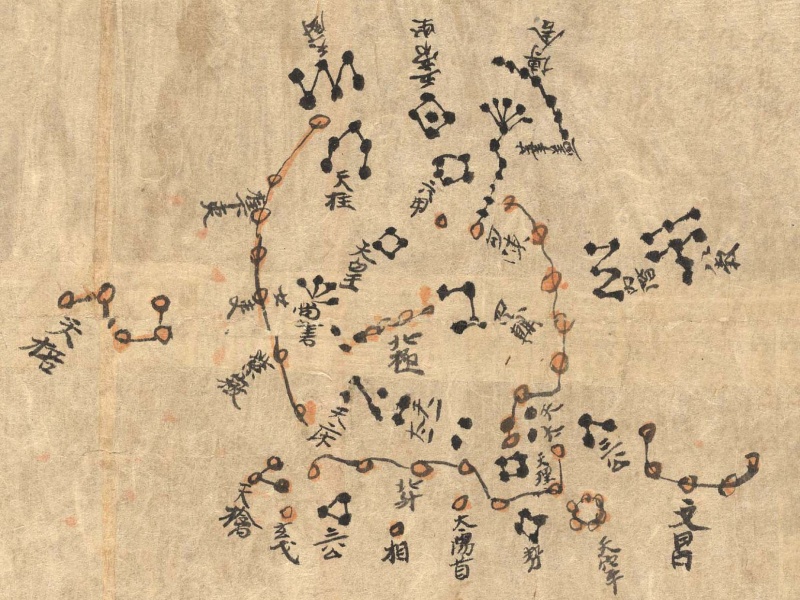
Dunhuang Star Atlas


Dunhuang Star Atlas

“This ancient Chinese map of planet Earth’s northern sky is part of the Dunhuang Star Atlas, one of the most impressive documents in the history of astronomy. The oldest complete star atlas known, it dates to the years 649 to 684, discovered at the Silk Road town of Dunhuang in 1907. A recent analysis that examines the accuracy and projections used to make it notes the atlas marks positions of over 1,300 stars and outlines 257 Chinese star groups or asterisms. The star positions in the hand drawn atlas were found to be accurate to within a few degrees. In this example showing the north polar region, a very recognizable Big Dipper, part of the modern constellation Ursa Major, lies along the bottom of the chart. An additional 12 charts depicting equatorial regions in 30 degree sections also includes a group resembling the modern constellation Orion. The atlas is on display at the British Library in London to celebrate the International Year of Astronomy.”