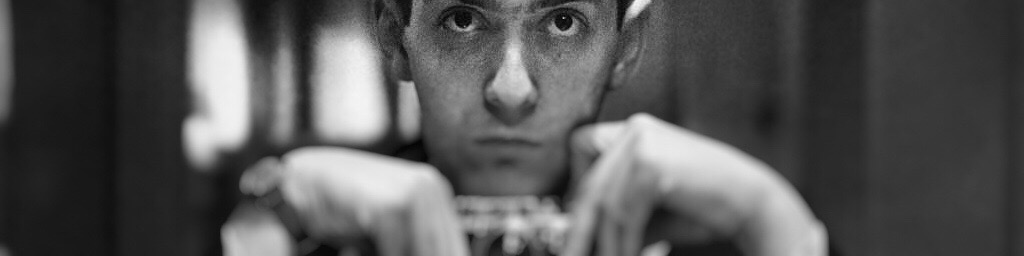
Stanley Kubrick: The Lost Tapes

“A short documentary about the early life and feature films of the great Stanley Kubrick, as narrated by himself. The narration was pulled from interviews that took place in 1966 with Jeremy Bernstein. Bernstein was writing a profile on the director and used these recordings as a chance to gather information. As it turns out the tapes themselves were a rare and incredibly interesting insight into the mind of Kubrick. Its also a glimpse at the director before his “masterpieces” such as ‘2001 : A Space Odyssey’ and ‘The Shining’ had been made. The films mentioned are as follows :

1968 – 2001: A Space Odyssey
1964 – Dr. Strangelove or: How I Learned to Stop Worrying and Love the Bomb
1962 – Lolita
1960 – Spartacus
1957 – Paths of Glory
1956 – The Killing
1955 – Killer’s Kiss


1953 – Fear and Desire
1951 – Day of the Fight (Documentary short)
1951 – Flying Padre (Documentary short)”

Via

“Stop Motion Animators Are Amazing”

“Animation is an in-depth, moment-by-moment exploration of space and time, of motion, both conscious and unconscious, of gravity, of weather, of material, of action and reaction. It asks, how does a leaf falling differ from a person falling? It looks at what I do with my hands when I’m worried, how I hold my shoulders while I’m waiting, where my eyes look when I’m sad. It asks, how do I position myself in relation to someone I love. Animators are observers and psychologists. They are actors inhabiting characters from the outside. They are physicists and engineers, first studying how things move in the real world, then figuring out how to represent that in an artificial one. How does a football bounce when it hits the ground? How does snow fall on a windy day? When you rub your eye, how long does it take to reposition itself properly in its socket? That’s one we explore in Anomalisa.

The thing I especially love about stop motion animation is that it has to figure out how to accomplish all this simulation in real space and actual time. A shirt has to be suspended in multiple positions in space as it is tossed toward a bed. How does it tumble as it’s tossed? All the different types of animators need to understand that trajectory, but only stop motion animators have to make it tumble in a real, albeit tiny room onto a real, albeit tiny bed. It has to be lit with real, albeit tiny lights. If the object tossed onto the bed is heavy enough—a suitcase, a person, for example—the bed has to react to the weight. Maybe the object has to bounce a little after it lands. How would it bounce? Straight up and down? Off at an angle? The animator must know. All this action has to be broken down into still photos, 24 of them for a second of screen time. Being involved in Anomalisa has made me more observant and more thoughtful about movement. I watch people walk and ask myself what it says about them. I watch myself fidget and ask the same questions. I notice gestures. I pay attention to the crazy movement of leaves in the breeze on the tree outside my window. I try to understand how those seemingly haphazard movements might be simplified but effectively represented. I realize we’re all moving constantly, in relation to others, unconsciously revealing our secrets, our fears, our attractions and repulsions, consciously trying to hide them, protect ourselves, make ourselves less obvious, less vulnerable.

Stop motion is an old fashioned, maybe even antiquated method of animation. And I love that about it, as well. I love that it is done by hand and that the “fingerprints” of the animators remains present in the finished film. You can see their presence in the slight chatter of clothing and hair, in the occasional awkwardness of a silicone body resisting being moved into a certain position. These are the flaws that make stop motion sing.

Lewis Hyde wrote a poem entitled “This Error is the Sign of Love” that resonates greatly with me. It begins:

This error is the sign of love,
the crack in the ice where the otters breathe,
the tear that saves a man from power,
the puff of smoke blown down the chimney one morning, and the
widower sighs and gives up his loneliness,
the lines transposed in the will so the widow must scatter
coins from the cliff instead of ashes and she marries
again, for love,
the speechlessness of lovers that forces them to leave it alone
while it sends up its first pale shoot like an onion
sprouting in the pantry,
this error is the sign of love.

As we move into an increasingly virtual society, I find solace and comfort in the hands-on, human imperfection of the stop motion process. It is to me both heartbreaking and beautiful. The imperfections of the humans who create these works make it so. And, oddly perhaps, because of this, these puppets make me feel more connected to those sweet aspects of us as human beings.”

“It took just 10 years from scribbling this in prison, as leader of a banned party, for Hitler to achieve power. That happened, primarily, because the German economy collapsed and because no major power was willing to enforce the world “order” established at Versailles in 1919. But it also happened because, by the mid-1930s, a lot of people had begun to hate each other.

Since 1945, every generation in the educated world has been taught “the lessons” of the rise of Nazism. But surveying the world at the start of 2016 it seems as if we have been learning the wrong lessons. The world is awash with hatred. And since around a quarter of its inhabitants have mobile social media accounts we are leaving a very detailed evidential trail about its spread.”

As Mein Kampf returns to Germany, the world is again awash with hatred | Paul Mason

Where do you see the film fitting within the spectrum from news to documentary?

“In Syd Field’s book about screenwriting, he said to take a phrase that must sing throughout the film and tape it to your typewriter. And here that phrase is “Europe smashed the first left government in modern history. The politicians made mistakes, but the people were always really strong.” That’s what it’s about.”

Interview With Paul Mason, Producer of #ThisIsACoup

Cinema Is a Mosaic Made of Time

“There are two basic categories of film directors. One consists of those who seek to imitate the world in which they live, the other of those who seek to create their own world. The second category contains the poets of cinema, Bresson, Dovzenko, Mizoguchi, Bergman, Buñuel and Kurosawa, the cinema’s most important names. The work of these film-makers is difficult to distribute: it reflects their inner aspirations, and this always runs counter to public taste. This does not mean that the film-makers don’t want to be understood by their audience. But rather that they themselves try to pick up on and understand the inner feelings of the audience.”

Andrei Tarkovsky

On Gwangi


Amongst the methonal fumes, corduroy flares and taste of cresta in the pre-star wars seventies there was relatively little of the fantastic to occupy the day dreaming mind of the under 10s. There was occasional Saturday morning Godzilla, there was Flash Gordon and various other assorted grand ideas fitting into a budget.

Valley of Gwangi crashed into my world during this time. At Gran’s house, A creepy pre title, the very western theme music with crashing timpani (by Jerome Morross of Big Country (not that one that one), the promise of cowboys vs dinosaurs. A playfulness of genre unusual until the age when comic books finally took over cinema.

Gwangi was conceived by Willis O’Brien, prime animator of the original King Kong. It was Part of a set of ideas featuring Cowboys and monsters (including Mighty Joe Young and the xxxxx). O’Brien was unable to finish the project and handed it to his apprentice, Ray Harryhausen, who had by then completed many multi creature films which were mostly better t.

The Allosaurus in gwangi was fast moving, tail constantly curling, in a candid moment it scratched it’s nose. It was alive. Many books at that time were still telling us that dinosaurs were sluggish, slow moving cold blooded creatures. But Harryhuasen looked at them with the eye of an animator, seeing how they neeed to move. Consequently he was ahead of many paleantologists and he produced a level of dynamism unmatched until Speilberg got his hands in the Train Set 23 years later.

Showing my children a film such as this is a recipe for heartbreak. They’re raised on hi end 21st century cgi, it’s meaning is lost to them because they don’t get the history and it’s just too old. Sometimes it’s equally devastating revisiting a treasure of childhood, one sees the flaws not perceived at such a young age. Gwangi carries some of that, yet the magic still carries me away.

I had the privilege of meeting Harryhausen about twenty years ago. I managed to mumble about how much I loved the film and had gone through the lasso sequence frame by frame enough times to degrade a VHS. He smiled and told me the story of how they had taken a jeep with a pole, the stunt riders lassoed the pole and the jeep accelerated back and forth pulling the riders off the horses, and then by the “magic of cinema” (his words) they removed the pole and put Gwangi in. I nodded gratefully and crawled back under my stone.

As mentioned The Valley of Gwangi is being shown as an open air screening in  Victoria Square, Bedminster, Bristol on August 8th as part of the Bristol Bad Film Club (wtf?) (oh wait, they apologise). I am unable to attend and have nothing but cold, hard envy for all of you who can.