Far Flung Flora and Fauna

German biologist and artist Ernst Haeckel dedicated his life studying far flung flora and fauna, drawing each of their peculiar specificities with an immense scientific detail. Haeckel made hundreds of such renderings during his lifetime, works which were used to explain his biological discoveries to a wide audience. In addition to these visual masterpieces, Haeckel also discovered many microbes, and coined several scientific terms commonly known today, such as ecology, phylum, and stem cell.


A new book from Taschen titled The Art and Science of Ernst Haeckel outlines the 19th-century artist-biologist’s most important visual works and publications across a hefty 704 pages. The compendium includes 450 drawings, watercolors, and sketches from his research, which was in large support of Darwin’s theory of evolution. Most notably the book contains the Kunstformen der Natur (Art Forms in Nature), a collection of 100 prints of varying organisms originally published between 1899 and 1904.

You can learn more about the collection of illustrations and Haeckel’s discoveries on Taschen’s website. (via Fast Co. Design) (via Colossal)

On What Comics Can Do

“If Art Spiegelman’s MAUS had been filmed first, it would have had an audience of maybe three people at Sundance. Because the moment everyone trooped on wearing their mouse masks, any larger audience would have lost it and left giggling. Only in the space of cartooning could that conceit work. Not least because we’re already aware, when we come to cartooning, that we’re looking at someone’s processed and hermetic perception of the world. The great success of MAUS is that the mouse faces make us let our guard down, and so we’re hit by the horrible truth of that book from an unprotected angle.”

“..a curling, snarling Peter Kuper piece can sear the page with its anger in a way that no photorealistic artist will ever be able to communicate. A room drawn by Eddie Campbell will be more real than any snapshot, because his line is almost like handwriting, and has human breath upon it. Dash Shaw’s work may look rough on first look, but stay with it, look at how he conveys the essence of an idea in every panel, and you’ll realise how hard he sometimes works to evoke an entire world with so few elements.”

“This is a field that combines, on the one hand, the novel and the poem and the slogan and the news story, and on the other hand every stop from pointillism to cave painting. Understand comics as the marriage of word and picture, as simple as that, and you’ll get a sense of how broad the medium’s reach really is.”

Warren Ellis

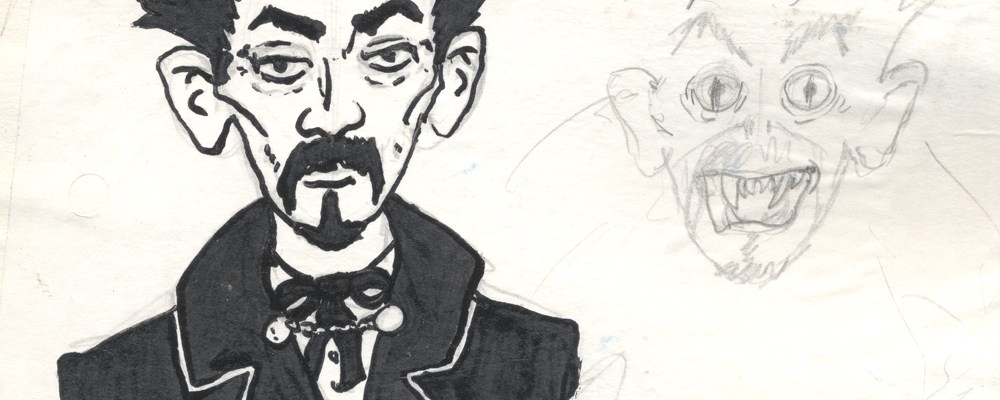
My Dracula

“A great awe came on all as they realised that the ship, as if by a miracle, had found the harbour, unsteered save by the hand of a dead man! However, all took place more quickly than it takes to write these words. The schooner paused not, but rushing across the harbour, pitched herself on that accumulation of sand and gravel washed by many tides and many storms into the southeast corner of the pier jutting under the East Cliff, known locally as Tate Hill Pier.

There was of course a considerable concussion as the vessel drove up on the sand heap. Every spar, rope, and stay was strained, and some of the `top-hammer’ came crashing down. But, strangest of all, the very instant the shore was touched, an immense dog sprang up on deck from below, as if shot up by the concussion, and running forward, jumped from the bow on the sand.”


1992

He really is quite the dude, and could take you quite easily, just look into his eyes.

Drawn about 1 year before Gary Oldman turned the character into pantomime dame.

My world is all heat and flies at the moment, can’t you tell?

Here’s to old friends.

Fortune: “You guys are all the same!”