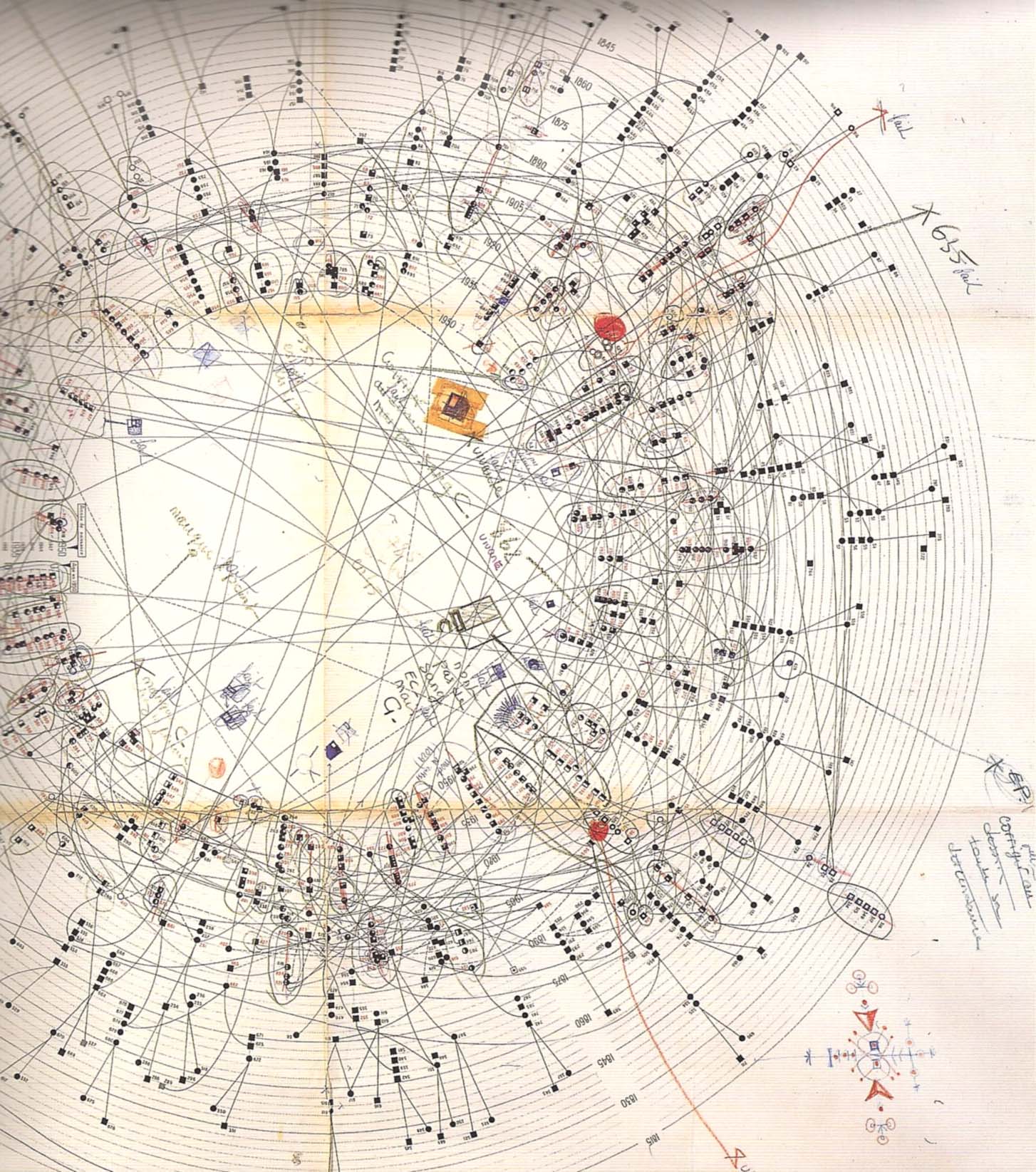
Inuit Genealogy

reblogging johnfass

johnfass's avatarfevered imaginings

Currently working on a research project related to Canadian and Greenland Inuit with R0gMedia in Berlin. The diagram above is a genealogical diagram made in the mid 1950s by anthropologist Jean Malaurie, the first of its kind. It’s a hand made radial drawing, Malaurie has a whole series of them in his apartment in Paris, along with his extensive personal archive of research materials including photos, films, notebooks, drawings. While the broader aims of the project are to find an institution willing to host the collection, I’m trying to make an digital artefact out of this diagram that could bring the information alive and demonstrate how historical anthropological materials can be made relevant and contextualised for present and future generations. DIS2012 published a paper on this project for a workshop about slow technology. Slow technology DIS2012

View original post

Rumble by Link Wray & His Ray Men (1954)

reblogging i12bent:


link

Guitarist Link Wray (May 2, 1929 – 2005) was one of the first Native American recording artists to produce a major hit…

Rumble was released in 1958 to immediate acclaim by young people (it is one of the only instrumentals to be banned from airplay, due to its supposed ability to incite rebellion and rioting) – later generations will know it from the soundtrack of Pulp Fiction

Link played a heavy, distorted lead guitar and his raw sound has influenced power guitarists from Pete Townsend to Jeff Beck, Jimmy Page, Jimi Hendrix, Marc Bolan, Neil Young and Bob Dylan.

Wray lived his last decades in Denmark and is buried in Copenhagen…

(via straycatsfangirl)

Also:

Eventually the instrumental came to the attention of record producer Archie Bleyer of Cadence Records, who hated it, particularly after Wray poked holes in his amplifier’s speakers[7] to make the recording sound more like the live version. But Bleyer’s stepdaughter loved it, so he released it despite his misgivings.[8] Phil Everly heard it and suggested the title “Rumble”, as it had a rough sound and said it sounded like a street fight.”

“The 1980 Adam and the Ants song “Killer in the Home”, from their Kings of the Wild Frontier album, is based on the same refrain that is featured in “Rumble” (Ants guitarist Marco Pirroni has cited Link Wray as a major influence).”

“In an interview with Stephen Colbert on April 29, 2013, Iggy Pop stated that he “left school emotionally” at the moment he first heard “Rumble” at the student union, leading him to pursue music as a career.”

It is also one of the first tunes to use the power chord, the “major modus operandi of the modern rock guitarist.”