“…keep drawing, make A LOT of drawings, and don’t worry about making bad drawings.”
note taking
“EDC: What I Carry Every Day”
“Never, ever, ever be without a notebook and something to write with. Phones are great for lots of things, but nothing beats paper and pen for complex thoughts, notes and sketches. I wrote an entire issue of PLANETARY in a notebook on a long three-leg train journey once.”
Galileo GALILEI. Autograph notes on the satellites of Jupiter, 14–25 January 1611
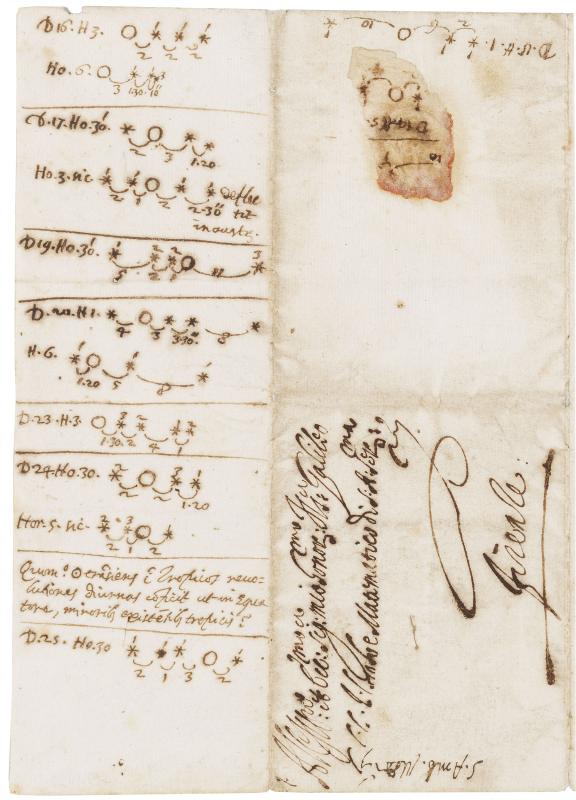
“On this scrap of paper (an unfolded envelope), Galileo recorded the positions of four satellites of Jupiter over a period of several nights. He had observed the moons with the aid of his newly constructed telescope and published his findings in his revolutionary book The Starry Messenger (1610). He then worked to define more precisely the periods of the orbits of the Jovian moons, setting up his telescope night after night and making notes such as these. In a radical departure from his university training, Galileo insisted that scientific theory be grounded in observation and physical evidence rather than reliance on ancient authority.”
On Mind Maps and Dyslexia
Why do I need mind-maps?
“There are a few things you need to know:
First, I am lucky enough to have a number of positive impacts of dyslexia. One of those is that once I have acquired new information I can process it very rapidly and often have multiple thoughts at once. That often means that I can solve the most complex problems faster than others.
Second, I have a problem writing and thinking at the same time. I believe it is to do with short-term memory. However, the bottom line is that I keep forgetting where I am in the overall flow of the thing that I am writing. As a result, my writing meanders and needs to be edited (by me) again and again until it finally expresses what I mean.
Thirdly, I see patterns in things – often before others. I use that to form and then set out compelling arguments and explanations that become very clear to readers.
Finally, I have a fairly precise use of language and so – whilst not finding it easy to write – am a fierce critic of my own work. So that means the editing can take a very long time.”
From Isaac Newton’s “Waste Book”

3 x notes on notes and sketch pages


“Why did I write it down? In order to remember, of course, but exactly what was it I wanted to remember? How much of it actually happened? Did any of it? Why do I keep a notebook at all? It is easy to deceive oneself on all those scores. The impulse to write things down is a peculiarly compulsive one, inexplicable to those who do not share it, useful only accidentally, only secondarily, in the way that any compulsion tries to justify itself. I suppose that it begins or does not begin in the cradle. Although I have felt compelled to write things down since I was five years old, I doubt that my daughter ever will, for she is a singularly blessed and accepting child, delighted with life exactly as life presents itself to her, unafraid to go to sleep and unafraid to wake up. Keepers of private notebooks are a different breed altogether, lonely and resistant rearrangers of things, anxious malcontents, children afflicted apparently at birth with some presentiment of loss.”

 Paul Greer