NOTES
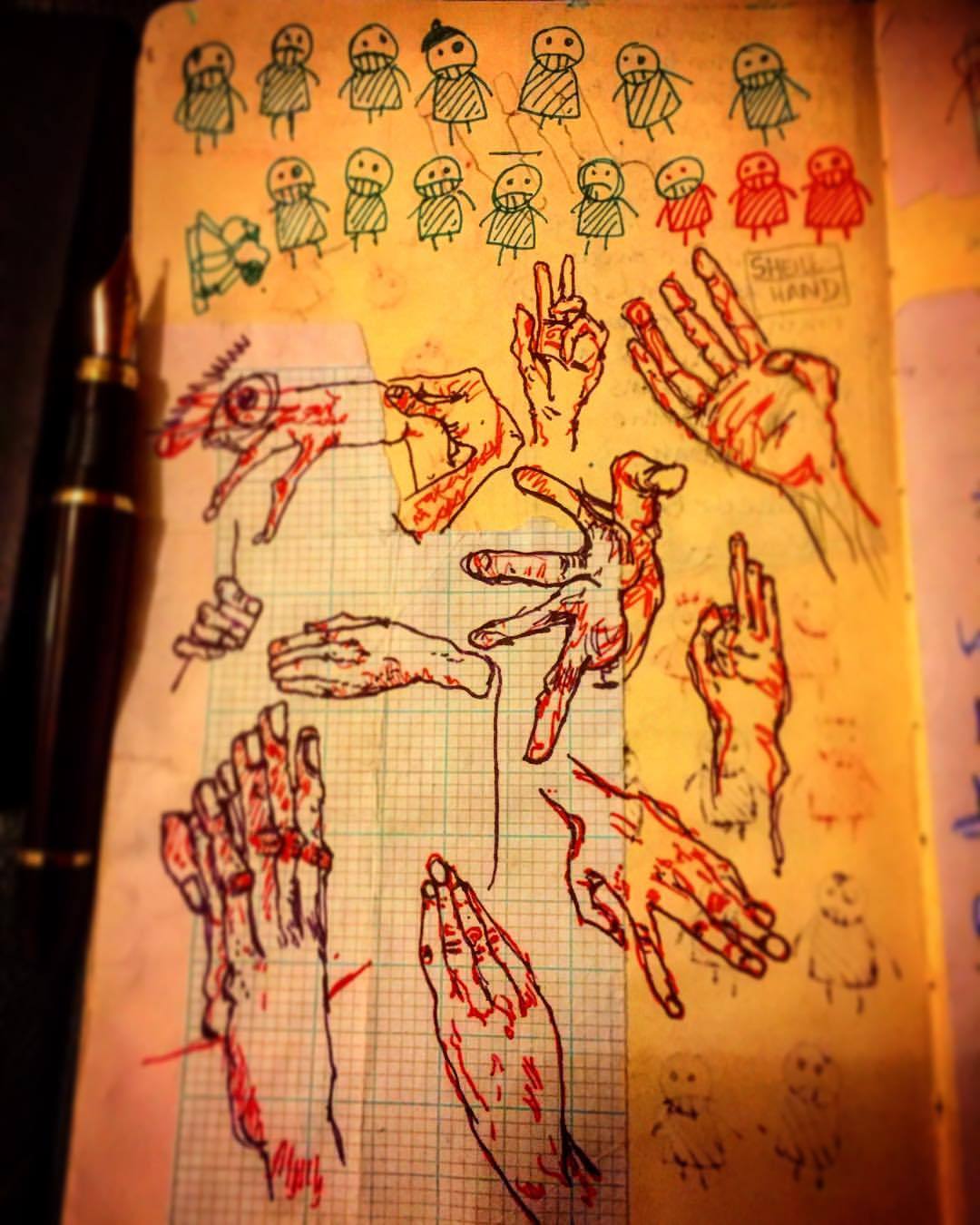
note taking method, master mind groups, daydreams, ticket stubs, daily pages, day books, sketch pads, tentative drawings, empty cities
Athanasius Kircher’s Mundus Subterraneus, 1665.

“Athanasius Kircher’s diagrams of the interconnectedness of fire (above) and water (below) in Earth. The diagrams are just a piece of his large, multi-volume work Mundus Subterraneus, published in 1665.”

“On a visit to southern Italy in 1638, the ever-curious Kircher was lowered into the crater of Vesuvius, then on the brink of eruption, to examine its interior. He was also intrigued by the subterranean rumbling which he heard at the Strait of Messina. His geological and geographical investigations culminated in his Mundus Subterraneus of 1664, in which he suggested that the tides were caused by water moving to and from a subterranean ocean.
“Kircher was also puzzled by fossils. He understood that fossils were the remains of animals. He ascribed large bones to giant races of humans.[24] Not all the objects which he was attempting to explain were in fact fossils, hence the diversity of explanations. He interpreted mountain ranges as the Earth’s skeletal structures exposed by weathering.
“Kircher’s map of Atlantis, oriented with south at the top, from Mundus Subterraneus.
Mundus Subterraneus includes several pages about the legendary island of Atlantis including a map with the Latin caption “Situs Insulae Atlantidis, a Mari olim absorpte ex mente Egyptiorum et Platonis descriptio.” translating as “Site of the island of Atlantis, in the sea, from Egyptian sources and Plato’s description.”
Sketches of Nikolai Gogol, Count Fyodor Petrovich Tolstoy, and other Russian artists by poet Alexander Pushkin.

“Pushkin would frequently jot down these charming black and white sketches both in his personal writings, and in the margins of his manuscripts. The final image, a page from Eugene Onegin, is a terrific example of his notebooks. Alongside the text, Pushkin included a sketch of a well-known Russian painter and aristocrat, with whom the author was certainly acquainted: Count Fyodor Petrovich Tolstoy (not to be confused with the Leo Tolstoy).”
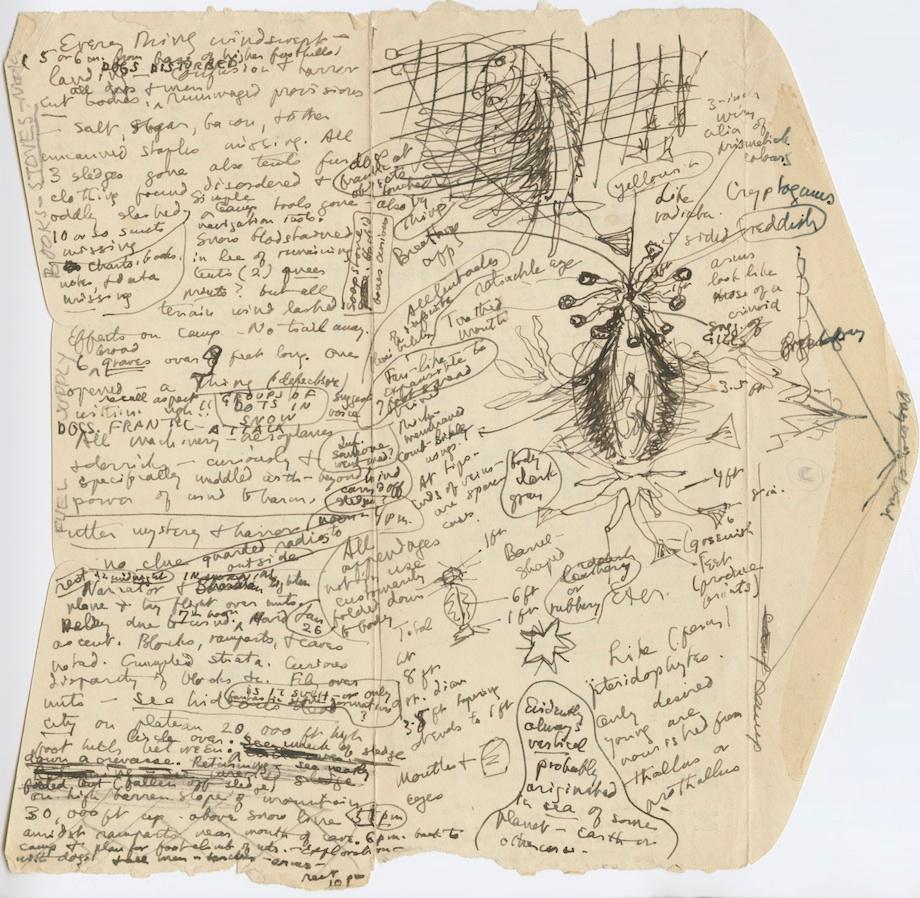
H.P. Lovecraft’s Monster Drawings: Cthulhu and “an open slice of howling fear”

“On March 23rd, the manuscript continued, Wilcox failed to appear; and inquiries at his quarters revealed that he had been stricken with an obscure sort of fever and taken to the home of his family in Waterman Street. He had cried out in the night, arousing several other artists in the building, and had manifested since then only alternations of unconsciousness and delirium.”

“Mountains featured several species of forgotten, intelligent beings, including the ‘Elder Things.’ The sketch on the right side of this page of notes (click here to view it in a larger format), with its annotations (‘body dark grey’; ‘all appendages not in use customarily folded down to body’; ‘leathery or rubbery’) represents Lovecraft working out the specifics of an Elder Thing’s anatomy.” That such things lurked in Lovecraft’s imagination have made his state of mind a subject of decades and decades of rich discussion among his enthusiasts. But just the body count racked up by Cthulhu, the Elder Things, and the other denizens of this unfathomable realm should make us thankful that Lovecraft saw them in his mind’s eye so we wouldn’t have to.”
from openculture
Galileo GALILEI. Autograph notes on the satellites of Jupiter, 14–25 January 1611
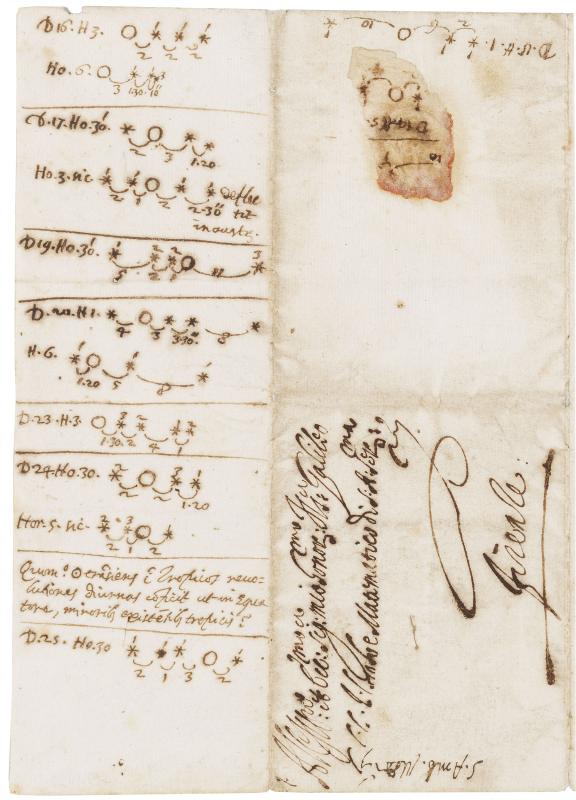
“On this scrap of paper (an unfolded envelope), Galileo recorded the positions of four satellites of Jupiter over a period of several nights. He had observed the moons with the aid of his newly constructed telescope and published his findings in his revolutionary book The Starry Messenger (1610). He then worked to define more precisely the periods of the orbits of the Jovian moons, setting up his telescope night after night and making notes such as these. In a radical departure from his university training, Galileo insisted that scientific theory be grounded in observation and physical evidence rather than reliance on ancient authority.”
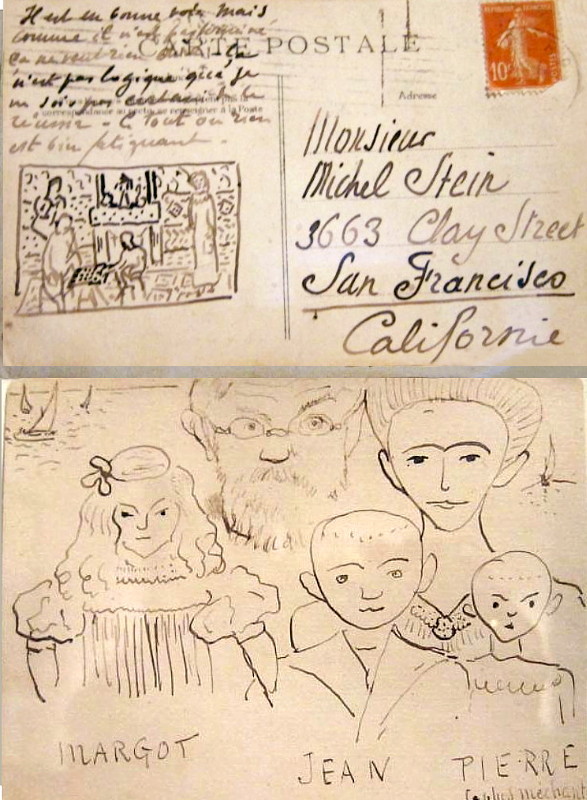
Henri Matisse to Michael Stein (Gertrude’s brother) postcard
Galileo Galilei, Sunspot Observations, 3 May 1612

Marilyn Monroe’s 1955 New Year’s resolution list,

“Must make effort to do
Must have the dicipline to do the following –z – go to class – my own always – without fail
x – go as often as possible to observe Strassberg’s other private classes
g – never miss actor’s studio sessions
v – work whenever possible – on class assignments – and always keep working on the acting exercises
u – start attending Clurman lectures – also Lee Strassberg’s directors lectures at theater wing – enquire about both
l – keep looking around me – only much more so – observing – but not only myself but others and everything – take things (it) for what they (it’s) are worth
y – must make strong effort to work on current problems and phobias that out of my past has arisen – making much much much more more more more more effort in my analisis. And be there always on time – no excuses for being ever late.
w – if possible – take at least one class at university – in literature –
o – follow RCA thing through.
p – try to find someone to take dancing from – body work (creative)
t – take care of my instrument – personally & bodily (exercise)
try to enjoy myself when I can – I’ll be miserable enough as it is.”
— via ListsOfNote
 Paul Greer