“I don’t have a clue. Ideas are simply starting points. I can rarely set them down as they come to my mind. As soon as I start to work, others well up in my pen. To know what you’re going to draw, you have to begin drawing… When I find myself facing a blank page, that’s always going through my head. What I capture in spite of myself interests me more than my own ideas.”
Pablo Picasso
Pablo Picasso: Portrait of Igor Stravinsky, May 24, 1920 – pen
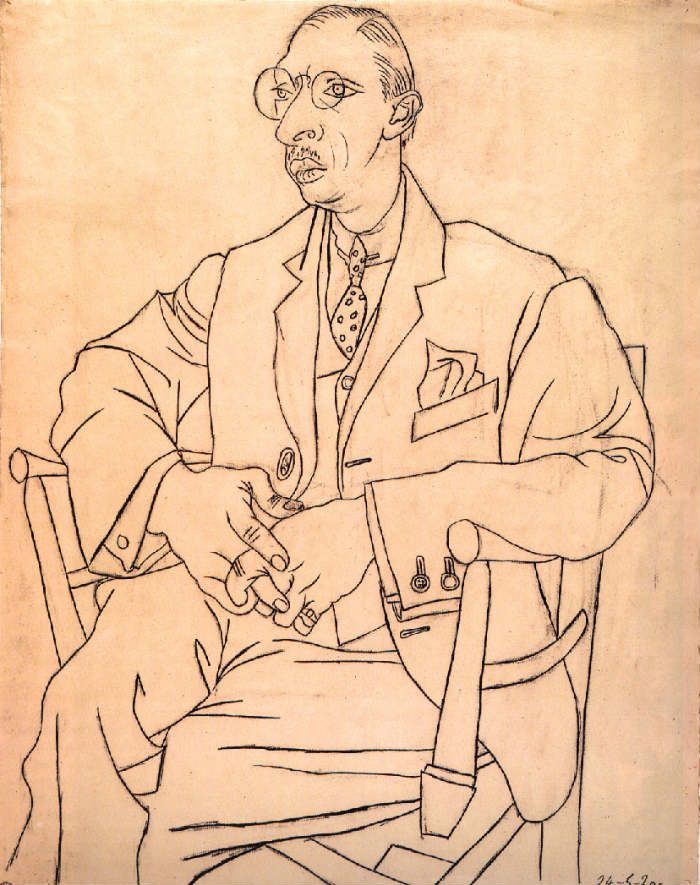
In 1917, Stravinsky met the great artist Pablo Picasso in Italy. While visiting him, Picasso drew a picture of Stravinsky. Igor packed it in his luggage to bring back to Switzerland.
When the customs officer inspected the suitcase, he thought the portrait was a spy plan. Their conversation went like this:
“What is this sketch?”
“My portrait drawn by Picasso.”
“Nonsense. It must be a plan.”
“Yes – the plan of my face.”
via cmuse
“The idea of producing variations on a work from the past was probably inspired by Picasso who reinterpreted works by Grünewald, Delacroix, Manet, Gauguin and Velazquez himself.”
“Picasso is the reason why I paint. He is the father figure, who gave me the wish to paint……Picasso was the first person to produce figurative paintings which overturned the rules of appearance; he suggested appearance without using the usual codes, without respecting the representational truth of form, but using a breath of irrationality instead, to make representation stronger and more direct; so that form could pass directly from the eye to the stomach without going through the brain.”
“I have a horror of copying myself.”
“The artist is a receptacle for emotions that come from all over the place: from the sky, from the earth, from a scrap of paper, from a passing shape, from a spider’s web. That is why we must not discriminate between things. Where things are concerned there are no class distinctions. We must pick out what is good for us where we can find it – except from our own works. ”
Pablo Picasso
“What do you think an artist is? An imbecile who only has eyes, if he is a painter, or ears if he is a musician, or a lyre in every chamber of his heart if he is a poet, or even, if he is a boxer, just his muscles? Far from it: at the same time he is also a political being, constantly aware of the heartbreaking, passionate, or delightful things that happen in the world, shaping himself completely in their image. How could it be possible to feel no interest in other people, and with a cool indifference to detach yourself from the very life which they bring to you so abundantly? No, painting is not done to decorate apartments. It is an instrument of war.”
Dora Maar by Man Ray, 1936

“Henriette Theodora Markovitch (22 November 1907 – 16 July 1997), known as Dora Maar, was a French photographer, painter, and poet.”
“Man Ray (born Emmanuel Radnitzky; August 27, 1890 – November 18, 1976) was an American visual artist who spent most of his career in France. He was a significant contributor to the Dada and Surrealist movements, although his ties to each were informal. He produced major works in a variety of media but considered himself a painter above all. He was best known for his photography, and he was a renowned fashion and portrait photographer. Man Ray is also noted for his work with photograms, which he called “rayographs” in reference to himself.”
“the young women serious face, lit up by pale blue eyes which looked all the paler because of her thick eyebrows; a sensitive uneasy face, with light and shade passing alternately over it. She kept driving a small pointed pen-knife between her fingers into the wood of the table. Sometimes she missed and a drop of blood appeared between the roses embroidered on her black gloves… Picasso would ask Dora to give him the gloves and would lock them up in the showcase he kept for his mementos.”
What are you looking for?
“Inspiration exists, but it has to find us working.”
Bull by Pablo Picasso

Complexity means “reduction and removal of redundancy”, as first defined by the philospher John Locke (1632-1704): “Ideas thus made up of several simple ones put together, I call complex; such as beauty, gratitude, a man, an army, the universe.”, and as illustrated in art by Picasso in his famous bull drawing.
–-Jon Otto Fossum, Laboratory for Soft and Complex Matter Studies
via Vruz
Pablo Picasso created ‘Bull’ around the Christmas of 1945. ‘Bull’ is a suite of eleven lithographs that have become a masterclass in how to develop an artwork from the academic to the abstract. In this series of images, all pulled from a single stone, Picasso visually dissects the image of a bull to discover its essential presence through a progressive analysis of its form. Each plate is a successive stage in an investigation to find the absolute ‘spirit’ of the beast.
 Paul Greer