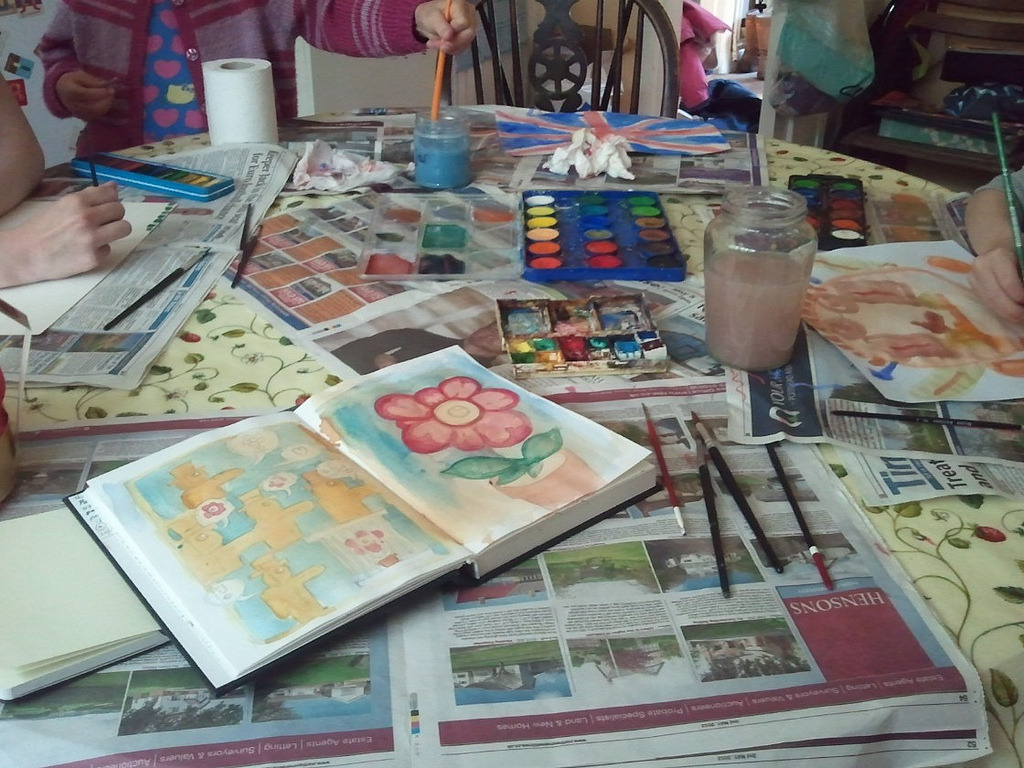
painting
“Pro painting techniques from John Singer Sargent, in a letter to Ben del Castillo, in reference to the painting Madame X, which was incredibly difficult to complete, mostly due to the restless and spoiled subject.”
“The painting is much changed and far more advanced that when you last saw it. One day I was dissatisfied with it and dashed a tone of light rose over the former gloomy background. I turned the painting upside down, retired to the other end of the studio and looked at it under my arm. Vast improvement.”
— via 3liza
“URGENT SUBTLE CONCISE ROBUST” – Paintings (1987)
“I always felt that my work hadn’t much to do with art; my admirations for other art had very little room to show themselves in my work because I hoped that if I concentrated enough the intensity of scrutiny alone would force life into the pictures. I ignored the fact that art, after all, derives from art. Now I realize that this is the case.”
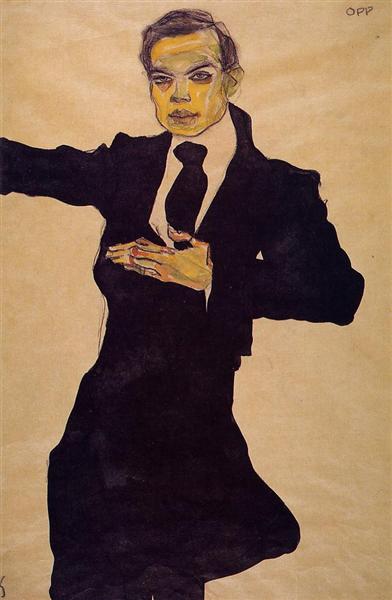
Portrait of artist Max Oppenheimer by Egon Schiele
“The idea of producing variations on a work from the past was probably inspired by Picasso who reinterpreted works by Grünewald, Delacroix, Manet, Gauguin and Velazquez himself.”
“Picasso is the reason why I paint. He is the father figure, who gave me the wish to paint……Picasso was the first person to produce figurative paintings which overturned the rules of appearance; he suggested appearance without using the usual codes, without respecting the representational truth of form, but using a breath of irrationality instead, to make representation stronger and more direct; so that form could pass directly from the eye to the stomach without going through the brain.”
“Paul puts things in motion (literally, figuratively, you name it)”

I got painted by the excellent Molly Peck!!
I have been a big fan of her work for a while, so to see my wretched face in one of her beautiful paintings really is quite something.
Thanks Molly.
Gustav Klimt. Philosophy (1899).

“Philosophy was the first of the three pictures presented to the Austrian Government at the seventh Vienna Secession exhibition in March 1900. It had been awarded a gold medal at the World Exhibition in Paris, but was attacked by those in his own country. Klimt described the painting as follows: “On the left a group of figures, the beginning of life, fruition, decay. On the right, the globe as mystery. Emerging below, a figure of light: knowledge.” Critics were disturbed by its depiction of men and women drifting in an aimless trance. The original proposal for the theme of the painting was “The Victory of Light over Darkness”, but what Klimt presented instead was a dreamlike mass of humanity, referring neither to optimism nor rationalism, but to a “viscous void””
“Klimt came under attack for ‘pornography’ and ‘perverted excess’ in the paintings. None of the paintings would go on display in the university.
In May 1945, it is contended that all three paintings were destroyed by retreating SS forces.”
Gustav Klimt – Island in the Attersee (1901)

“Attersee (also known as the Kammersee or Lake Attersee) is the largest lake of the Salzkammergut area of Austria. It extends for about 20 km from north to south and 4 km from east to west. Its water comes from the Seeache, which flows out of another lake, the Mondsee.”
Hilma af Klint (1862 – 1944)
“Hilma af Klint was a Swedish artist and mystic whose paintings were amongst the first abstract art. She belonged to a group called ‘The Five’ and the paintings or diagrams were a visual representation of complex philosophical ideas.”

“At the Academy of Fine Arts she met Anna Cassel, the first of the four women with whom she later worked in “The Five” (de Fem), a group of artists who shared her ideas. The group of female artists The Five was engaged in the paranormal and regularly organized spiritistic séances. They recorded in a book a completely new system of mystical thoughts in the form of messages from higher spirits, called The High Masters (“Höga Mästare”). One, Gregor, spoke thus: “all the knowledge that is not of the senses, not of the intellect, not of the heart but is the property that exclusively belongs to the deepest aspect of your being…the knowledge of your spirit”.”

Booklet with drawings by Hilma af Klint.
“The pictures were painted directly through me, without any preliminary drawings, and with great force. I had no idea what the paintings were supposed to depict; nevertheless I worked swiftly and surely, without changing a single brush stroke.”

Svanen (The Swan), nr 17, Group 9, Series SUW, October 1914 – March 1915. This abstract work was never exhibited during af Klint’s lifetime.
 Paul Greer