Stan.Brakhage – Persian Series 1-3

“1) This hand-painted and elaborately step-printed work begins with a flourish of reds and yellows and purples in palpable fruit-like shapes intersperced by darkness, then becomes lit lightning-like by sharp multiply-colored twigs-of shape, all resolving into shapes of decay. 2) Multiple thrusts and then retractions of oranges, reds, blues, and the flickering, almost black, textural dissolves suggesting an amalgam approaching script. 3) Dark, fast-paced symmetry in mixed weave of tones moving from oranges & yellows to blue-greens, then retreating (dissolves of zooming away) to both rounded and soft-edged shapes shot with black. 4) Elaborate petal-like, stamen-and-stem-like, multicolored flowers rising in white space until the whole field is as if crushed by floral designs in madly-swift mixtures of every conceivable previous (in the PERSIAN SERIES) shape, evolving back to brilliant petals against what was as at beginning of #4. 5) Dark blood red slow shifting tones (often embedded in dark) / (often shot-thru with parallel wave-like lines) composed of all previous shapes AND flowers as if trying, linierally, to evolve a glyph-script.”

film-makerscoop


More in #RollFilm:

“46,656 Words or Sentences Represented with 6 colors, 1862”

reblogging Ben Katchor:

from A. F. Ward’s Universal System of Semaphoric Color Signals, 1862

“A Novel and Original Invention, by which 46,656 words or sentences can be represented with six colors, intended as A Medium of Communication between all Nations, and Applicable to any Language; also adapted to sound and night signals, by which communications may be made at all-seasons, without regard to weather.”


via benkatchor

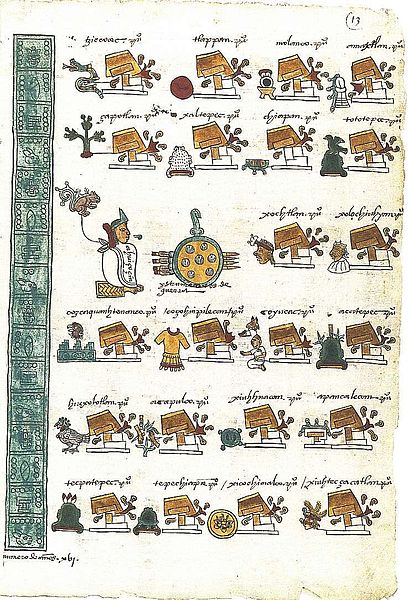
Codex Mendoza (1542)


Codex Mendoza (1542)


Codex Mendoza (1542)

Codex Mendoza (1542)

Codex Mendoza (1542)


Codex Mendoza (1542)


Codex Mendoza (1542)

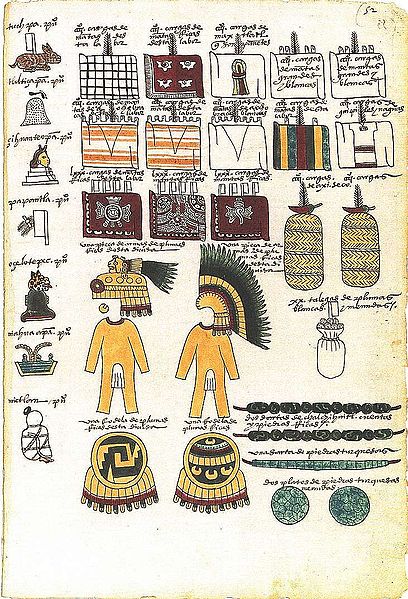
“The Codex Mendoza is an Aztec codex, created about twenty years after the Spanish conquest of Mexico with the intent that it be seen by Charles V, the Holy Roman Emperor and King of Spain. It contains a history of the Aztec rulers and their conquests, a list of the tribute paid by the conquered, and a description of daily Aztec life, in traditional Aztec pictograms with Spanish explanations and commentary. It is named after Antonio de Mendoza, then the viceroy of New Spain, who may have commissioned it. After creation in Mexico City, it was sent by ship to Spain. The fleet, however, was attacked by French privateers, and the codex, along with the rest of the booty, was taken to France. There it came into the possession of André Thévet, cosmographer to King Henry II of France. Thévet wrote his name in five places on the codex, twice with the date 1553. It was later bought by the Englishman Richard Hakluyt for 20 French francs. Some time after 1616 it was passed to Samuel Purchase, then to his son, and then to John Selden. The codex was deposited into the Bodleian Library at Oxford University in 1659, 5 years after Selden’s death, where it remained in obscurity until 1831, when it was rediscovered by Viscount Kingsborough and brought to the attention of scholars.”

from Wikipedia and ThePublicDomainReview

via Radimus


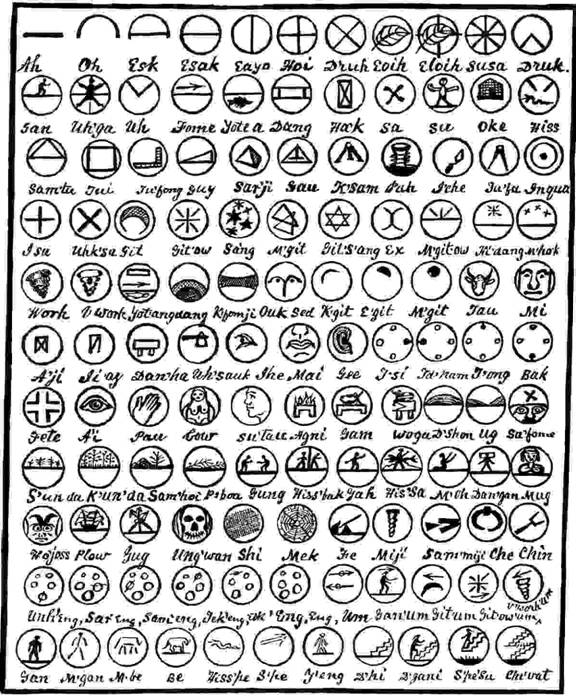
‘Se’moin’ from the Tablet of Fonece (Oahspe ‘primordial language’ also known as Panic, from the name Pan), John Ballou Newbrough, d. 1891.


‘Se'moin’ from the Tablet of Fonece (Oahspe 'primordial language’ also known as Panic, from the name Pan), John Ballou Newbrough, d. 1891.

“i033 Tablet of Se’moin. Panic language means earth-language; things were named after the sounds they uttered; thus, the soul of each thing spoke, and that which was voiced was called the Panic language. Panic was the first language on earth but was not written until Se’moin, given in the time of Sethantes, being the first written language given to I’hins. As such, Se’moin represents the first explanation of creation ever given to man.”

more here

via

from “Sentences and Paragraphs.” (1931)

“Sentences are made wonderfully one at a time. Who makes them. Nobody can make them because nobody can what ever they do see.

All this makes sentences so clear I know how I like them.

What is a sentence mostly what is a sentence. With them a sentence is with us about us all about us we will be willing with what a sentence is. A sentence is that they cannot be carefully there is a doubt about it.

The great question is can you think a sentence. What is a sentence. He thought a sentence. Who calls him to come which he did.

…What is a sentence. A sentence is a duplicate. An exact duplicate is depreciated. Why is a duplicated sentence not depreciated. Because it is a witness. No witnesses are without value.”

Gertrude Stein

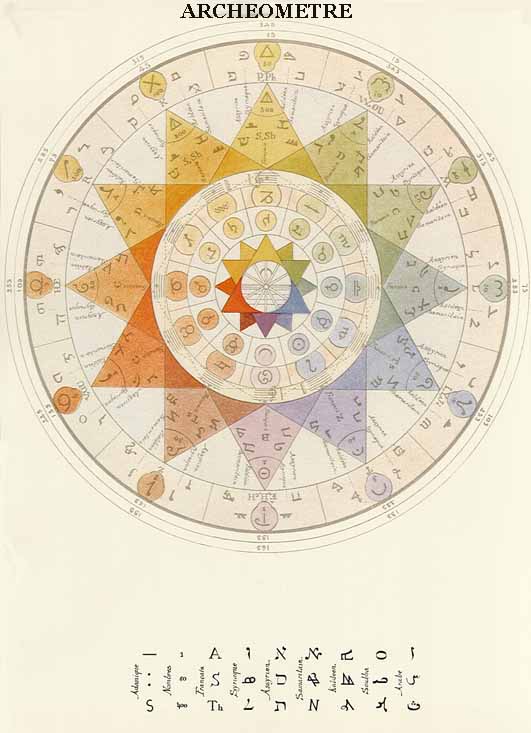
Archeometre by Alexandre Saint-Yves d’Alveydre


HTML tutorial

The term “Archeometre” originates from the Greek and means “the measure of the principle”. The system refers also to a series of symbols and meanings, which refer to the federal drawer.

‘Archeometre’ is it the measurement of the ‘Archee’ (Universal Cosmic Force) of which the Hermetists speaks. Is it a process, a ‘key’ which makes it possible to penetrate the Mysteries of the Word. It is a measuring instrument of the first (primary) principles of the manifested universe.

Alexandre Saint Yves d’Alveydre’s Archeometre shows the original Atlantean alphabet translates into the material the word, form, color, smell, sound and taste, the key to all religions and the sciences of antiquity.