“Suppose that a ramp leading to the top of a ziggurat wall is 56 cubits long, and the vertical height of the ziggurat is 45 cubits. What is the distance x from the outside base of the ramp to the point directly below the top? (Ziggurats were terraced pyramids built in the ancient Middle East; a cubit is a length of measure equal to about 18 inches or 44 centimeters.)”
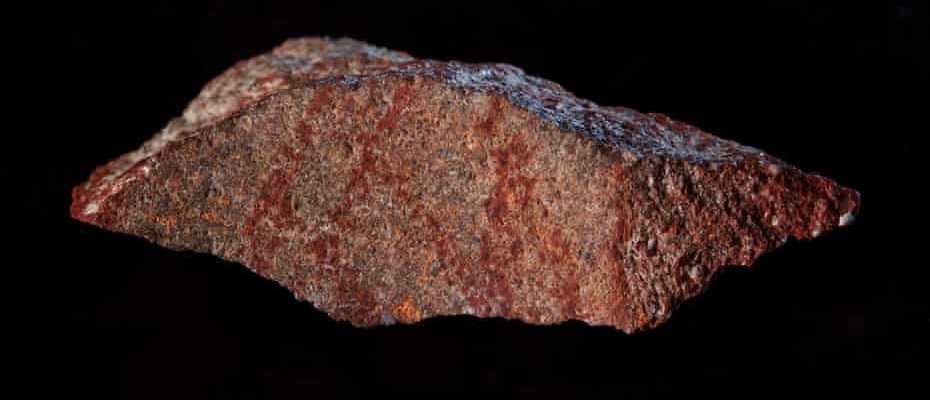
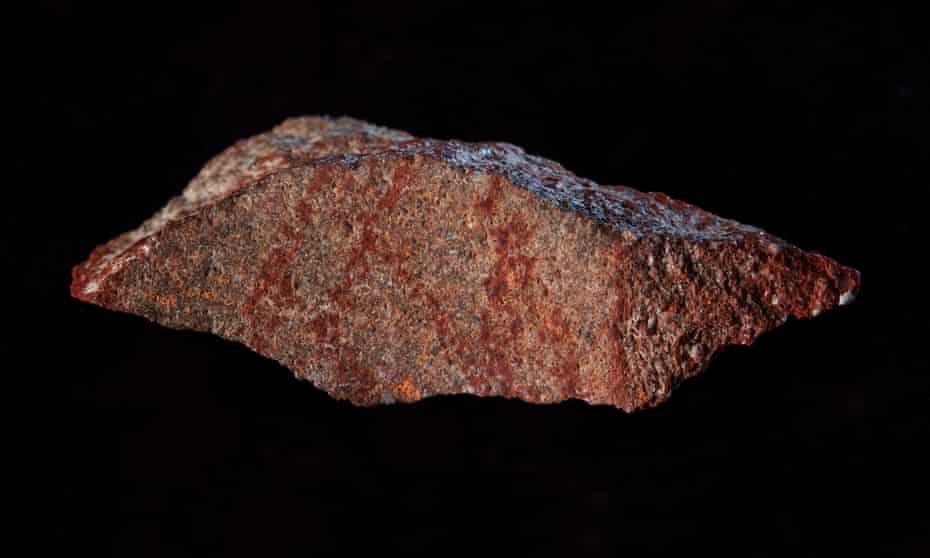
Researchers believe the pattern on the fragment of rock is 73,000 years old, but are perplexed as to what it might represent
“Archaeologists found the marked stone fragment as they sifted through spear points and other material excavated at Blombos cave in South Africa. It has taken seven years of tests to conclude that a human made the lines with an ochre crayon 73,000 years ago.
“The simple red marks adorn a flake the size of two thumbnails which appears to have broken off a grindstone cobble used to turn lumps of ochre into paint powder. The lines end so abruptly at the fragment’s edges that researchers believe the cross-hatches were originally part of a larger design drawn on the cobble.
“This is first known drawing in human history,” said Francesco d’Errico, a researcher on the team at the University of Bordeaux. “What does it mean? I don’t know. What I do know is that what can look very abstract to us could mean something to the people in the traditional society who produced it.”
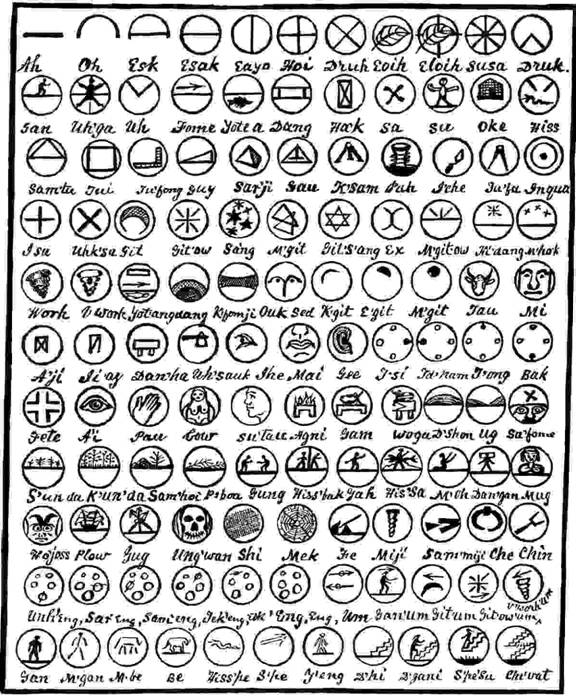
“i033 Tablet of Se’moin. Panic language means earth-language; things were named after the sounds they uttered; thus, the soul of each thing spoke, and that which was voiced was called the Panic language. Panic was the first language on earth but was not written until Se’moin, given in the time of Sethantes, being the first written language given to I’hins. As such, Se’moin represents the first explanation of creation ever given to man.”

 Paul Greer