The Value of Literacy

“I generally have four or five books open around the house—I live alone; I can do this—and they are not books on the same subject. They don’t relate to each other in any particular way, and the ideas they present bounce off one another. And I like this effect. I also listen to audio-books, and I’ll go out for my morning walk with tapes from two very different audio-books, and let those ideas bounce off each other, simmer, reproduce in some odd way, so that I come up with ideas that I might not have come up with if I had simply stuck to one book until I was done with it and then gone and picked up another.”

Octavia Butler

(See also “This is how I read” and “the tyranny of belief in linear time.” (via robertogreco)

“Curating can take the lead in pointing us towards this crucial importance of choosing.”

“Lately, the word “curate” seems to be used in an greater variety of contexts than ever before, in reference to everything from a exhibitions of prints by Old Masters to the contents of a concept store. The risk, of course, is that the definition may expand beyond functional usability. But I believe ‘curate’ finds ever-wider application because of a feature of modern life that is impossible to ignore: the incredible proliferation of ideas, information, images, disciplinary knowledge, and material products that we all witnessing today. Such proliferation makes the activities of filtering, enabling, synthesizing, framing, and remembering more and more important as basic navigational tools for 21st century life. These are the tasks of the curator, who is no longer understood as simply the person who fills a space with objects but as the person who brings different cultural spheres into contact, invents new display features, and makes junctions that allow unexpected encounters and results.”

Hans-Ulrich Obrist

(T)

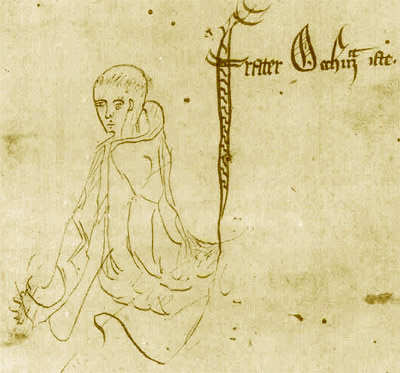
Occam’s razor »

The principle was often inaccurately summarized as “the simplest explanation is most likely the correct one.” This summary is misleading, however, since in practice the principle is actually focused on shifting the burden of proof in discussions.That is, the razor is a principle that suggests we should tend towards simpler theories (see justifications section below) until we can trade some simplicity for increased explanatory power. Contrary to the popular summary, the simplest available theory is sometimes a less accurate explanation. Philosophers also add that the exact meaning of “simplest” can be nuanced in the first place.“

William of Ockham
William of Ockham

Does Children’s Television Matter?

“Suppose, if you will, that I am part of a silent Martian invasion and that my intention is slowly to destroy the whole culture of the human race. Where would I start? I would naturally start where thought first grows. I would start with children’s television. My policy would be to give the children only the sort of thing that they ‘already know they enjoy’, like a fizzing diet of manic jelly-babies. This would no doubt be exciting, but their hearts and their minds would receive no nourishment, they would come to know nothing of the richness of human life, love and knowledge, and slowly whole generations would grow up knowing nothing about anything but violence and personal supremacy. Is that a fairytale? Look around you.”

Oliver Postgate

via