‘This Chansonnier, named by Knud Jeppesen as the perhaps most interesting and valuable medieval music handwriting in the Royal Library, occupies a special position among the relatively few manuscripts that surrender the French-Burgundian Chansons repertoire from the late 1400s. The script contains text and nodes for 33 three-star songs. A song – “Iactens secours” – was added in the 16th century. In conclusion, there are a number of “modulation exercises.”‘
Images
Bowling With Adam

The Netherlands diary

Entry from ‘Albrecht Dürer and his Legacy’ BM exh. cat. 2002, no.103:
‘This woodcut design for ornament is one of six ‘knots’, as Dürer referred to them in his Netherlands diary (see Goris and Marlier, p. 81) copied after six engravings of c. 1490-1500 thought to be designed by Leonardo da Vinci
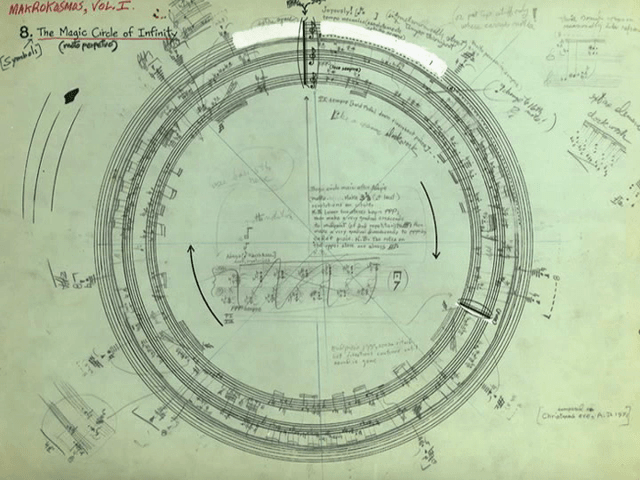
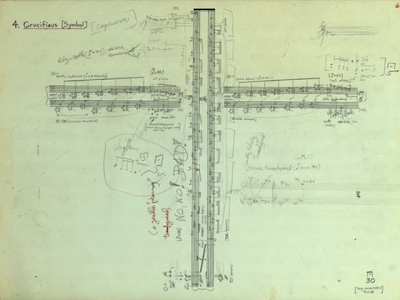
GEORGE CRUMB MAKROKOSMOS I & II: SCORES (2004)
“Notation naturally underwent the same ruptures that its signified did throughout the 20th century, not only in the attempt to find technically suitable illustrations for unprecedented forms of sonic expression, but also, as it was often the case, as a deliberate attack on the conventions of the graphic representation of sound. In the process, scores became increasingly idiosyncratic, more conscious about their arbitrary (i.e. semiotic) nature, and concomitantly assumed the status of art objects in themselves.”
— Eye Of Sound
The blessed Stone Age Phone.

The first picture taken with its replacement.
He only went and posted it.
“Paul puts things in motion (literally, figuratively, you name it)”

I got painted by the excellent Molly Peck!!
I have been a big fan of her work for a while, so to see my wretched face in one of her beautiful paintings really is quite something.
Thanks Molly.
Learning from Lombardi
“…In Lombardi’s case, even his early scribbles on a project are more informative, because they show a fundamentally human thought process, of trying to draw the story out of the mass of data he had collected. This is the opposite of many computational approaches that begin with a mass of data, followed by an often failed attempt to simplify it.
As part of the research for his drawings, Lombardi assembled some 14,000 index cards, which are now part of the permanent collection at the Museum of Modern Art in New York. Each 3 by 5 inch card referenced a person or other entity. In the computational pieces that I just showed, it’s as if we’re looking at all 14,000 index cards at once. Having completed the research and data collection process, Mark knew that he must first synthesize that information into something useful. Too often, we try to make the machines synthesize for us, but in fact, synthesis—from the Greek and then Latin meaning “to place together”—is a fundamentally human task. It’s what separates us from Google…”
— Ben Fry
selection by ekstasis
Top of Mt. Vesuvius – (Campi Phlegraei)
“Sir William Hamilton (1730-1803), perhaps best-known today as the husband of Emma Hamilton, mistress of Admiral Lord Nelson, was in his own right a skilled diplomatist, a celebrated connoisseur and collector, and a respected natural historian. In his own time he was honoured in particular for his contributions to the study of volcanoes, acquiring the title ‘the modern Pliny’ for his studies of Vesuvius.”
vi BibliOdyssey