Images
How to Look at Modern Art by Ad Reinhardt
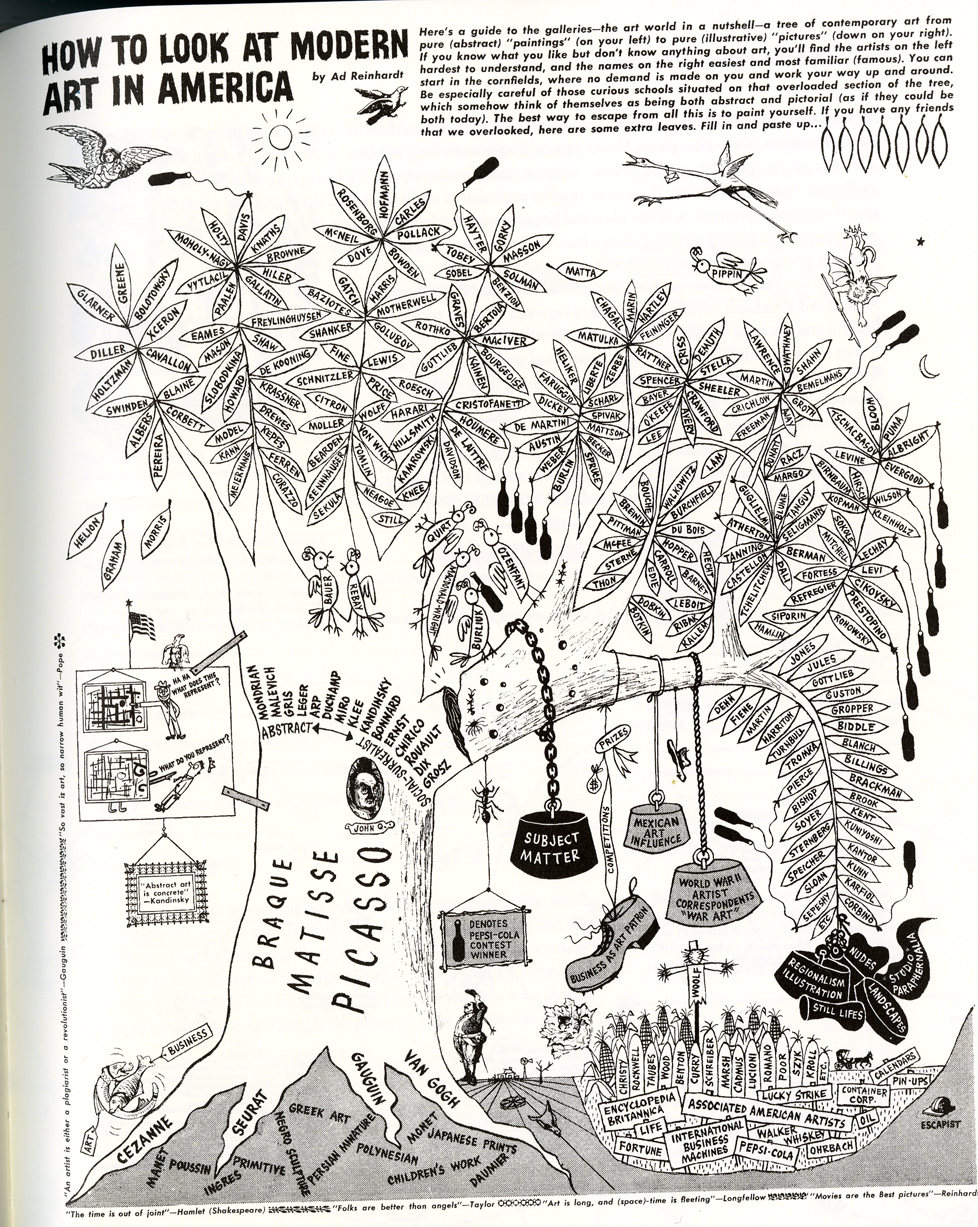
“In this famous cartoon of 1946 Ad Reinhardt tried to encapsulate the essence of the artistic modernism with its history and inherent conflicts within the American context. The tree of modern art has its roots deep in history – the Greeks are here, and so are Persian miniatures and Japanese prints. The roots represent the four pillars of Post-Impressionism: Vincent Van Gogh, George Seurat, Paul Cezanne, and Paul Gauguin. The tree is burdened by the weights of “subject matter” and “business as art patron,” and a cartoon within the cartoon mocks the perpetual debate of representation versus abstraction. By juxtaposing business and art, Reinhardt aptly comments on the situation of the avant-garde in the United States, where the public and, more importantly, the patrons were rather biased against the abstract art, often calling it “degenerate” and “subversive.””
— (via)
Naples Dioscurides

Beethoven opus 101 manuscript

— via Vruz
A page from the original handwritten and illustrated manuscript of Alice’s Adventures Under Ground by Lewis Carroll.

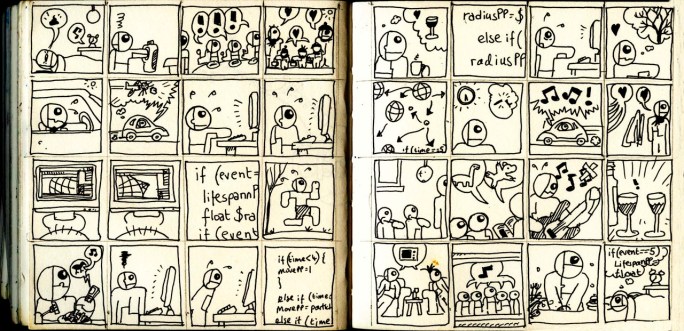
My Submission for Hourly Comics Day 2010
Dostoyevsky’s notes for chapter 5 of The Brothers Karamazov

heinrich-siegfried bormann – visual analysis of a piece of music from a color-theory class with vasily kandinsky – october 21, 1930

(via)
On Ditko and Abstraction

“The script is dominant, the story is what matters, images are subservient. This is what I would call–to borrow a term from deconstruction–the logocentric view of comics. “Logocentric” as centered upon the logos, which means not only “speech” or “discourse,” but also meaning, as in a verbalizable meaning.”

“Obviously, I’m a proponent of an anti-logocentric view of comics. Ditko and Kirby, in this view, only achieve their heights of artistry when they reverse that hierarchy, when the script becomes subservient to the art, rather than the reverse. Is this such a novel view of art? Not at all. As a matter of fact, the reversal has happened repeatedly in one of our most popular arts, or forms of entertainment, which most of the time is enjoyed precisely from this perspective: specifically, music.”
 Paul Greer