
Images
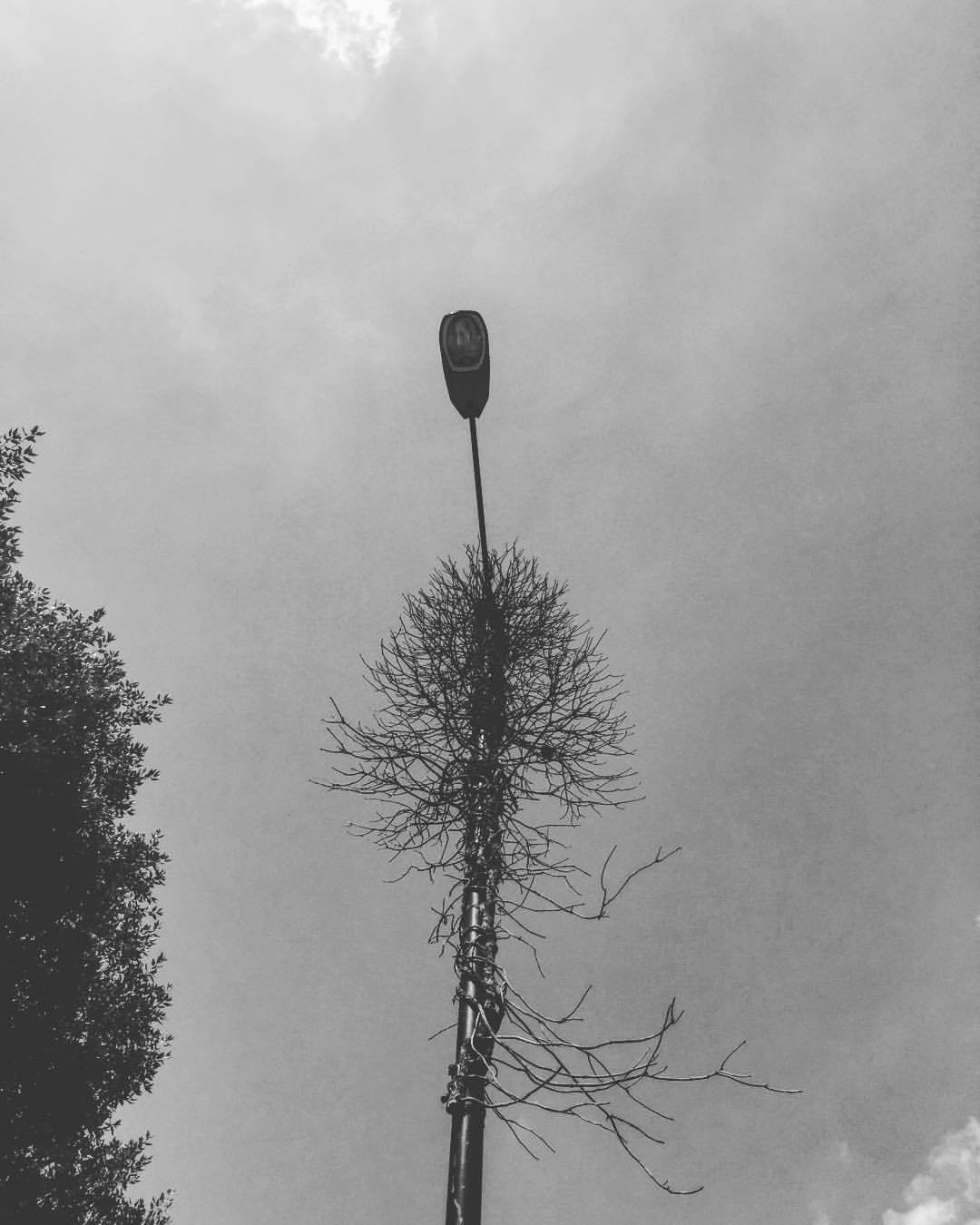
Is it a tree or is it a lamppost?
Girlfriend by Christine and The Queens – (feat. Dâm-Funk) (2018)
Venus, The Rose and the Heart

“Venus has an eight-year rhythm, which formed the subject of the world’s oldest astrological text, a Venus-tablet from Nineveh. It was part of a series called Enuma Anu Enlil, the ‘Book of the Gods of Heaven and Earth’, and was dated to the 17th century BC. It effectively recorded the five synodic periods of Venus, giving a series of ten omens over the eight-year cycle through the pattern of Venus’s appearance and disappearance from view.
“To the astronomer Johannes Kepler, the musical interval generated by Venus and Earth was a ‘sixth’, given by dividing a string in the fraction 5/8. He said the relation was a ‘marital’ one and varied between the ‘masculine sixth’ G# – E and the ‘feminine’ one of Gb – E. This ratio of 5 to 8 is the key to the pattern traced by Venus against the stars.
“Venus traces a pentagon shape in the sky over ten meetings with the Sun; it does this by moving, between each ‘inferior’ conjunction, exactly 1.6 times around the zodiac, and the time it takes to do this, 584 days, is its synodic period. The pentagon shape is traced around the zodiac in five such synodic periods, which is 7.993 years or 8 years to a fraction of a day. Venus returns to the same portion of the zodiac after ten solar conjunctions, over a period of exactly 8 years.
“The rotation rate of Venus on its own axis was not discovered until 1967 by means of radar. This was able to peer through the dense mists surrounding the planet, and find a rotation period of precisely two-thirds of an Earth-year, or 243 days. Strangely enough, it was in the opposite direction to its rotation around the Sun. This meant that, in an eight-year period, Venus revolves exactly twelve times on its own axis. The numbers 5, 8 and 12 are here interacting. “
Tonight’s sunset and what it did to the inside of the window fram

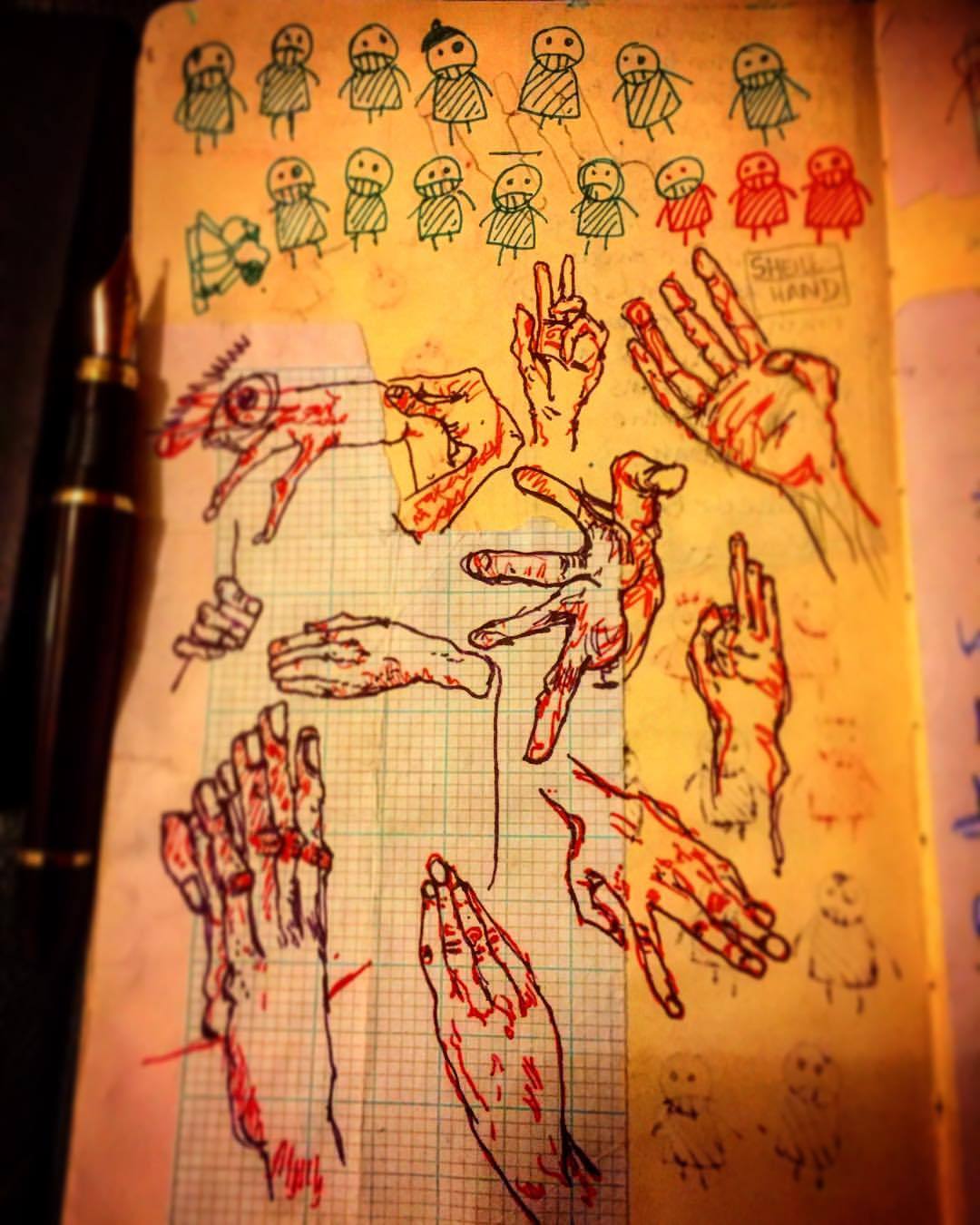
Out of practice so I practice drawing hands. After Shiele. Also some little men.
“Early Chinese hieroglyphics.” Mythical monsters. 1886.

via Nemfrog
Codex Mendoza (1542)

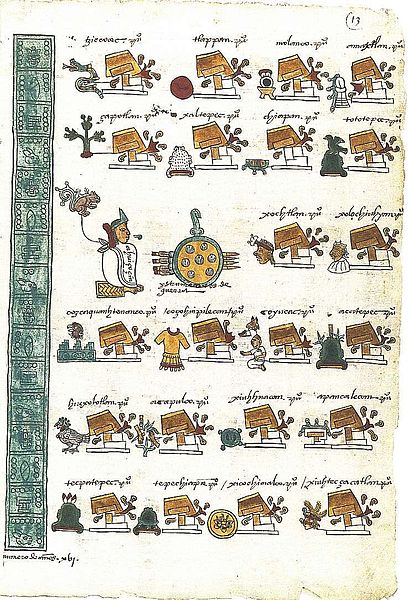

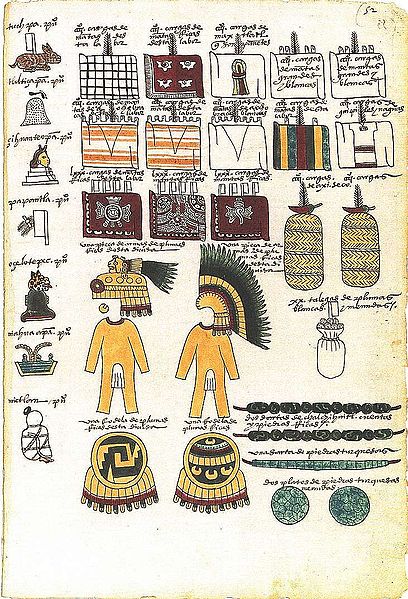


“The Codex Mendoza is an Aztec codex, created about twenty years after the Spanish conquest of Mexico with the intent that it be seen by Charles V, the Holy Roman Emperor and King of Spain. It contains a history of the Aztec rulers and their conquests, a list of the tribute paid by the conquered, and a description of daily Aztec life, in traditional Aztec pictograms with Spanish explanations and commentary. It is named after Antonio de Mendoza, then the viceroy of New Spain, who may have commissioned it. After creation in Mexico City, it was sent by ship to Spain. The fleet, however, was attacked by French privateers, and the codex, along with the rest of the booty, was taken to France. There it came into the possession of André Thévet, cosmographer to King Henry II of France. Thévet wrote his name in five places on the codex, twice with the date 1553. It was later bought by the Englishman Richard Hakluyt for 20 French francs. Some time after 1616 it was passed to Samuel Purchase, then to his son, and then to John Selden. The codex was deposited into the Bodleian Library at Oxford University in 1659, 5 years after Selden’s death, where it remained in obscurity until 1831, when it was rediscovered by Viscount Kingsborough and brought to the attention of scholars.”
from Wikipedia and ThePublicDomainReview
via Radimus

 Paul Greer