Bellicorum Instrumentorum Liber

The First Italian Technology Manuscript

A generation before the extraordinary machine drawings of Leonardo da Vinci, the first technology manuscript of the Italian Renaissance was produced by a Venetian scholar who had familiarised himself with the handful of books on the mechanical arts from the Greek and Arabic traditions.”

 The First Italian Technology Manuscript
The First Italian Technology Manuscript

Giovanni da Fontana (?1395-1455) obtained degrees in arts and medicine in Padua and was appointed physician to the Venetian army in Brescia. He had a wide range of interests and studied historical works on optics, astrology/alchemy (intrinsic medical studies back then), pneumatic and hydraulic mechanics, military machines and the art of memory.”

–from Bibliodyssey

‘Ezo-shi’ by Arai Hakuseki (1720)


'Ezo-shi' by Arai Hakuseki (1720)

The Ainu are generally considered to be the indigenous population of Japan. But, like all cultures on earth, the history of the Ainu is much more complex than any one label. The 20,000 to 60,000 people who presently identify themselves as Ainu are concentrated on Japan’s northern island of Hokkaido, but the Ainu culture once stretched up to the southern part of Sakhalin Island and the Kurile Islands (now part of Russia).”

from BibliOdyssey

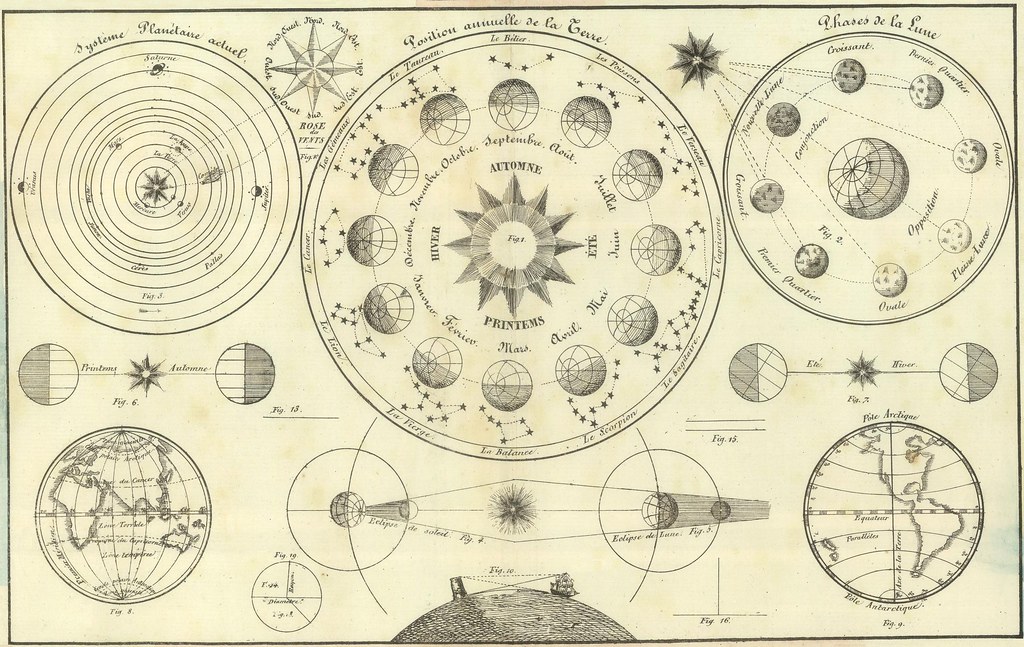
Tableau d’Astronomie et de Sphère

H'Atlas Universel d'Histoire et de Geographie Anciennes et Modernes, de Mythologie, des Religions, d'Astronomie, de Physique, de Geologie, de Histoire Naturelle, de Grammaire, de Rhetorique..' by Henri Duval, 1834; published in Paris by L Houbloup.
H’Atlas Universel d’Histoire et de Geographie Anciennes et Modernes, de Mythologie, des Religions, d’Astronomie, de Physique, de Geologie, de Histoire Naturelle, de Grammaire, de Rhetorique..’ by Henri Duval, 1834; published in Paris by L Houbloup.

'General Atlas Of The World: Containing Upwards Of Seventy Maps. Engraved On Steel, In The First Style Of Art, By Sidney Hall, William Hughes, F.R.G.S., &c. New Edition. Embracing All The Latest Discoveries Obtained From Government Surveys And Expeditions, Books Of Recent Travel, And Other Sources, Including The North-West Passage Discovered By H.M. Ship Investigator. With Introductory Chapters On The Geography And Statistics Of The Various Countries Of The World, And A Complete Index Of 65,000 Names' by Adam & Charles Black, Sidney Hall and William Hughes, 1854; published in Edinburgh by A & C Black.
‘General Atlas Of The World: Containing Upwards Of Seventy Maps. Engraved On Steel, In The First Style Of Art, By Sidney Hall, William Hughes, F.R.G.S., &c. New Edition. Embracing All The Latest Discoveries Obtained From Government Surveys And Expeditions, Books Of Recent Travel, And Other Sources, Including The North-West Passage Discovered By H.M. Ship Investigator. With Introductory Chapters On The Geography And Statistics Of The Various Countries Of The World, And A Complete Index Of 65,000 Names’ by Adam & Charles Black, Sidney Hall and William Hughes, 1854; published in Edinburgh by A & C Black.

A time table indicating the difference in time between the principal cities of the World and also showing their air-line distance from Washington. - 'Mitchell's New General Atlas, Containing Maps Of The Various Countries Of The World, Plans Of Cities, Etc., Embraced In Ninety-Three Quarto Maps, Forming A Series Of One Hundred and Forty-seven Maps and Plans, Together With Valuable Statistical Tables..' by Samuel Augustus Mitchell Jr, 1883; published in Philadelphia by WM Bradley.
A time table indicating the difference in time between the principal cities of the World and also showing their air-line distance from Washington. – ‘Mitchell’s New General Atlas, Containing Maps Of The Various Countries Of The World, Plans Of Cities, Etc., Embraced In Ninety-Three Quarto Maps, Forming A Series Of One Hundred and Forty-seven Maps and Plans, Together With Valuable Statistical Tables..’ by Samuel Augustus Mitchell Jr, 1883; published in Philadelphia by WM Bradley.

From BliOdyssey

Monomyth / Hero’s Journey

By scan from an unknown publication by an anonymous poster, in a thread, gave permission to use it. Re-drawn by User:Slashme - 4chan.org, thread about monomyths, AKA the hero's journey, Public Domain, https://commons.wikimedia.org/w/index.php?curid=10284342
By scan from an unknown publication by an anonymous poster, in a thread, gave permission to use it. Re-drawn by User:Slashme – 4chan.org, thread about monomyths, AKA the hero’s journey, Public Domain, https://commons.wikimedia.org/w/index.php?curid=10284342


“The study of hero myth narratives started in 1871 with anthropologist Edward Taylor’s observations of common patterns in plots of hero’s journeys. Later on, others introduced various theories on hero myth narratives such as Otto Rank and his Freudian psychoanalytic approach to myth, Lord Raglan’s unification of myth and rituals, and eventually hero myth pattern studies were popularized by Joseph Campbell, who was influenced by Carl Jung’s view of myth. In his 1949 work The Hero with a Thousand Faces, Campbell described the basic narrative pattern as follows:

‘A hero ventures forth from the world of common day into a region of supernatural wonder: fabulous forces are there encountered and a decisive victory is won: the hero comes back from this mysterious adventure with the power to bestow boons on his fellow man.'”

via

Dora Maar by Man Ray, 1936


"Dora

Henriette Theodora Markovitch (22 November 1907 – 16 July 1997), known as Dora Maar, was a French photographer, painter, and poet.”

Man Ray (born Emmanuel Radnitzky; August 27, 1890 – November 18, 1976) was an American visual artist who spent most of his career in France. He was a significant contributor to the Dada and Surrealist movements, although his ties to each were informal. He produced major works in a variety of media but considered himself a painter above all. He was best known for his photography, and he was a renowned fashion and portrait photographer. Man Ray is also noted for his work with photograms, which he called “rayographs” in reference to himself.”

the young women serious face, lit up by pale blue eyes which looked all the paler because of her thick eyebrows; a sensitive uneasy face, with light and shade passing alternately over it. She kept driving a small pointed pen-knife between her fingers into the wood of the table. Sometimes she missed and a drop of blood appeared between the roses embroidered on her black gloves… Picasso would ask Dora to give him the gloves and would lock them up in the showcase he kept for his mementos.”

Leabhar Bhaile an Mhóta 1390-1391

fol. 170r of the Book of Ballymote (AD 1390), part of the Auraicept na n-Éces, explaining the Ogham script. the page shows varianst of Ogham, nrs. 43 to 77 of 92 in total, including shield ogham (nr. 73). image via Ancient History Encyclopedia


The Book of Ballymote was compiled towards the end of the 14th century at the castle of Ballymote for Tonnaltagh McDonagh, who was then in occupation of the castle. The chief compiler was Manus O’Duignan, one of a family who were ollavs and scribes to the McDonagh and the McDermots. Other scribes of the book were Solomon O’Droma, a member of a famous Co. Fermanagh family, and a Robert McSheedy. The book is a compilation of older works, mostly loose manuscripts and valuable documents handed down from antiquity that came into possession of McDonagh.”