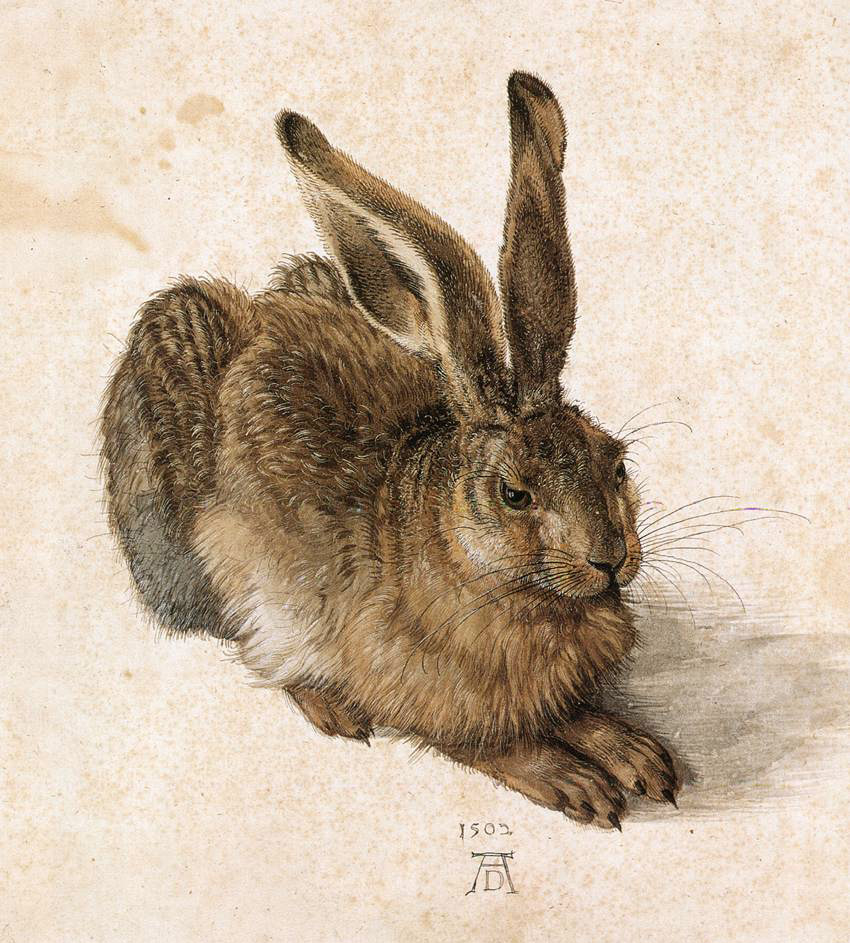
“There is some debate over how Dürer accurately captured the image of the hare: he may have sketched a hare in the wild and filled in the individual details from a dead animal, or captured one and held it alive in his studio while he worked on the painting. A reflection of the window frame in the hare’s eye is often cited as evidence for the theory that Dürer copied the hare from life in his workshop, but this cross-barred reflection is a technique that Dürer frequently used to add vitality to the eyes of his subjects.”
…performs an encyclopedic function, bringing together and organizing in a visual compendium a wealth of accumulated geographical knowledge from the Bible, Greek legends, Alexandrian adventure tales, and ancient cosmographies.
Nude Descending a Staircase, No.2, 1912, oil/canvas, 58×35” (147.3 x 88.9 cm), Philadelphia Museum of Art.
“Duchamp submitted the work to appear with the Cubists at the 28th exhibition of the Société des Artistes Indépendants, Paris, 25 March through 16 May 1912. It appeared under the number 1001 of the catalogue, entitled simply Nu descendant l’escalier, not Nu descendant un escalier n° 2. This catalogue revealed the title of the painting to the general public for the first time, even though the painting itself would be absent from the exhibition. It has been noted disquisitively that the number 1001 of Duchamp’s entry at the 1912 Indépendants catalogue also happens to represent in the form 10.01 the integer 2 in the Golden ratio base, related to the golden section, something of much interest to the Duchamps and others of the Puteaux Group. This, of course, was by chance—and it is not known whether Duchamp was familiar enough with the mathematics of the golden ratio to have made such a connection—as it was by chance too the relation to Arabic Manuscript of One Thousand and One Nights dating back to the 14th century.”
Marey- Man walking, 1890–91
“The painting combines elements of both the Cubist and Futurist movements. In the composition, Duchamp depicts motion by successive superimposed images, similar to stroboscopic motion photography. Duchamp also recognized the influence of the stop-motion photography of Étienne-Jules Marey, particularly Muybridge’s Woman Walking Downstairs from his 1887 picture series, published as The Human Figure in Motion.”
Frans Masereel (1919) Passionate Journey—arriving on the train
“Passionate Journey, or My Book of Hours (French: Mon livre d’heures), is a wordless novel of 1919 by Flemish artist Frans Masereel. The story is told in 167 captionless prints, and is the longest and best-selling of the wordless novels Masereel made. It tells of the experiences of an early 20th-century everyman in a modern city.”
Mon livre d’heures – three panels
Masereel’s medium is the woodcut, and the images are in an emotional, allegorical style inspired by Expressionism. The book followed Masereel’s first wordless novel, 25 Images of a Man’s Passion (1918); both were published in Switzerland, where Masereel spent much of World War I. German publisher Kurt Wolff released an inexpensive “people’s edition” of the book in Germany with an introduction by German novelist Thomas Mann, and the book went on to sell over 100,000 copies in Europe. Its success encouraged other publishers to print wordless novels, and the genre flourished in the interwar years.
“The story follows the life of a prototypical early 20th-century everyman after he enters a city. It is by turns comic and tragic: the man is rejected by a prostitute with whom he has fallen in love. He also takes trips to different locales around the world. In the end, the man leaves the city for the woods, raises his arms in praise of nature, and dies. His spirit rises from him, stomps on the heart of his dead body, and waves to the reader as it sets off across the universe.”
“Look at these powerful black-and-white figures, their features etched in light and shadow. You will be captivated from beginning to end: from the first pictured showing the train plunging through the dense smoke and bearing the hero toward life, to the very last picture showing the skeleton-faced figure among the stars. Has not this passionate journey had an incomparably deeper and purer impact on you than you have ever felt before?”
“The phrase prepared piano is also sometimes applied to other kinds of preparations. Lou Harrison, for example, used something he called the tack piano, a piano with small nails stuck in the hammers to produce a more percussive sound. Conlon Nancarrow adapted his player pianos in a similar way, covering the hammers with metal and leather.”
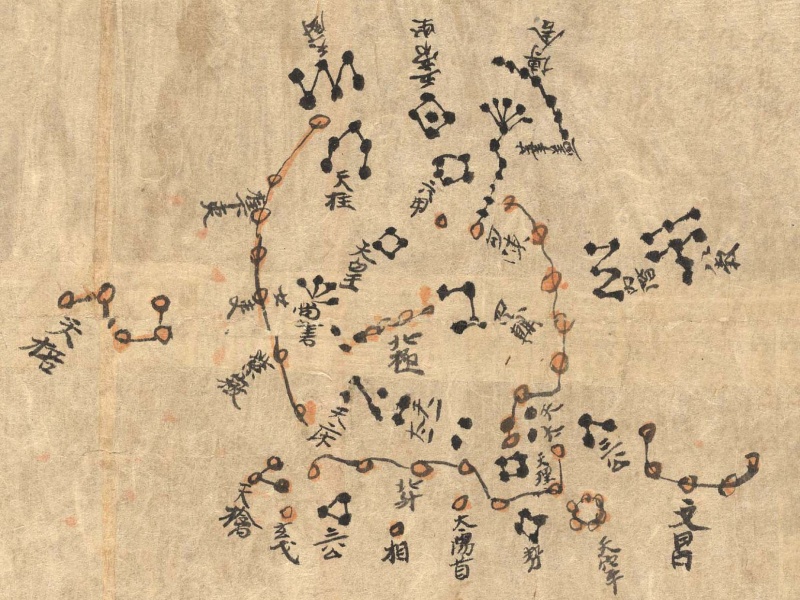
“This ancient Chinese map of planet Earth’s northern sky is part of the Dunhuang Star Atlas, one of the most impressive documents in the history of astronomy. The oldest complete star atlas known, it dates to the years 649 to 684, discovered at the Silk Road town of Dunhuang in 1907. A recent analysis that examines the accuracy and projections used to make it notes the atlas marks positions of over 1,300 stars and outlines 257 Chinese star groups or asterisms. The star positions in the hand drawn atlas were found to be accurate to within a few degrees. In this example showing the north polar region, a very recognizable Big Dipper, part of the modern constellation Ursa Major, lies along the bottom of the chart. An additional 12 charts depicting equatorial regions in 30 degree sections also includes a group resembling the modern constellation Orion. The atlas is on display at the British Library in London to celebrate the International Year of Astronomy.”
/ Autograph manuscript definition of futurism and related movements, with corrections, diagrams, and drawings, undated. From the Filippo Tommaso Marinetti Papers


_Passionate_Journey_urination_page.jpg)
_Passionate_Journey%E2%80%94final_panel.jpg)



 Paul Greer