
Images
City of Shadows by Alexi Titarenko
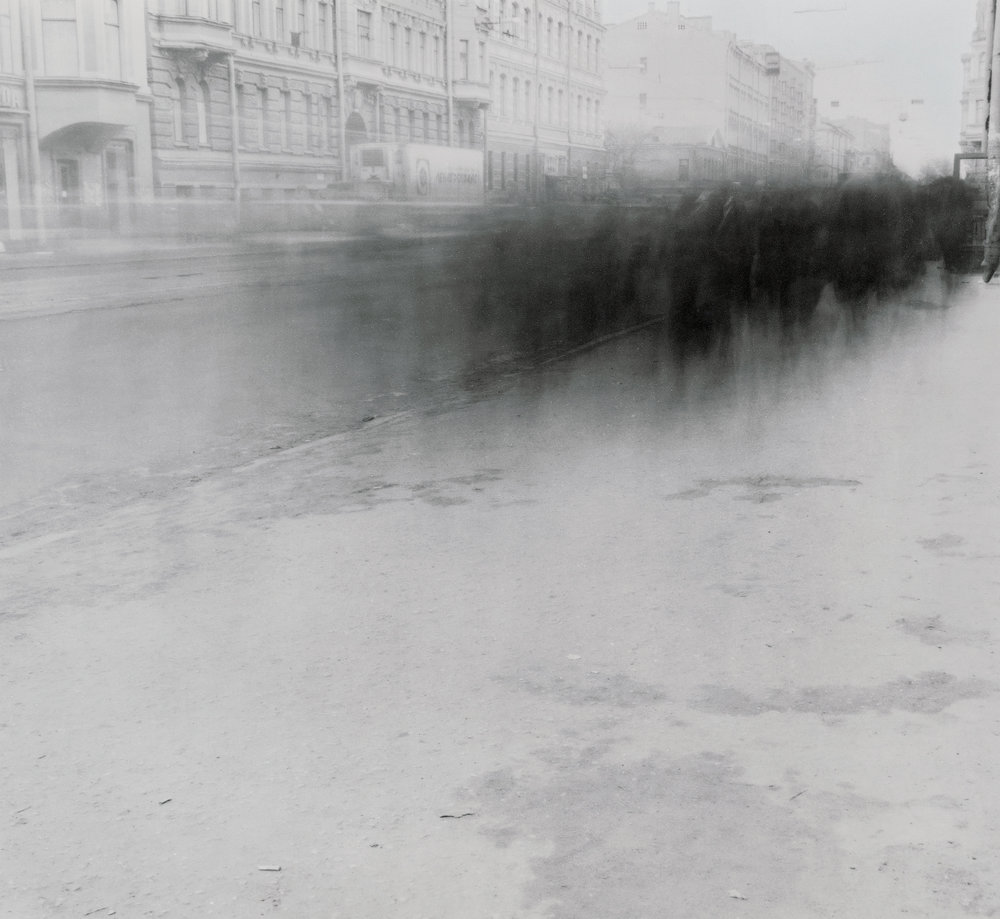
“Titarenko’s prints are subtly crafted in the darkroom. Bleaching and toning add depth to his nuanced palette of grays, rendering each print a unique interpretation of his experience and imbuing his work with a personal and emotive visual character. “
“L’Inquietude” by Man Ray (1890-1976)

“One of Man Ray’s guiding principles was “to do the things that one is not supposed to do,” and here it seems he has used the camera to make a picture of something intangible, an emotion. Man Ray explored photography’s potential in the realm of abstraction, photographing a cloud of smoke gathering around a found-object sculpture in his New York studio. By manipulating his camera, he blurred the subject beyond recognition and created a sense of velocity and disequilibrium. The enigmatic title denies the existence of a recognizable subject in the photograph. Unknown to the viewer is the fact that Anxiety (L’Inquietude) is the name of the sculpture in the photograph, making this a craftily anti-documentary document of the three-dimensional piece.”
by Linda Vachon
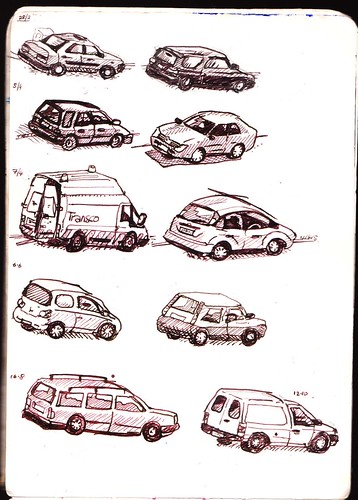
Cars

Karoo Ashevak

Karoo Ashevak, (Fantasy) Figure with Birds, 1972
Karoo Ashevak (1940 – October 19, 1974) was an Inuit sculptor who lived a nomadic hunting life in the Kitimeot, central Arctic region before moving into Spence Bay in 1960. His career as an artist started in 1968 by participating in a government-funded carving program. Working with the primary medium of fossilized whalebone, Ashevak created approximately 250 sculptures in his lifetime, and explored themes of shamanism and Inuit spirituality through playful depictions of human figures, shamans, spirits, and arctic wildlife
Newton’s colour circle
“In a mixture of primary colours, the quantity and quality of each being given, to know the colour of the compound.”

from wiki – Throughout Opticks, Newton compared colours in the spectrum to a run of musical notes. To this purpose, he used a Dorian mode, similar to a white-note scale on the piano, starting at D. He divided his colour wheel in musical proportions round the circumference, in the arcs from DE to CD. Each segment was given a spectral colour, starting from red at DE, through orange, yellow, green, blew [sic], indigo, to violet in CD. (The colours are commonly known as ROY G BIV.)
The middle of the colours—their ‘centres of gravity’—are shown by p, q, r, s, t, u, and x. The centre of the circle, at O, was presumed to be white. Newton went on to describe how a non-spectral colour, such as z, could be described by its distance from O and the corresponding spectral colour, Y.
[dragons]
![[dragons]](https://78.media.tumblr.com/ZS10409bwmolxrjj82McK74fo1_540.jpg)
Johannes Ionstonus. Historiæ Natura. Francofurti : Hæredum Merianoru, 1755. Page 0.52, Plate 10
 Paul Greer