Hokusai Manga (early 19th century)


Hokusai

“The Hokusai Manga (北斎漫画, “Hokusai’s Sketches”) is a collection of sketches of various subjects by the Japanese artist Hokusai. Subjects of the sketches include landscapes, flora and fauna, everyday life and the supernatural. The word manga in the title does not refer to the contemporary story-telling manga, as the sketches in the work are not connected to each other. Block-printed in three colours (black, gray and pale flesh), the Manga comprise literally thousands of images in 15 volumes, the first published in 1814, when the artist was 55. The final three volumes were published posthumously, two of them assembled by their publisher from previously unpublished material. The final volume was made up of previously published works, some not even by Hokusai, and is not considered authentic by art historians.”


Hokusai

“The first volume of ‘Manga‘ (Defined by Hokusai as ‘Brush gone wild’), was an art instruction book published to aid his troubled finances. Shortly after he removed the text and republished it.The Manga evidence a dedication to artistic realism in portrayal of people and the natural world. The work was an immediate success, and the subsequent volumes soon followed. The work became known to the West since Philipp Franz von Siebold’s lithographed paraphrases of some of the sketches appeared in his Nippon: Archiv Zur Beschreibung von Japon in 1831. The work began to circulate in the West soon after Matthew C. Perry’s entry into Japan in 1854.”

The Notebook of William Blake

Copyright © The British Library Board

Copyright © The British Library Board

N50
“This folio is one of the most closely filled in the notebook. In the centre, we see a naked figure of a man, on the point of stabbing himself with a dagger held in his right hand. In a later emblem in the notebook, Blake suggests that those who take their own lives cannot go to heaven, yet here the man is turning his face towards heaven with a hopeful – and possibly ironic – gaze.”

Copyright © The British Library Board

N99 & N98
“We see workings here of several poems for which the notebook has been rotated to enter fair copies of poems. We see workings here of several poems, including ‘Several Questions Answerd’ in the top left, with lines salvaged from previous drafts in the notebook (see N103). To the right of this poem, ‘Let the Brothels of Paris be opened’ is a strongly felt criticism of the overindulgent French monarchy. The poet’s attack on Marie Antoinette in the final stanza (‘The Queen of France just touchd this Globe And the Pestilence darted from her robe’) distorts Edmund Burke’s romantic description of the French Queen and Court in his Reflections on the Revolution in France (1790): ‘surely never lighted on this orb, which she hardly seemed to touch, a more delightful vision.'”

Copyright © The British Library Board

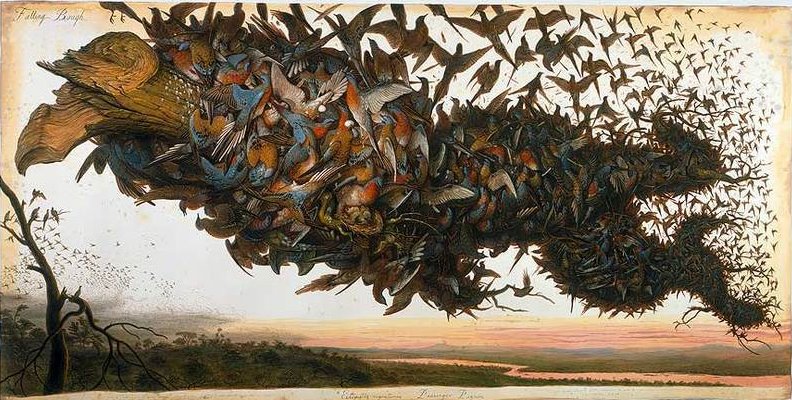
Walton Ford


audobon

‘An enthusiast of the watercolors of Audubon, Ford celebrates the myth surrounding the renowned naturalist-painter while simultaneously repositioning him as an infamous anti-hero who, in reality, killed more animals than he ever painted. Each of Ford’s animal portraits doubles as a complex, symbolic system, which the artist layers with clues, jokes, and erudite lessons in colonial literature and folktales.’

  — via Ingoing

“Madame X” by John Singer Sargent

“The model was an American expatriate, ((a young socialite named Virginie Amélie Avegno Gautreau)) who married a French banker, and became notorious in Parisian high society for her beauty and rumored infidelities. She wore lavender powder and prided herself on her appearance. The English-language term “professional beauty” was used to refer to her and to a woman in general who uses personal skills to advance herself socially.[4] Her unconventional beauty made her an object of fascination for artists; the American painter Edward Simmons claimed that he “could not stop stalking her as one does a deer.” Sargent was also impressed, and anticipated that a portrait of Gautreau would garner much attention at the upcoming Paris Salon, and increase interest in portrait commissions.”


Madame X

“While the work was in progress, Gautreau was enthusiastic; she believed that Sargent was painting a masterpiece. When the painting first appeared at the Paris Salon under the title Portrait de Mme *** in 1884, people were shocked and scandalized; the attempt to preserve the subject’s anonymity was unsuccessful, and the sitter’s mother requested that Sargent withdraw the painting from the exhibition. Sargent refused, saying he had painted her “exactly as she was dressed, that nothing could be said of the canvas worse than had been said in print of her appearance”. Later, Sargent overpainted the shoulder strap to raise it up and make it look more securely fastened. He also changed the title, from the original Portrait de Mme ***, to Madame X – a name more assertive, dramatic and mysterious, and, by accenting the impersonal, giving the illusion of the woman archetype.The poor public and critical reception was a disappointment to both artist and model. Gautreau was humiliated by the affair, and Sargent would soon leave Paris and move to London permanently.”