Eldest daughter’s portrait of William Golding is featured on the Nailsea School Twitter account.
Links
Norman Mailer’s 1191-Page Harlot’s Ghost Outlined in One Handwritten Sheet

The Books of Charles Dellshau

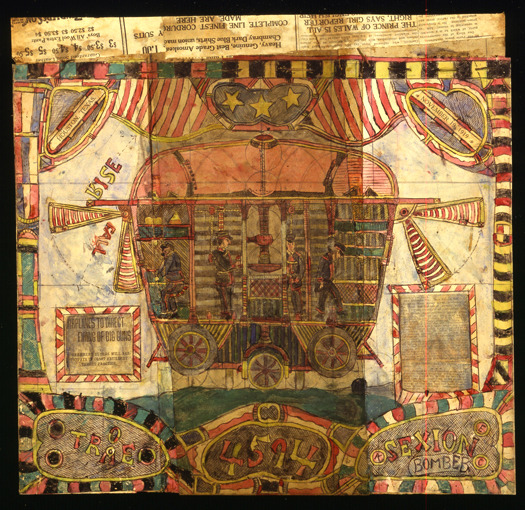
“In 1969, used furniture dealer Fred Washington bought 12 large discarded notebooks from a garbage collector, where they found a new home in his warehouse under a pile of dusty carpets. In 1969, art history student, Mary Jane Victor, was scouring through his bazaar of castaways when she came upon the mysterious works of a certain Charles Dellschau.”
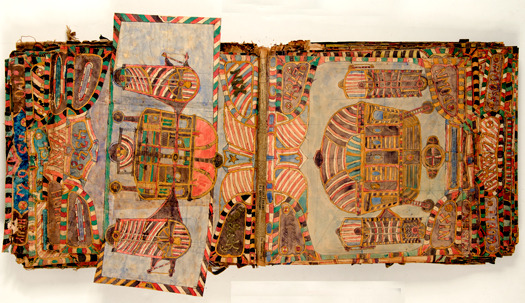
“He had arrived in the United States at 25 years old from Hamburg in 1853 and documents show he lived in both California and Texas with his family, working as a butcher. After his retirement in 1899, he took to filling his days by filling notebooks with a visual journal of his youth. He called the first three books, Recollections and recounts a secret society of flight enthusiasts which met in California in the mid-19th century called the ‘Sonora Aero Club’.”
There’s more on the story and other incredible images at Messy Nessy, please take a look.
via SigerGallery
SouthBank Arts Trail 2017

This year I will be participating in the Bristol SouthBank Arts Trail, taking place from the 13th – 14th May 1017. I’ll be sharing a venue with Orla Handley and The Secret Stuff Laboratory.
You can see a full list of artists on the trail here.
Hopefully see you there.
(image by Paul from Plaster)
The Secrets Of Your Food
At BDH we made some pretty delicious graphics for this series on the chemistry of food.

Michael Mosley and James Wong reveal the physics, chemistry and biology hidden inside our food. They travel the world in a culinary adventure to search for the origins of our favourite foods and using specialist photography and CGI, they take us on a journey inside the most sumptuous food, right down to the molecular level.
You can see a promo here featuring some of the work we did.
Watch out for the tongue and tastebud sequences ;-).
9pm Friday 24th February (This evening) BBC2.
“Steve Lacy wrote down a list of advice from jazz pianist Thelonious Monk”

via Kottke
The Idea—the Origin of Everything 1979
From Hayao Miyazaki:
“From within the confusion of your mind, you start to capture the hazy figure of what you want to express. And then you start to draw. It doesn’t matter if the story isn’t yet complete. The story will follow. Later still the characters take shape. You draw a picture that establishes the underlying tone for a specific world. Of course, what you have drawn will not be your final product. At times, your work may be rejected entirely. When I mentioned earlier that you must have the will to go to any length, this is what I meant. When you draw that first picture, it is only the beginning of an immense journey. This is the start of the preparation stage of the film.”
It’s worth reading here.
“Draw many pictures, as many as you can. Eventually a world is created. To create one world means to discard other inconsistent or clashing worlds. If something is very important to you, you can keep it carefully stored in your heart for use at another time. Those who have experienced an outpouring of an amazing number of pictures from inside themselves can feel it. They feel that the fragment of a picture they envisioned, the other trunk of a story that was thrown out while piecing together a narrative, the memory of pining for a girl, the knowledge about a subject gained as they delved deeply into a hobby – all of these play a role and become entwined into one thick strand. The scattered material within you has found its direction and started to flow.”
How to compose a successful critical commentary
-
You should attempt to re-express your target’s position so clearly, vividly, and fairly that your target says, “Thanks, I wish I’d thought of putting it that way.
-
You should list any points of agreement (especially if they are not matters of general or widespread agreement).
-
You should mention anything you have learned from your target.
-
Only then are you permitted to say so much as a word of rebuttal or criticism.
Val Telberg

Born in Moscow, Val Telberg lived in China, Japan, and Korea during his youth. He studied painting at the Art Student’s League, New York, in 1942, where he was exposed to the surrealism movement and experimental filmmaking. To support his painting, Telberg traveled from Florida to Massachusettes, printing photographs of nightclub patrons and working at photographic concession stands where people posed with cutouts of celebrities. In 1945, he returned to New York and produced narrative, surrealist photographs using sandwiched, bleached or burned negatives and double exposure within the camera. His later work evolved to large scale, scroll-like multiple images.

Around that time, Mr. Telberg began experimenting with the multiple-image photographic technique for which he became known. His photomontages, which sometimes were mural-size, consisted of layered images of figures in motion and had a dreamlike weightlessness associated with Surrealism. He had his first major show at the Brooklyn Museum in 1948. In the mid-1950’s he collaborated with Nin, creating images for the 1958 edition of her book “The House of Incest.”
– NYT

In 1942 he began to study painting at the Art Students League in New York City; there he met Kathleen Lambing, who taught him photography and whom he married in 1944. His first professional photographic experience came that year, when he was employed as a nightclub photographer in Florida and later at a portrait concession in Fall River, Massachusetts. In 1948 he returned to New York and did freelance photography. In addition to his commercial endeavors, Telberg did his own work, much of which involved experimental printing from multiple negatives.
–ICP

via of-saudade
 Paul Greer
