No writing is wasted.

“No writing is wasted. Did you know that sourdough from San Francisco is leavened partly by a bacteria called lactobacillus sanfrancisensis? It is native to the soil there, and does not do well elsewhere. But any kitchen can become an ecosystem. If you bake a lot, your kitchen will become a happy home to wild yeasts, and all your bread will taste better. Even a failed loaf is not wasted. Likewise, cheese makers wash the dairy floor with whey. Tomato gardeners compost with rotten tomatoes. No writing is wasted: the words you can’t put in your book can wash the floor, live in the soil, lurk around in the air. They will make the next words better.”

Erin Bow

Vladimir Nabokov on What Makes a Good Reader

Nabokov offers the following exercise, which he posed to students at a “remote provincial college” while on an extended lecture tour: Select four answers to the question what should a reader be to be a good reader:

  1. The reader should belong to a book club.
  2. The reader should identify himself or herself with the hero or heroine.
  3. The reader should concentrate on the social-economic angle.
  4. The reader should prefer a story with action and dialogue to one with none.
  5. The reader should have seen the book in a movie.
  6. The reader should be a budding author.
  7. The reader should have imagination.
  8. The reader should have memory.
  9. The reader should have a dictionary.
  10. The reader should have some artistic sense.

The students leaned heavily on emotional identification, action, and the social-economic or historical angle. Of course, as you have guessed, the good reader is one who has imagination, memory, a dictionary, and some artistic sense–which sense I propose to develop in myself and in others whenever I have the chance. via brainpickings

This was originally a bad clipping and has since been ammended, please see apology here.

Ancient Egyptian music notation


Ancient Egyptian music notation

“From a set of 6 parchments described by German musicologist Hans Hickmann in his 1956 book Musicologie Pharaonique, or Music under the Pharaohs, as dating from the 5th to 7th centuries C.E. Colors are presumed to indicate pitch and size to indicate duration. Writings on the parchment are in Coptic with indications like “Spiritual Harmony” and “Holy Hymn Singer”. This manuscript had a profound influence on Egyptian composer Halim El-Dabh’s music notation and paintings when he discovered a reproduction in Vogue magazine in 1952.

Note: I wasn’t able to locate these manuscripts and couldn’t find any reference to them online, but they are presumably in NY’s Metropolitan Museum collections. This image comes from Theresa Sauer’s book Notations 21, Mark Batty Publisher, USA, 2009.”

reblogged from continuo-docs

monsieur rené magritte, interview

via thenearsightedmonkey

Beinvenue yourself on down the rickety stairs to the Near Sighted Monkey Lounge where we are watching a film interview in French. It doesn’t matter if you understand it or not because no matter what it sounds good playing in the background and it features Monsieur Magritte speaking about mystery:

“Everything we see hides another thing, we always want to see what is hidden by what we see. There is an interest in that which is hidden and which the visible does not show us. This interest can take the form of a quite intense feeling, a sort of conflict, one might say, between the visible that is hidden and the visible that is present.”

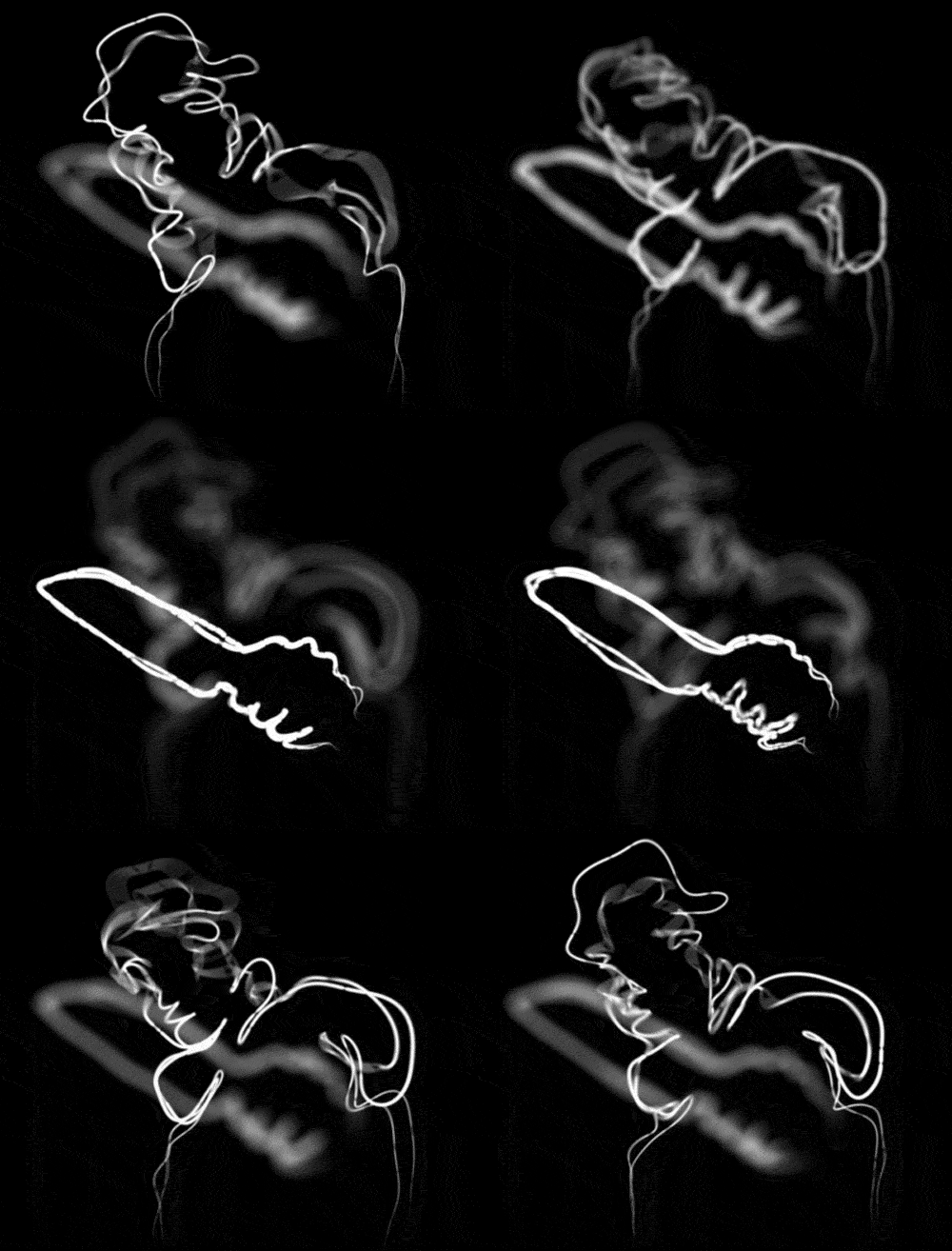
Drawing of GDSP10 by MortalCompass

I gave the prompt for the Guest Directed Self Portrait number 10.

I took it upon myself to draw the results.

This is my drawing of MortalCompass’ contribution.

(T)

see also: