- Scribbled secret notebooks, and wild typewritten pages, for yr own joy
- Submissive to everything, open, listening
- Try never get drunk outside yr own house
- Be in love with yr life
- Something that you feel will find its own form
- Be crazy dumbsaint of the mind
- Blow as deep as you want to blow
- Write what you want bottomless from bottom of the mind
- The unspeakable visions of the individual
- No time for poetry but exactly what is
- Visionary tics shivering in the chest
- In tranced fixation dreaming upon object before you
- Remove literary, grammatical and syntactical inhibition
- Like Proust be an old teahead of time
- Telling the true story of the world in interior monolog
- The jewel center of interest is the eye within the eye
- Write in recollection and amazement for yourself
- Work from pithy middle eye out, swimming in language sea
- Accept loss forever
- Believe in the holy contour of life
- Struggle to sketch the flow that already exists intact in mind
- Dont think of words when you stop but to see picture better
- Keep track of every day the date emblazoned in yr morning
- No fear or shame in the dignity of yr experience, language & knowledge
- Write for the world to read and see yr exact pictures of it
- Bookmovie is the movie in words, the visual American form
- In praise of Character in the Bleak inhuman Loneliness
- Composing wild, undisciplined, pure, coming in from under, crazier the better
- You’re a Genius all the time
- Writer-Director of Earthly movies Sponsored & Angeled in Heaven”
Author: Paul Greer
The Comic Strip Art of Lyonel Feininger

Of all the “Masters of American Comics”, Lyonel Feininger is clearly the least well known. Who is this artist placed between Winsor McCay and George Herriman? He’s best known as a “fine” artist, having taught at the famous Bauhaus school.
Study for Metastaseis, c. 1953.

“Metastaseis was inspired by the combination of an Einsteinian view of time and Xenakis’ memory of the sounds of warfare, and structured on mathematical ideas by Le Corbusier. Music usually consists of a set of sounds ordered in time; music played backwards is hardly recognizable. Messiaen’s similar observations led to his noted uses of non-retrogradable rhythms; Xenakis wished to reconcile the linear perception of music with a relativistic view of time. In warfare, as Xenakis knew it through his musical ear, no individual bullet being fired could be distinguished among the cacophony, but taken as a whole the sound of “gunfire” was clearly identifiable. The particular sequence of shots was unimportant: the individual guns could have fired in a completely different pattern from the way they actually did, but the sound produced would still have been the same. These ideas combined to form the basis of Metastaseis.”
(via)
Walton Ford
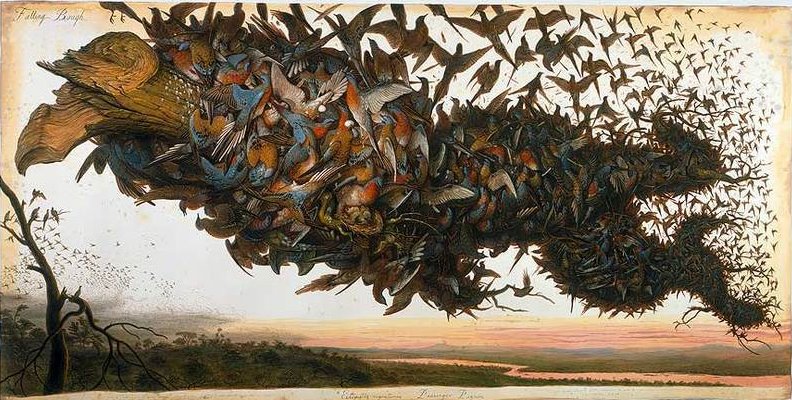
‘An enthusiast of the watercolors of Audubon, Ford celebrates the myth surrounding the renowned naturalist-painter while simultaneously repositioning him as an infamous anti-hero who, in reality, killed more animals than he ever painted. Each of Ford’s animal portraits doubles as a complex, symbolic system, which the artist layers with clues, jokes, and erudite lessons in colonial literature and folktales.’
— via Ingoing
The Ripley Scroll

Image from Wiki
More info from Peacay:
“The remarkable Ripley Scroll is, in simple terms, an alchemical manuscript that shows in pictorial cryptograms the production of the philosopher’s stone (the elusive ingredient that produces incorruptible gold out of lesser metals; and/or the elixir of life).”
connect the pieces
“Folk songs were the way I explored the universe. They were pictures, and the pictures were worth more than anything I could say. I knew the inner substance of the thing. I could easily connect the pieces. Most of the other performers tried to put themselves across, rather than the song. But I didn’t care about doing that. With me it was about putting the song across.”
– Bob Dylan (Chronicles (Volume One))
Half Solarized Face. E. Blumenfeld

Frank Zappa Explains Why Cartoons Today Suck
“Want to understand why entertaining cartoons are all but impossible to produce nowadays? You can have the answer in just two short minutes by watching the first part of this interview with Frank Zappa. Though Zappa is explaining the decline of the music business, everything he says is applicable to the animation world as well.”
(via CartoonBrew)
“Madame X” by John Singer Sargent
“The model was an American expatriate, ((a young socialite named Virginie Amélie Avegno Gautreau)) who married a French banker, and became notorious in Parisian high society for her beauty and rumored infidelities. She wore lavender powder and prided herself on her appearance. The English-language term “professional beauty” was used to refer to her and to a woman in general who uses personal skills to advance herself socially.[4] Her unconventional beauty made her an object of fascination for artists; the American painter Edward Simmons claimed that he “could not stop stalking her as one does a deer.” Sargent was also impressed, and anticipated that a portrait of Gautreau would garner much attention at the upcoming Paris Salon, and increase interest in portrait commissions.”

“While the work was in progress, Gautreau was enthusiastic; she believed that Sargent was painting a masterpiece. When the painting first appeared at the Paris Salon under the title Portrait de Mme *** in 1884, people were shocked and scandalized; the attempt to preserve the subject’s anonymity was unsuccessful, and the sitter’s mother requested that Sargent withdraw the painting from the exhibition. Sargent refused, saying he had painted her “exactly as she was dressed, that nothing could be said of the canvas worse than had been said in print of her appearance”. Later, Sargent overpainted the shoulder strap to raise it up and make it look more securely fastened. He also changed the title, from the original Portrait de Mme ***, to Madame X – a name more assertive, dramatic and mysterious, and, by accenting the impersonal, giving the illusion of the woman archetype.The poor public and critical reception was a disappointment to both artist and model. Gautreau was humiliated by the affair, and Sargent would soon leave Paris and move to London permanently.”

