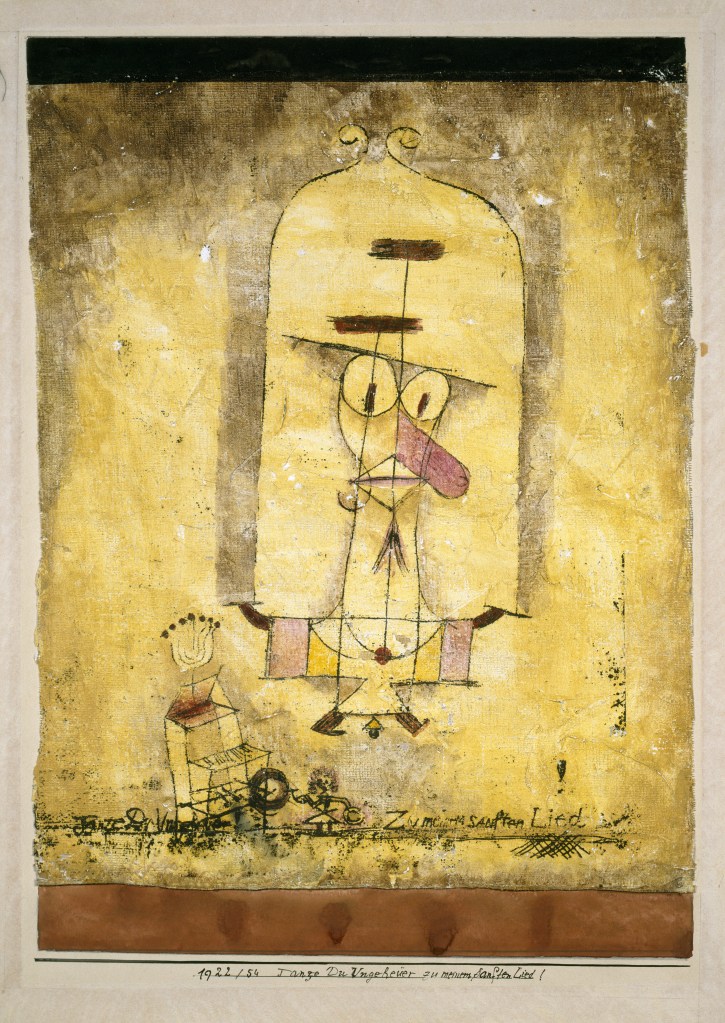
Paul Klee -Dance You Monster to My Soft Song! (Tanze Du Ungeheuer zu meinem sanften Lied!) 1922
Medium: Watercolor and oil transfer drawing on plaster-primed gauze, with watercolor and ink on paperboard mount Dimensions: gauze: approximately 13 7/8 x 11 1/2 inches (35.2 x 29.2 cm); mount: 17 6/8 x 12 7/8 inches (44.9 x 32.6 cm)
“The most valuable thing to me in terms of my mental health is to read a poem or see a painting or listen to music which speaks to me, which breaks me open for a moment, and where I feel an experience honestly and delicately portrayed. That’s another reason AI can never create anything artistically. It can trick us into thinking it has, but it doesn’t have the experience of being alive. It doesn’t know loss and joy and love and what it feels like to face mortality.I’m very worried about the future in so many ways, and if we don’t allow ourselves to connect with other humans who have the experiences that we have, then I think we’re lost.”
Beautiful, terrible, rebellious, dreamlike. A lovely collection of short stories vary from the good to the very excellent. Recommended if you like your realism magical.
I found this quote by the author in a recent interview:
“Some people would argue that writing stories about rebellious people is not actually an act of rebellion, but I believe those people underestimate the extent to which we internalize a story that really moves us. In the introduction to her novel The Rending and the Nest (Bloomsbury, 2018) Kaethe Schwehn writes, “The most dangerous thing of all is the absence of a story, a narrative to explain what is happening to you … Because someone will always arrive to invent one. Then you will be at the whim of someone else’s story…” I absolutely agree with that, and I think there’s a lot of hope to be found in reading stories where you see people fight back against injustice and ugliness.”
..and on endings:
“My endings definitely evolve as I write the story. They are almost always the last thing I write, and it’s not at all uncommon for me to write three or four different endings before I find one that I’m satisfied with (to say nothing of the additional revisions where I fiddle with the ending to try to get the pacing and the cadence and the final note just right). I have heard some great writers say they always or often write their endings first, or at least know what the ending is going to be when they start out, but I am almost never in that position.”
Didn’t quite hit me as hard as it did when I was fifteen (understandable?). But still illuminating and great. Get a real sense of his working process, especially after that bit in On Writing when he talks about the block and how he came through it.
Yorgos Lanthimos’ “The Favourite” was definitely my favourite from the recent awards season’s batch of films.
I truly had never seen a film like it, all the performances were incredible, the story was amazing, the cinematography, Olivia Coleman, everything.
I just listened to Lanthimos’ interview on Marc Marin’a podcast. He has this today about watching Tarkovsky:
“During the summer in Greece there’s a lot of open air cinemas, beautiful open air cinemas in a lot of neighbourhoods. You have a little table outside surrounded by apartment buildings, and you watch films.
So they would do retrospectives of his <Tarkovsky> films and John Cassevetes.
It was the first time seeing a different medium, seeing something new, like how an image can affect you in a different way, it doesn’t have to be a fast narrative, how poetic it can be, and how you can lose yourself in it, engage, but with your own personality. There’s an openness to it, you can bring your own stuff, and see things and understand things, maybe in a different way from how the person sitting next to you is experiencing the same thing at the same time.
…
It feels realistic but transcends that and you enter a different space. “



 Paul Greer