MAPPING
Narrative method, mythical shapes, hysterical realism, literary maximalism, codified things, unauthentic representation.
“Avis d’orage en fin de journée”
“Il faut que je vous fasse un aveu: je suis absolument en faveur du plagiat. Je crois que si on veut arriver à une nouvelle renaissance des arts et des lettres, le gouvernement devrait encourager le plagiat (…) Je ne plaisante pas car les très grands auters n’ont pas fait autre chose que d’être des plagiaires et ça leur a très bien réussi: Shakespeare, Molière… Cette habitude d’utiliser une histoire inventée par un autre vous libère de ce qui n’est pas important. L’histoire n’a pas d’importance, ce qui est important c’est la façon dont on la raconte. Ce qui est important c’est l’attention porté aux détails.”
[I have to confess to you: I am absolutely in favor of plagiarism. I believe that if we are to arrive at a new renaissance of the arts and letters, the government must encourage plagiarism (…) I’m not joking. The greatest authors, Shakespeare, Moliere, haven’t been anything other than plagiarists, to their great success… The custom of using a story created by someone else frees you from the unimportant. The story isn’t important, what is important is the way the story is told. What is important is the attention brought to the details.]
Learning from Lombardi

“…In Lombardi’s case, even his early scribbles on a project are more informative, because they show a fundamentally human thought process, of trying to draw the story out of the mass of data he had collected. This is the opposite of many computational approaches that begin with a mass of data, followed by an often failed attempt to simplify it.
As part of the research for his drawings, Lombardi assembled some 14,000 index cards, which are now part of the permanent collection at the Museum of Modern Art in New York. Each 3 by 5 inch card referenced a person or other entity. In the computational pieces that I just showed, it’s as if we’re looking at all 14,000 index cards at once. Having completed the research and data collection process, Mark knew that he must first synthesize that information into something useful. Too often, we try to make the machines synthesize for us, but in fact, synthesis—from the Greek and then Latin meaning “to place together”—is a fundamentally human task. It’s what separates us from Google…”
— Ben Fry
selection by ekstasis
C&C
“The thing I have come to love about Tumblr is that it’s not just writing in community. It’s reading and thinking and inspiring discipline and teaching in community. Some of the best things I’ve read anywhere have been on Tumblr by people I can email later that night. And correspondingly, I think some of the better things I’ve written this year were fleshed out and finished and offered up publicly because I know that would mean something to a community of not just friends but writers. I knew I would receive thoughtful feedback (when the writing warranted it) and might even prime the pump for someone else—returning the favor they’d done me with their piece I couldn’t stop reading the month before. And if my writing is flat—contrived or lazy or some flimsy imitation—well, I’ll know that through them too.
Writing in this community is life-giving and adds a fuel and urgency I haven’t felt in more static, one-dimensional platforms.
The book itself is a community of a different sort. Sometimes I envision it as a lit up apartment building, and I am standing across the street at night. I live across the hall from these people, quite literally, our stories are housed together but I don’t know most of these people yet. There’s a bundle of kinetic excitement I drag into each new story I read. A bundle of anticipation of new stories I’ll hear from writers I already love and all the moments I’ll meet from people I am related to but not in relation with.”
–
Erica, Coming & Crying: C&C Contributors, part 12
via meaghano
The Nebra Sky Disk (1600 BC)
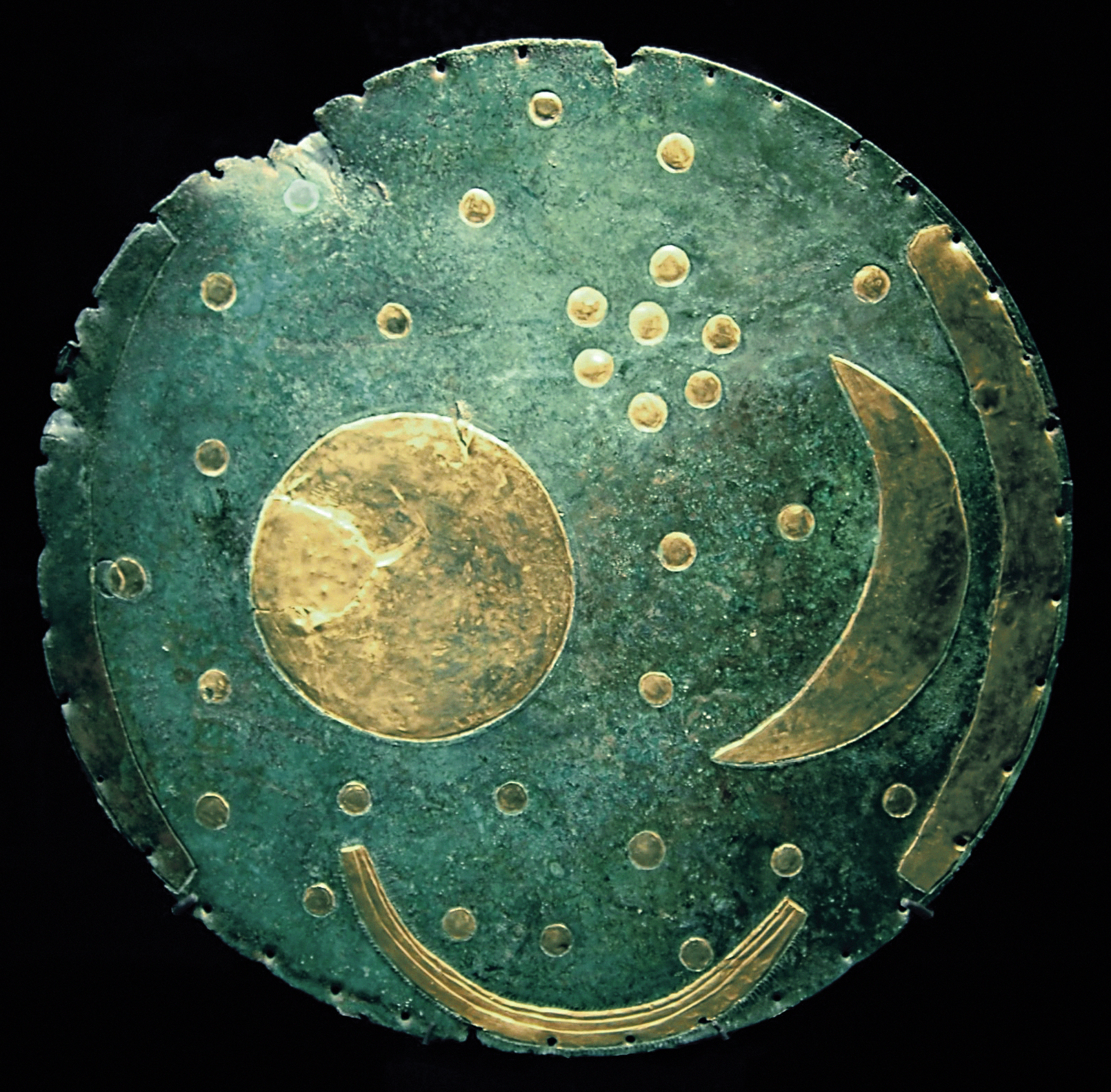
“The Nebra sky disk is a bronze disk of around 30 centimeters (12 in) diameter and a weight of 2.2 kilograms (4.9 lb), with a blue-green patina and inlaid with gold symbols. These are interpreted generally as a sun or full moon, a lunar crescent, and stars (including a cluster interpreted as the Pleiades). Two golden arcs along the sides, marking the angle between the solstices, were added later. A final addition was another arc at the bottom surrounded with multiple strokes (of uncertain meaning, variously interpreted as a Solar Barge with numerous oars, as the Milky Way, or as a rainbow).”
“The disk may be an astronomical instrument as well as an item of religious significance. The blue-green patina of the bronze may have been an intentional part of the original artifact. The find is regarded as reconfirming that the astronomical knowledge and abilities of the people of the European Bronze Age included close observation of the yearly course of the Sun, and the angle between its rising and setting points at summer and winter solstice. While much older earthworks and megalithic astronomical complexes such as the Goseck circle and Stonehenge had already been used to mark the solstices, the disk is the oldest known “portable instrument” to allow such measurements. Pásztor, however, sees no evidence that the disk was a practical device for solar measurements.”
via trixietreats
Jeanette Winterson on starting points
A Room of One’s Own
“Fiction is like a spider’s web, attached ever so lightly perhaps, but still attached to life at all four corners.”
Monomyth / Hero’s Journey

“The study of hero myth narratives started in 1871 with anthropologist Edward Taylor’s observations of common patterns in plots of hero’s journeys. Later on, others introduced various theories on hero myth narratives such as Otto Rank and his Freudian psychoanalytic approach to myth, Lord Raglan’s unification of myth and rituals, and eventually hero myth pattern studies were popularized by Joseph Campbell, who was influenced by Carl Jung’s view of myth. In his 1949 work The Hero with a Thousand Faces, Campbell described the basic narrative pattern as follows:
‘A hero ventures forth from the world of common day into a region of supernatural wonder: fabulous forces are there encountered and a decisive victory is won: the hero comes back from this mysterious adventure with the power to bestow boons on his fellow man.'”
Movie Narrative Charts by xkcd
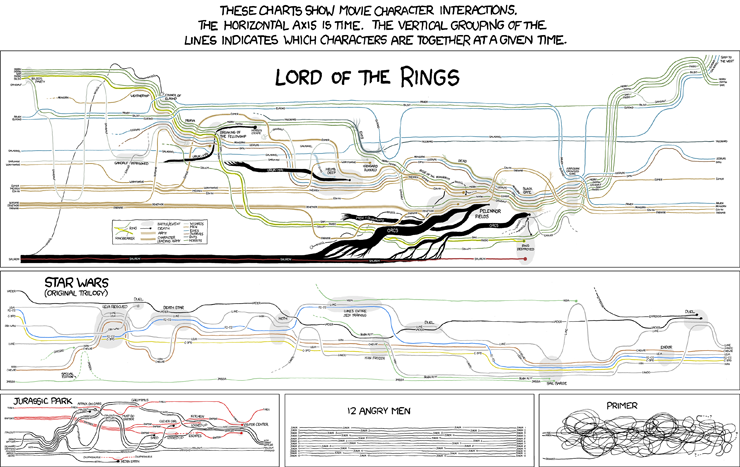
by xkcd
 Paul Greer