‘This Chansonnier, named by Knud Jeppesen as the perhaps most interesting and valuable medieval music handwriting in the Royal Library, occupies a special position among the relatively few manuscripts that surrender the French-Burgundian Chansons repertoire from the late 1400s. The script contains text and nodes for 33 three-star songs. A song – “Iactens secours” – was added in the 16th century. In conclusion, there are a number of “modulation exercises.”‘
NOTES
note taking method, master mind groups, daydreams, ticket stubs, daily pages, day books, sketch pads, tentative drawings, empty cities
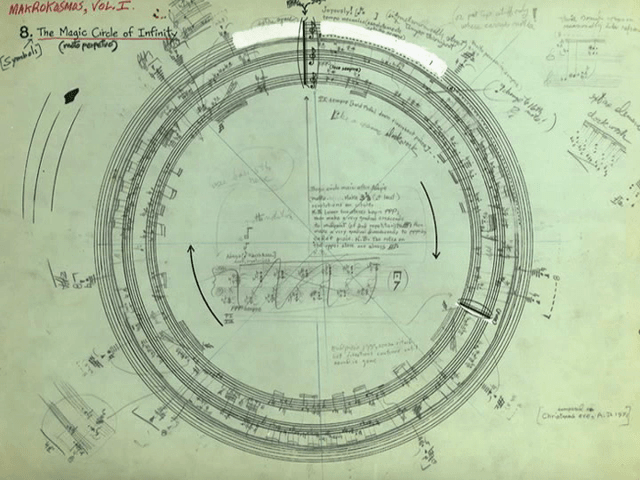
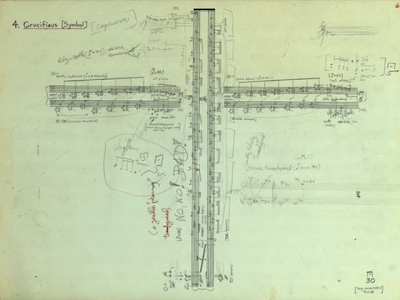
GEORGE CRUMB MAKROKOSMOS I & II: SCORES (2004)
“Notation naturally underwent the same ruptures that its signified did throughout the 20th century, not only in the attempt to find technically suitable illustrations for unprecedented forms of sonic expression, but also, as it was often the case, as a deliberate attack on the conventions of the graphic representation of sound. In the process, scores became increasingly idiosyncratic, more conscious about their arbitrary (i.e. semiotic) nature, and concomitantly assumed the status of art objects in themselves.”
— Eye Of Sound
Gestik
“A video of Slavoj Zizek discussing Orpheus and Eurydice, Zizek has been removed digitally and his gestures are traced in white on a black screen.”
Leonardo da Vinci, Head of Leda 1503-1507, Black chalk, pen and ink on paper.
Entropy study suggests Pictish symbols likely were part of a written language.
“For the small set of Pictish symbols, the researchers concluded that the symbols likely correspond to words, based on their degree of Shannon di-gram entropy modified by these two parameters. In addition to showing that its very unlikely that the Pictish symbols are simply random pictures, these methods used with verbal datasets could be applied to investigating the level of information communicated by animal languages, which are often hampered by small sample datasets.”
“I….Sleeping (being a dream journal and parenthetical explication)”
“I am running down a street.
I am wearing a silvered business suit.
It is not I.
The figure is stopped mid-stride, one arm flung out.
The street vanishes.
——-
The word ‘title’ is flung at me off five white gloved fingers backed by a vague clown face.
——-
Something of dead leaves… a rustling.
——-
a waiting – expectancy.
a sea-scape.
large people with smashed faces bending over.——-
A paw print – one toe bent in cashew curl… So that it reminds me of a flower petal.
——-
A quarter-turn clockwise of multicolored basket shapes merry-go-rounding – reds, blues, yellows, and more distant blurs of other shades. Dusty-yellowed browns for ground, and a pale blue clouded sky. A very few still silhouettes of people shape.”
——-
Some of Stan Brakhage’s 1975 dreams as remembered upon waking, from “I….Sleeping (being a dream journal and parenthetical explication)”, published 1988 by Island Cinema Resources (via Airform Archives)(via elettra)
Crash by J.G. Ballard

via ekstasis and marginalgloss
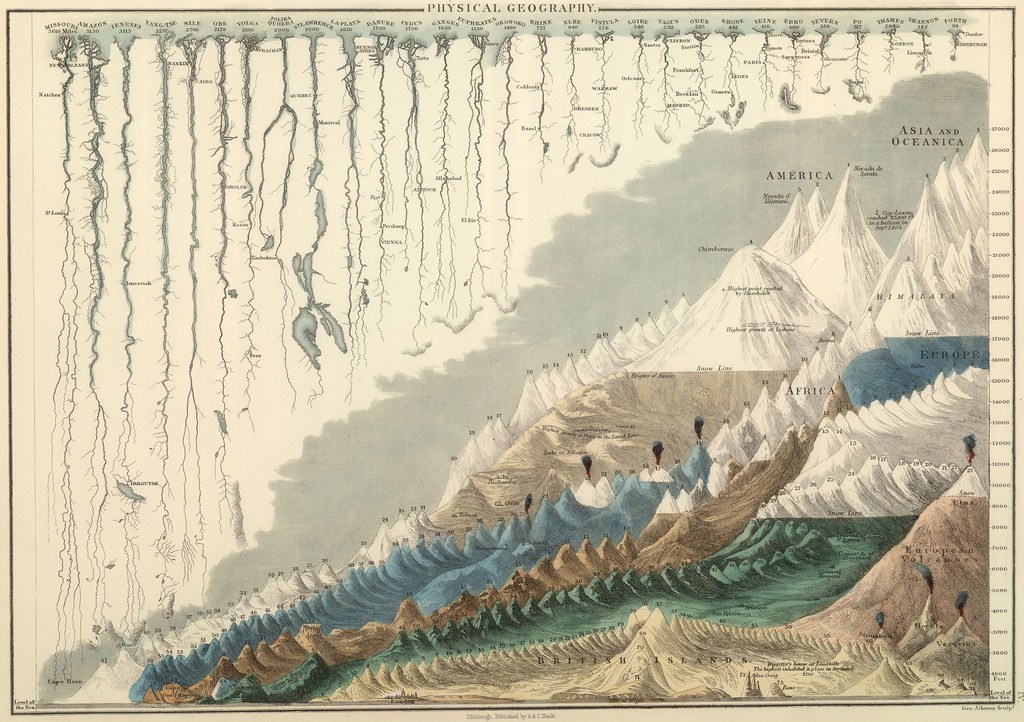
“Tinted drawing showing the comparative lengths of rivers and heights of mountains worldwide. “
“No symbols where none intended”

“Although popularly thought of as a rather dour and ascetic writer, there is a wonderfully playful aspect to Samuel Beckett’s creative output: the pictorial array of raggle-taggle characters and baroque broidery that scampers through his notebooks and manuscripts. Continuously—from decorating 1930s exercise books to embellishing the scraps of paper bearing his 1970s Mirlitonnades—doodling provided an amiable outlet when, yet again, he found himself up against the obduracy of words.
Beckett’s interest in the visual arts is well known. During his exhaustive travels around Germany in the 1930s he kept notes detailing his responses to the Old Master and more modern paintings that he had seen. More communally, throughout his life he formed close friendships with a number of artists including Jack B. Yeats, Bram Van Velde, Henri Hayden, and Avigdor Arikha. However, his appreciation of Fine Art seems to have had no discernibly direct effect on his own spontaneous drawings, which repeatedly appear to have earthier, and more mixed, antecedents.”