2017 Review: Books

These are the books I have read in the last 12 months:

Dubliners

author: James Joyce  published: 1914

Always love this. It’s more of a comfort read for me these days.

The Essays of Montaigne, Book 1

author: Michel de Montaigne  published: 1580 rating: 5

Jamilti and Other Stories

author: Rutu Modan  published: 2008 rating: 5

Great mixture of the everyday, the extraordinary and the fantastic. Stories beautifully told.

Billie Holiday

author: Carlos Sampayo  published: 1989 rating: 3

The Grapes of Wrath

Author: John Steinbeck  published: 1939 rating: 5

“I want to put a tag of shame on the greedy bastards who are responsible for this.”- John Steinbeck, 1936.  I have always known of this book but never read it or even knew very much about what is was about. I really wasn’t prepared by how relevant it was to so many situations occurring globally at the moment. The mass migration of populations due to climate changes, infrastructure collapse and economics, the refusal of a system to help and indeed the full demonisation of those in transit.The language is beautifully simple and yet says so much about strength, sadness, suffering, perseverance and dignity.

The Assassination of Margaret Thatcher

author: Hilary Mantel  published: 2014 rating: 5

The Fortune of the Rougons (Les Rougon-Macquart, #1)

author: Émile Zola  published: 1870 rating: 5

Worth having an idea of the background and circumstance of the coup d’etat of the Second French Empire (Wikipedia will do), as knowledge seems to be assumed.

Deadpool & the Mercs For Money, Volume 0: Merc Madness

author: Cullen Bunn  published: 2016 rating: 3

The Collected Stories Volume 4

author: Arthur C. Clarke published: 1956 rating: 4

Rabbit, Run (Rabbit Angstrom #1)

author: John Updike published: 1960 rating: 4

A really intense, gruelling book about a pretty loathsome wretch. Horrible thing is there’s a billion Rabbits in the actual world. Ahead of its time in many ways. This is my first Updike. His writing is profound. But yeah. Relentless.

Captain Marvel, Volume 3: Alis Volat Propriis

published: 2015 rating: 5

When the World Screamed (Professor Challenger, #4)

author: Arthur Conan Doyle published: 1928 rating: 4

Captain Marvel, Volume 2: Down

author: Kelly Sue DeConnick  published: 2013 rating: 4

The Iliad

author: Homer published: -750 rating: 5

Captain Marvel, Volume 1: In Pursuit of Flight

author: Kelly Sue DeConnick  published: 2011 rating: 4

The Schoolmaster and Other Stories

author: Anton Chekhov published: 1921 rating: 5

Batman: The Killing Joke

author: Alan Moore & Brian Bolland published: 1988 rating: 4

The Rough Guide to Berlin

author: Christian Williams rating: 4

Akira, Vol. 1

author: Katsuhiro Otomo  published: 1984 rating: 4

A Room with a View

author: E.M. Forster published: 1908 rating: 5

The Tenant of Wildfell Hall

author: Anne Brontë published: 1848 rating: 5

Whatcha Mean, What’s a Zine?

author: Mark Todd published: 2006 rating: 5

Inherent Vice

author: Thomas Pynchon published: 2009 rating: 5

Syllabus: Notes from an Accidental Professor

author: Lynda Barry published: 2014 rating: 5

Meditations

author: Marcus Aurelius  published: 180 rating: 4

The Shining

author: Stephen King  published: 1977 rating: 5

Better than the film.I do love the film, though.

The Shock Doctrine: The Rise of Disaster Capitalism

author: Naomi Klein published: 2006 rating: 5

Heavy going and ten years old. But does help you understand this place where we are is a logical step from where we’ve been.

The Descent of Man, and Other Stories

author: Edith Wharton published: 1903 rating: 3

I’m Still on:

SPLIT: True Stories About The End of Marriage and What Happens Next

editor: Katie West published: 2017

A Clash of Kings (A Song of Ice and Fire, #2)

author: George R.R. Martin  published: 1998

Becoming a Writer

author: Dorothea Brande  published: 1934

Drawn & Quarterly: Twenty-five Years of Contemporary Cartooning, Comics, and Graphic Novels

author/editor: Tom Devlin  published: 2015
See also what I watched and listened to in 2017.

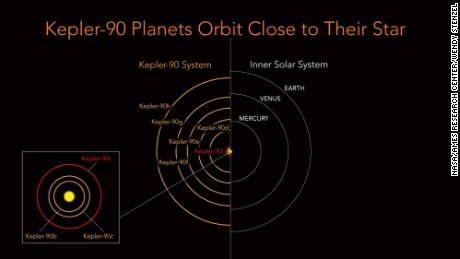
8 for Kepler-90

For the first time, eight planets have been found orbiting a distant star, Kepler-90, 2,545 light-years from Earth in the Draco constellation, NASA announced Thursday. It is the first star known to support as many planets as are orbiting our own sun, and researchers believe that this is the first of many to come.

Researchers had known that seven planets were orbiting the star. But Google Artificial Intelligence — which enables computers to “learn” — looked at archival data obtained by NASA’s planet-hunting Kepler telescope and uncovered the eighth planet.

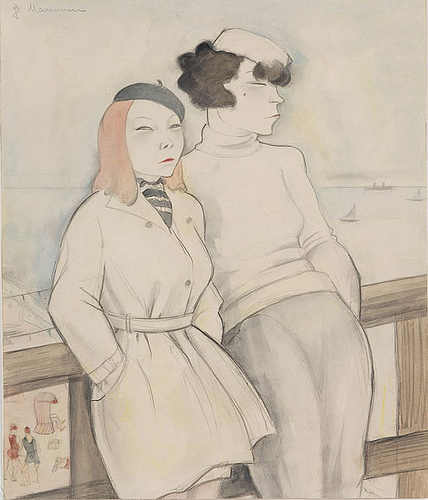
Jeanne Mammen & the Women of Berlin’s Cabaret

This is a great post on German painter Jeanne Mammen:

womensartblog's avatar#womensart ♀

German painter Jeanne Mammen was born in Berlin in 1890, however she spent her early years living in Paris. Here Mammen’s formative years were immersed in a love of French literature and the arts of the age. The artist’s privileged upbringing enabled her to study painting and drawing at various top academies in Paris, Brussels and Rome. However, with the outbreak of World War I, Mammen’s family had their assets confiscated as they were categorised as a foreign enemy, leading to impoverished conditions for the artist. Mammen, however, also benefited from the experience, as she was able to associate with a variety of people from various backgrounds, an eclectic world once hidden from the limited niceties of her middle class social circle. This, in turn, would have a major influence on her later artwork.

jeanne-mammen5

After moving back to Berlin, in 1921 Mammen began a professional career in art, first as…

View original post 392 more words

Theorists of Colour (1665-1810)

Color is always representative. Newton’s original wheel included “musical notes correlated with color.” By the end of the 18th century, color theory had become increasingly tied to psychological theories and typologies, as in the wheel above, the “rose of temperaments,” made by Goethe and Friedrich Schiller in 1789 to illustrate “human occupations and character traits,” the Public Domain Review notes, including “tyrants, heroes, adventurers, hedonists, lovers, poets, public speakers, historians, teachers, philosophers, pedants, rulers,” grouped into the four temperaments of humoral theory.

via Open Culture

Coltrane’s Circle of Fifths

From Open Culture:

Physicist and saxophonist Stephon Alexander has argued in his many public lectures and his book The Jazz of Physics that Albert Einstein and John Coltrane had quite a lot in common. Alexander in particular draws our attention to the so-called “Coltrane circle,” which resembles what any musician will recognize as the “Circle of Fifths,” but incorporates Coltrane’s own innovations. Coltrane gave the drawing to saxophonist and professor Yusef Lateef in 1967, who included it in his seminal text, Repository of Scales and Melodic Patterns. Where Lateef, as he writes in his autobiography, sees Coltrane’s music as a “spiritual journey” that “embraced the concerns of a rich tradition of autophysiopsychic music,” Alexander sees “the same geometric principle that motivated Einstein’s” quantum theory.

Neither description seems out of place. Musician and blogger Roel Hollander notes, “Thelonious Monk once said ‘All musicians are subconsciously mathematicians.’ Musicians like John Coltrane though have been very much aware of the mathematics of music and consciously applied it to his works.”

“I’ll be there” – The Final Speech of Tom Joad

“I want to put a tag of shame on the greedy bastards who are responsible for this.”

I just finished reading The Grapes of Wrath by John Steinbeck.  I have always known of this book but never read it or even knew very much about what is was about.

I really wasn’t prepared by how relevant it was to so many situations occurring globally at the moment. The mass migration of populations due to climate changes, infrastructure collapse and economics, the refusal of a system to help and indeed the full demonisation of those in transit.

The language is beautifully simple and yet says so much about strength, sadness, suffering, perseverance and dignity.

Continue reading

Far Flung Flora and Fauna

German biologist and artist Ernst Haeckel dedicated his life studying far flung flora and fauna, drawing each of their peculiar specificities with an immense scientific detail. Haeckel made hundreds of such renderings during his lifetime, works which were used to explain his biological discoveries to a wide audience. In addition to these visual masterpieces, Haeckel also discovered many microbes, and coined several scientific terms commonly known today, such as ecology, phylum, and stem cell.


A new book from Taschen titled The Art and Science of Ernst Haeckel outlines the 19th-century artist-biologist’s most important visual works and publications across a hefty 704 pages. The compendium includes 450 drawings, watercolors, and sketches from his research, which was in large support of Darwin’s theory of evolution. Most notably the book contains the Kunstformen der Natur (Art Forms in Nature), a collection of 100 prints of varying organisms originally published between 1899 and 1904.

You can learn more about the collection of illustrations and Haeckel’s discoveries on Taschen’s website. (via Fast Co. Design) (via Colossal)

Animation Axis: Persistence of Vision III

Love this.

An animated short film made with just one image exploring the dancing potential of the still sculptures at Nidaros Cathedral in Trondheim, Norway.

by Ismael Sanz-Pena

As you’d know if you followed my Instagram stories or Snapchat I am always looking for these kind of animatable repetitive elements in the world. Modern technology is a wonderful thing with regards to making that kind of capture possible and putting straight out into the world in a matter of moments.

This is a great example of applying animation to a great piece of architecture.

(via Stefan)