Write down what you value; what standards you hold for yourself and for others. Write about your dreams for the future and your hopes for your children. Write about the struggle of your ancestors and how the hardship they overcame shaped the person you are today.
Write your biography, write down your memories. Because if you do not do it now, you may forget.
Write a list of things you would never do. Because it is possible that in the next year, you will do them.
Write a list of things you would never believe. Because it is possible that in the next year, you will either believe them or be forced to say you believe them.
micro
And Still I Rise
Utagawa Kuniyoshi – “The Poet Dainagon Sees an Apparition”, 1860

The 14 Features of Eternal Fascism by Umberto Eco
“These features cannot be organized into a system; many of them contradict each other, and are also typical of other kinds of despotism or fanaticism. But it is enough that one of them be present to allow fascism to coagulate around it.:”
1. The cult of tradition. “One has only to look at the syllabus of every fascist movement to find the major traditionalist thinkers. The Nazi gnosis was nourished by traditionalist, syncretistic, occult elements.”
2. The rejection of modernism. “The Enlightenment, the Age of Reason, is seen as the beginning of modern depravity. In this sense Ur-Fascism can be defined as irrationalism.”
3. The cult of action for action’s sake. “Action being beautiful in itself, it must be taken before, or without, any previous reflection. Thinking is a form of emasculation.”
4. Disagreement is treason. “The critical spirit makes distinctions, and to distinguish is a sign of modernism. In modern culture the scientific community praises disagreement as a way to improve knowledge.”
5. Fear of difference. “The first appeal of a fascist or prematurely fascist movement is an appeal against the intruders. Thus Ur-Fascism is racist by definition.”
6. Appeal to social frustration. “One of the most typical features of the historical fascism was the appeal to a frustrated middle class, a class suffering from an economic crisis or feelings of political humiliation, and frightened by the pressure of lower social groups.”
7. The obsession with a plot. “The followers must feel besieged. The easiest way to solve the plot is the appeal to xenophobia.”
8. The humiliation by the wealth and force of their enemies. “By a continuous shifting of rhetorical focus, the enemies are at the same time too strong and too weak.”
9. Pacifism is trafficking with the enemy. “For Ur-Fascism there is no struggle for life but, rather, life is lived for struggle.”
10. Contempt for the weak. “Elitism is a typical aspect of any reactionary ideology.”
11. Everybody is educated to become a hero. “In Ur-Fascist ideology, heroism is the norm. This cult of heroism is strictly linked with the cult of death.”
12. Machismo and weaponry. “Machismo implies both disdain for women and intolerance and condemnation of nonstandard sexual habits, from chastity to homosexuality.”
13. Selective populism. “There is in our future a TV or Internet populism, in which the emotional response of a selected group of citizens can be presented and accepted as the Voice of the People.”
14. Ur-Fascism speaks Newspeak. “All the Nazi or Fascist schoolbooks made use of an impoverished vocabulary, and an elementary syntax, in order to limit the instruments for complex and critical reasoning.”
via Kottke
Si Lewen’s Parade: An Artist Odyssey
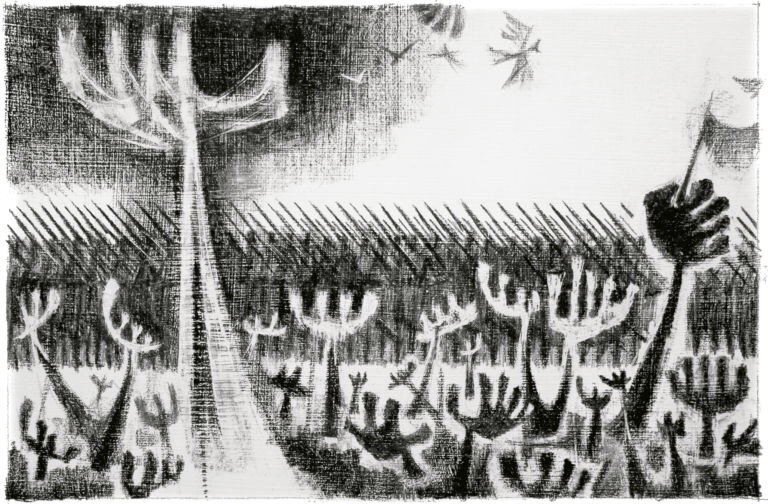
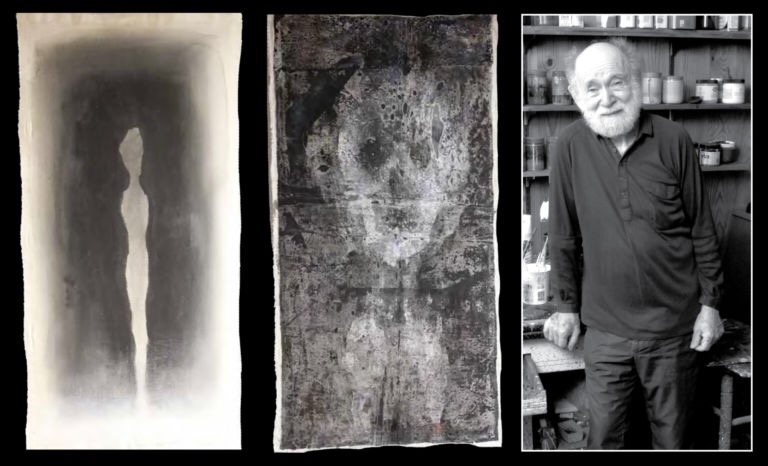
“The Parade” is a modernist dirge of a book that still packs an emotional wallop, telling the story of mankind’s recurring and deadly war fever. Einstein wrote Si a fan letter after seeing the drawings in 1951, saying, “Our time needs you and your work!” It doesn’t take a genius to see that this is still true today, so Si and I collaborated on an expanded “director’s cut” version of “The Parade,” remastered from the original art and published, this month, as a long accordion-fold book.
“I think the enemy of creativity in the world today is that so much thinking is done for you. The environment is so full of television, party political broadcasts and advertising campaigns, you hardly need to do anything. We’re just drowning under manufactured fiction, which satisfies our need for fiction – you scarcely need to go and read a novel.”
“Cyril Connolly, the 50s critic and writer, said that the greatest enemy of creativity is the pram in the hall, but I think that was completely wrong. It was the enemy of a certain kind of dilettante life that he aspired to, the man of letters, but for the real novelist the pram in the hall is the greatest ally – it brings you up sharp and you realise what reality is all about. My children were a huge inspiration for me. Watching three young minds creating their separate worlds was a very enriching experience.”
–- JG Ballard (via austinkleon)
#6DoF
Six degrees of freedom (6DoF) refers to the freedom of movement of a rigid body in three-dimensional space. Specifically, the body is free to change position as forward/backward (surge), up/down (heave), left/right (sway) translation in three perpendicular axes, combined with changes in orientation through rotation about three perpendicular axes, often termed pitch, yaw, and roll.
– wiki
This is something that will be crucial to any future plans of VR, AR and MR.
As a CGI artist I am fluent with navigating myself around a 3D space using a Wacom pen and a combination of customised button control and use of the ctrl/alt keys. But I was myself unfamiliar with this terminology which seems to be at the core of much development at the moment.
Obviously 360 video cannot provide full 6DoF so will naturally settle itself as different kind of medium.
Walt Disney’s corporate strategy chart 1957
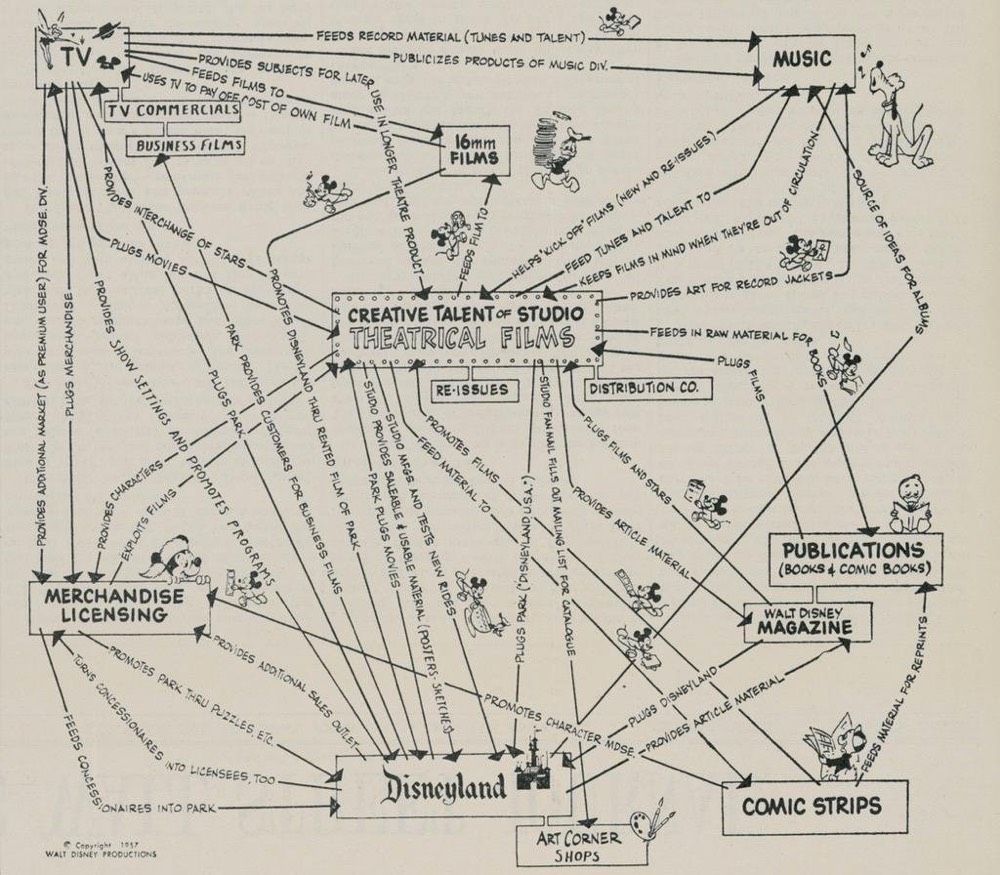
via kottke
Photography by Adam Goldberg
 Paul Greer