“She was four years old. She had a round head, a round face. She was round.”
micro
“YGT – Sinking Ship” by Sam Mason (2019)
Some great and mysterious work.
This is from Directors notes:
“On the foggy margins of the ancient and the new lies the world of Zuma, where the masked Truskan people, a once rich civilization, rot away, or where the forgotten Wazoh bird-men roam the desert ruins. In the mountains, deep in complex cave networks, dwell the Tholotec ape-men, and by the forests live the silent Mani who dawn themselves in outfits made of hollow reeds that whistle as they wander.”
“I like to think of my workflow as collage, I used primarily digital tools on Sinking Ship, though I love working with people costume and sets.”
NOTEPAD-2019-WEEKS-07-08
Being a weekly-ish round up of collected news, music, things seen and heard. I do these, then I stop, then I do them again. It feels good to me to turn the ephemeral into a more permanent daybook I can go back to. It reminds me of Robin Sloan‘s concept of “Stock and Flow” that Austin Kleon referred to last year:
“Do you know about this? It couldn’t be simpler. There are two kinds of quantities in the world. Stock is a static value: money in the bank or trees in the forest. Flow is a rate of change: fifteen dollars an hour or three thousand toothpicks a day. Easy. Too easy.
But I actually think stock and flow is a useful metaphor for media in the 21st century. Here’s what I mean:
- Flow is the feed. It’s the posts and the tweets. It’s the stream of daily and sub-daily updates that reminds people you exist.
- Stock is the durable stuff. It’s the content you produce that’s as interesting in two months (or two years) as it is today. It’s what people discover via search. It’s what spreads slowly but surely, building fans over time.”
Jaws (1975) – The Indianapolis Speech Scene
I recently caught Jaws on the TiVo and watched it through a few times. I hadn’t seen it through in decades. I had it on VHS as a teenager and it was one of those films I would turn to again and again. I actually made a comic book out of it, pausing the tape and writing down the dialogue. I did this with a few of my favourite films.
What struck me most I think, upon watching it this time was the lack of polish, something you get used to with Spielberg films of late. I think this was only his third feature(?) and he was still in his mid-twenties at the time. It has the multi-layered chaotic dialogue style he uses in Close Encounters of the Third Kind (a film he was writing as he filmed this one). In both cases this form of naturalistic dialogue style offsets the fantastic subject of the film. In CE3K’s case it was multi coloured UFOs and here it is the notoriously unrealistic shark. The point is though, as outmoded the effects are compared todays super CGI realism, you inevitably get pulled into the story, the film making is so strong.
One example of this storytelling is Quint’s Indianapolis speech which comes midway through the all-at-sea who is hunting who section. It provides a pause, but intensified and deepens the tension. Robert Shaw’s performance is extraordinary and there are many tales of how the speech came about.
Here’s Spielberg talking about how the scene came about:
I owe three people a lot for this speech. You’ve heard all this, but you’ve probably never heard it from me. There’s a lot of apocryphal reporting about who did what on Jaws and I’ve heard it for the last three decades, but the fact is the speech was conceived by Howard Sackler, who was an uncredited writer, didn’t want a credit and didn’t arbitrate for one, but he’s the guy that broke the back of the script before we ever got to Martha’s Vineyard to shoot the movie.
I hired later Carl Gottlieb to come onto the island, who was a friend of mine, to punch up the script, but Howard conceived of the Indianapolis speech. I had never heard of the Indianapolis before Howard, who wrote the script at the Bel Air Hotel and I was with him a couple times a week reading pages and discussing them.
Howard one day said, “Quint needs some motivation to show all of us what made him the way he is and I think it’s this Indianapolis incident.” I said, “Howard, what’s that?” And he explained the whole incident of the Indianapolis and the Atomic Bomb being delivered and on its way back it was sunk by a submarine and sharks surrounded the helpless sailors who had been cast adrift and it was just a horrendous piece of World War II history. Howard didn’t write a long speech, he probably wrote about three-quarters of a page.
But then, when I showed the script to my friend John Milius, John said “Can I take a crack at this speech?” and John wrote a 10 page monologue, that was absolutely brilliant, but out-sized for the Jaws I was making! (laughs) But it was brilliant and then Robert Shaw took the speech and Robert did the cut down. Robert himself was a fine writer, who had written the play The Man in the Glass Booth. Robert took a crack at the speech and he brought it down to five pages. So, that was sort of the evolution just of that speech.
see also The Last Speech of Tom Joad.
“The Chain” by Anna Calvi (2018)
NOTEPAD-2019-WEEKS-06-09
Being a weekly round up of collected news, music, things seen and heard.
”The Eyes of Orson Welles” by Mark Cousins (2018)
Just caught up with the Mark Cousins film, “The Eyes of Orson Welles”, a personal and expansive love letter to Welles himself.
The film shows many drawings by Welles, something I had not previously seen, it really builds an understanding of how he saw his ideas and the world around him.
It’s an unusual documentary with hardly any talking head interviews or people in frame at all really, unless they are drawn or filmed by Welles himself. But it touches on the nature of drawing, film making, film making as drawing, cameras as pens, calligraphy, notebooks, writing and creativity in all its forms, something Welles engaged with his whole life.
I don’t think it’s on the iPlayer anymore but there is a website here that has various links to different ways of seeing it.

On Base and Superstructure
A great thread here on artist production and it’s place in the modern world. Worth reading the whole lot (click on through). 🔽🔽🔽
A Mississippi Roll: Coloney & Fairchild’s Ribbon Map of the Father of Waters (1866)
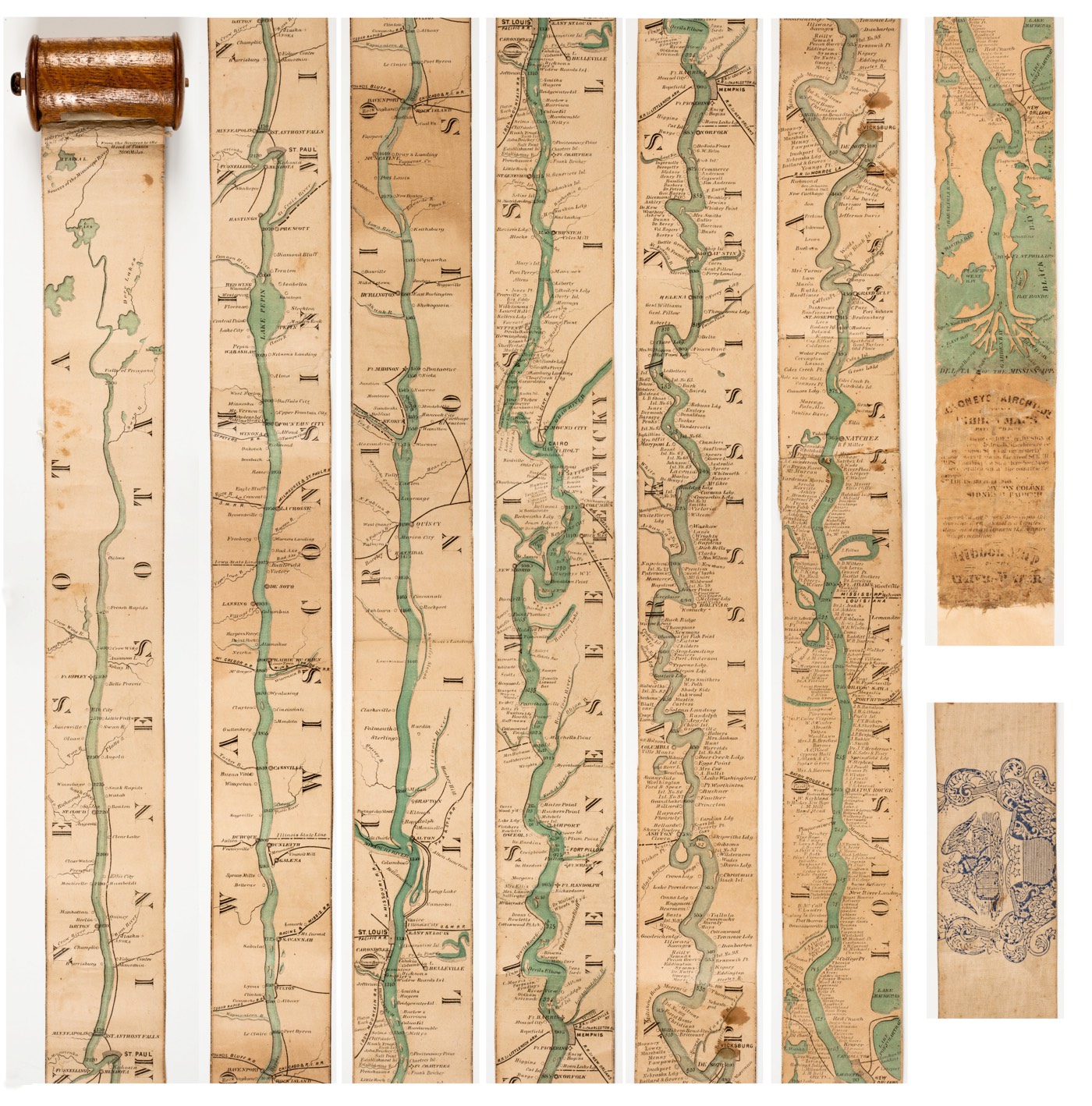 found via Kottke
“Coloney and Fairchild’s patented apparatus required that the single sheet be cut into strips, attached end-to-end, mounted on linen, and then rolled inside a wooden, metal, or paper spool (fig. 4). The resulting portability of the map was crucial because, as advertisements indicated, it was intended for business travelers, steamboat navigators, and tourists. Of this form, the Newberry Library and the Minnesota Historical Society Library hold what seems to be a first edition, while nearly a dozen archives around the U.S. hold an updated second version. With the addition of hundreds of towns, mile markers, islands, landings, landowner and plantation names, and significant Civil War locations, the Lower Mississippi appears to be a settled and thriving commercial space.”
Larger versions of the image can be found here.
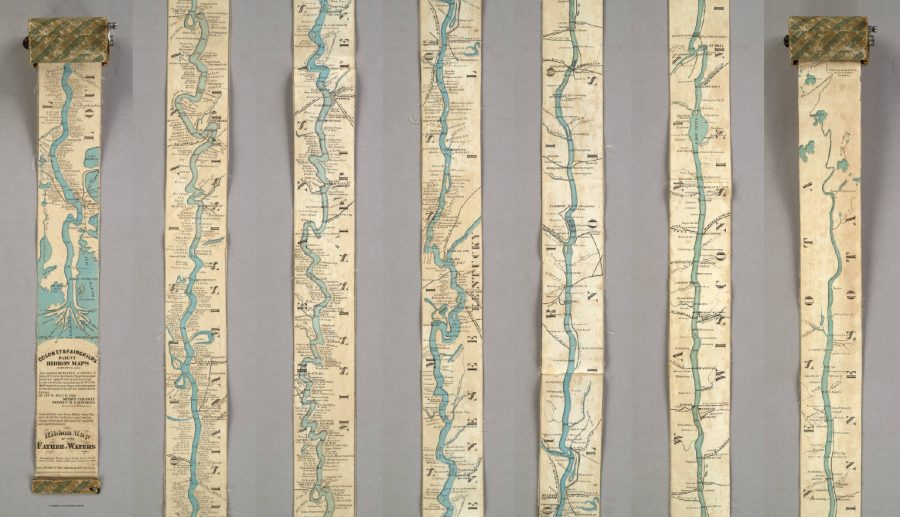
 Paul Greer