“When God, disgusted with man, Turned towards heaven, And man, disgusted with God, Turned towards Eve, Things looked like falling apart. But Crow Crow
Crow nailed them together, Nailing heaven and earth together-”
micro
Roald Dahl (and Hemingway) on writing.
“One of the vital things for a writer who’s writing a book, which is a lengthy project and is going to take about a year, is how to keep the momentum going. It is the same with a young person writing an essay. They have got to write four or five or six pages. But when you are writing for a year, you go away and have to come back. I never come back to a blank page; I always finish about halfway through. To be confronted with a blank page is not very nice.
“But Hemingway, a great American writer, taught me the finest trick when doing a long book, which is, he simply said in his own words, “When you are going good, stop writing.” And that means that if everything’s going well and you know exactly where the end of the chapter’s going to go and you know just what the people are going to do, you don’t go on writing and writing until you come to the end of it, because when you do, then you say, well, where am I going to go next? And you get up and you walk away and you don’t want to come back because you don’t know where you want to go.
“But if you stop when you’re going good, as Hemingway said…then you know what you are going to say next. You make yourself stop, put your pencil down and everything, and you walk away. And you can’t wait to get back because you know what you want to say next and that’s lovely and you have to try and do that. Every time, every day all the way through the year. If you stop when you are stuck, then you are in trouble!”
Edit 2018: I revisited this post to find the source of this quote as I did not originally provide a link. Consequently I found this post on SilverBirch Press which describes a bit more about the relationship between the two writers (there’s a phot too>).
“Reckoner” by Radiohead (2007)
Score for prepared piano by John Cage

“The phrase prepared piano is also sometimes applied to other kinds of preparations. Lou Harrison, for example, used something he called the tack piano, a piano with small nails stuck in the hammers to produce a more percussive sound. Conlon Nancarrow adapted his player pianos in a similar way, covering the hammers with metal and leather.”
“‘ARCHITECTURE IS FROZEN MUSIC.’ (This is, I think, the aesthetic key to the development of cartoons as an art form.)”
“What you do with comics, essentially, is take pieces of experience and freeze them in time,” Ware says. “The moments are inert, lying there on the page in the same way that sheet music lies on the printed page. In music you breathe life into the composition by playing it. In comics you make the strip come alive by reading it, by experiencing it beat by beat as you would playing music…”
Dunhuang Star Atlas
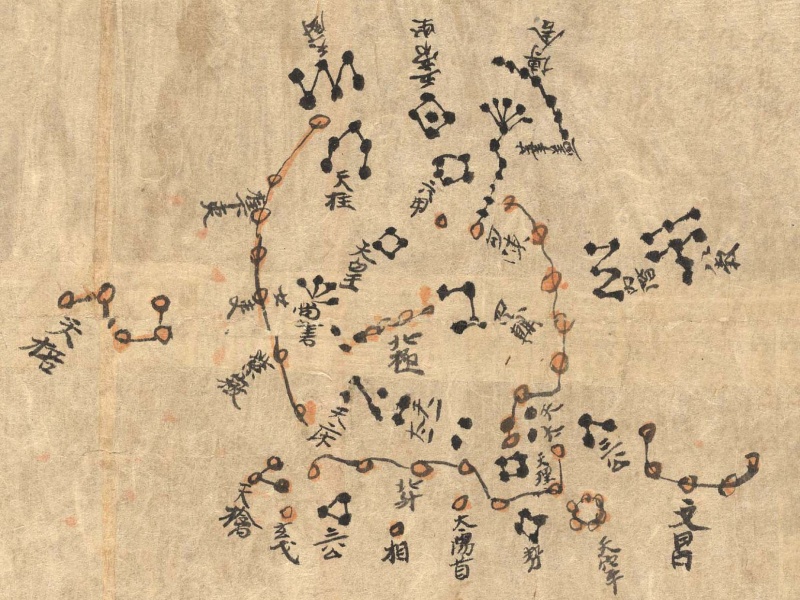
“This ancient Chinese map of planet Earth’s northern sky is part of the Dunhuang Star Atlas, one of the most impressive documents in the history of astronomy. The oldest complete star atlas known, it dates to the years 649 to 684, discovered at the Silk Road town of Dunhuang in 1907. A recent analysis that examines the accuracy and projections used to make it notes the atlas marks positions of over 1,300 stars and outlines 257 Chinese star groups or asterisms. The star positions in the hand drawn atlas were found to be accurate to within a few degrees. In this example showing the north polar region, a very recognizable Big Dipper, part of the modern constellation Ursa Major, lies along the bottom of the chart. An additional 12 charts depicting equatorial regions in 30 degree sections also includes a group resembling the modern constellation Orion. The atlas is on display at the British Library in London to celebrate the International Year of Astronomy.”
“Doll Eyes” by LIJING (2009)
“What I believe” – JG Ballard
“I believe in my own obsessions, in the beauty of the car crash, in the peace of the submerged forest, in the excitements of the deserted holiday beach, in the elegance of automobile graveyards, in the mystery of multi-storey car parks, in the poetry of abandoned hotels.”
(via feastingonroadkill)
What I talk about when I talk about running
“If people who rely on a natural spring of talent suddenly find they’ve exhausted their only source, they’re in trouble.”
 Paul Greer