Save us from the saviours

“There are two main stories about the Greek crisis in the media: the German-European story (the Greeks are irresponsible, lazy, free-spending, tax-dodging etc, and have to be brought under control and taught financial discipline) and the Greek story (our national sovereignty is threatened by the neoliberal technocracy imposed by Brussels). When it became impossible to ignore the plight of the Greek people, a third story emerged: the Greeks are now presented as humanitarian victims in need of help, as if a war or natural catastrophe had hit the country. While all three stories are false, the third is arguably the most disgusting. The Greeks are not passive victims: they are at war with the European economic establishment, and what they need is solidarity in their struggle, because it is our struggle too.

Greece is not an exception. It is one of the main testing grounds for a new socio-economic model of potentially unlimited application: a depoliticised technocracy in which bankers and other experts are allowed to demolish democracy. By saving Greece from its so-called saviours, we also save Europe itself.”

– Slavoj Žižek (via jhnbrssndn)

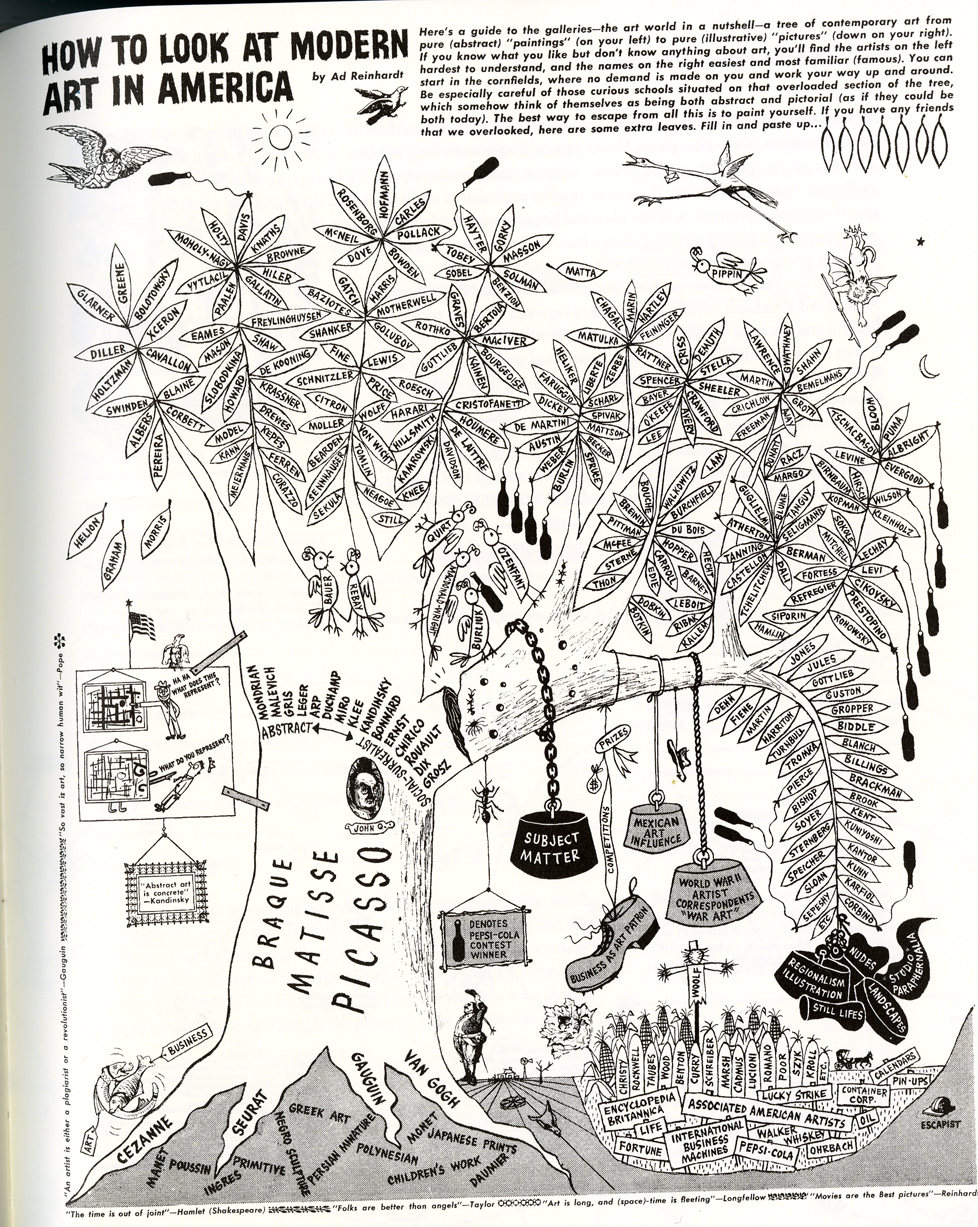
How to Look at Modern Art by Ad Reinhardt


HTML tutorial


In this famous cartoon of 1946 Ad Reinhardt tried to encapsulate the essence of the artistic modernism with its history and inherent conflicts within the American context. The tree of modern art has its roots deep in history – the Greeks are here, and so are Persian miniatures and Japanese prints. The roots represent the four pillars of Post-Impressionism: Vincent Van Gogh, George Seurat, Paul Cezanne, and Paul Gauguin. The tree is burdened by the weights of “subject matter” and “business as art patron,” and a cartoon within the cartoon mocks the perpetual debate of representation versus abstraction. By juxtaposing business and art, Reinhardt aptly comments on the situation of the avant-garde in the United States, where the public and, more importantly, the patrons were rather biased against the abstract art, often calling it “degenerate” and “subversive.””

— (via)

on “In Our Time”

“I can appreciate that for specialists in whichever field it is that Bragg and his guests are tackling in a given week In Our Time must be a torment. Far from losing themselves in the amiable excursus, they presumably sit at home bellowing at their radios, furious at this irrelevant point, or that partisan analysis. But for us dilettantes, who have only flipped through ‘The Jargon of Authenticity’, and read Hashish in Marseille 20 years ago, while actually smoking hashish in Marseille, a brisk trot from Felix Weil and Carl Grünberg’s founding of the Institute for Social Research in 1923, through the formulation of critical theory, to the exile of Horkheimer and Adorno, the suicide of Benjamin, and Adorno’s eventual repatriation to serve as the Janus-faced figurehead of the 1977 German Autumn, well … it was exactly what I needed.”

Will Self

Pablo Picasso

What do you think an artist is? An imbecile who only has eyes, if he is a painter, or ears if he is a musician, or a lyre in every chamber of his heart if he is a poet, or even, if he is a boxer, just his muscles? Far from it: at the same time he is also a political being, constantly aware of the heartbreaking, passionate, or delightful things that happen in the world, shaping himself completely in their image. How could it be possible to feel no interest in other people, and with a cool indifference to detach yourself from the very life which they bring to you so abundantly? No, painting is not done to decorate apartments. It is an instrument of war.”

“What I’m Talking About When I Talk About Magic”

“…What I’m suggesting is that feng shui and an awful lot of other things are precisely of that kind of problem. There are all sorts of things we know how to do, but don’t necessarily know what we do, we just do them. Go back to the issue of how you figure out how a room or a house should be designed, and instead of going through all the business of trying to work out the angles and trying to digest which genuine architectural principles you may want to take out of what may be a passing architectural fad, just ask yourself, ‘How would a dragon live here?’ We are used to thinking in terms of organic creatures; an organic creature may consist of an enormous complexity of all sorts of different variables that are beyond our ability to resolve, but we know how organic creatures live. We’ve never seen a dragon, but we’ve all got an idea of what a dragon is like, so we can say, ‘Well, if a dragon went through here, he’d get stuck just here and a little bit cross over there because he couldn’t see that and he’d wave his tail and knock that vase over.’ You figure out how the dragon’s going to be happy here, and lo and behold, you’ve suddenly got a place that makes sense for other organic creatures, such as ourselves, to live in.

So my argument is that as we become more and more scientifically literate, it’s worth remembering that the fictions with which we previously populated our world may have some function that it’s worth trying to understand and preserve the essential components of, rather than throwing out the baby with the bath water; because even though we may not accept the reasons given for them being here in the first place, it may well be that there are good practical reasons for them, or something like them, to be there. I suspect that as we move farther and farther into the field of digital or artificial life, we will find more and more unexpected properties begin to emerge out of what we see happening and that this is a precise parallel to the entities we create around ourselves to inform and shape our lives and enable us to work and live together. Therefore, I would argue that though there isn’t an actual God, there is an artificial God, and we should probably bear that in mind…”

— Douglas Adams, “Is There an Artifical God?” (Extemporaneous speech given at Digital Biota 2: Cambridge, SEPTEMBER 1998)

via ekstasis