Preparing for English summer family garden party, hence the rain. Countering the weather with borrowed company gazebo-thingy.
(T)
The Nebra Sky Disk (1600 BC)
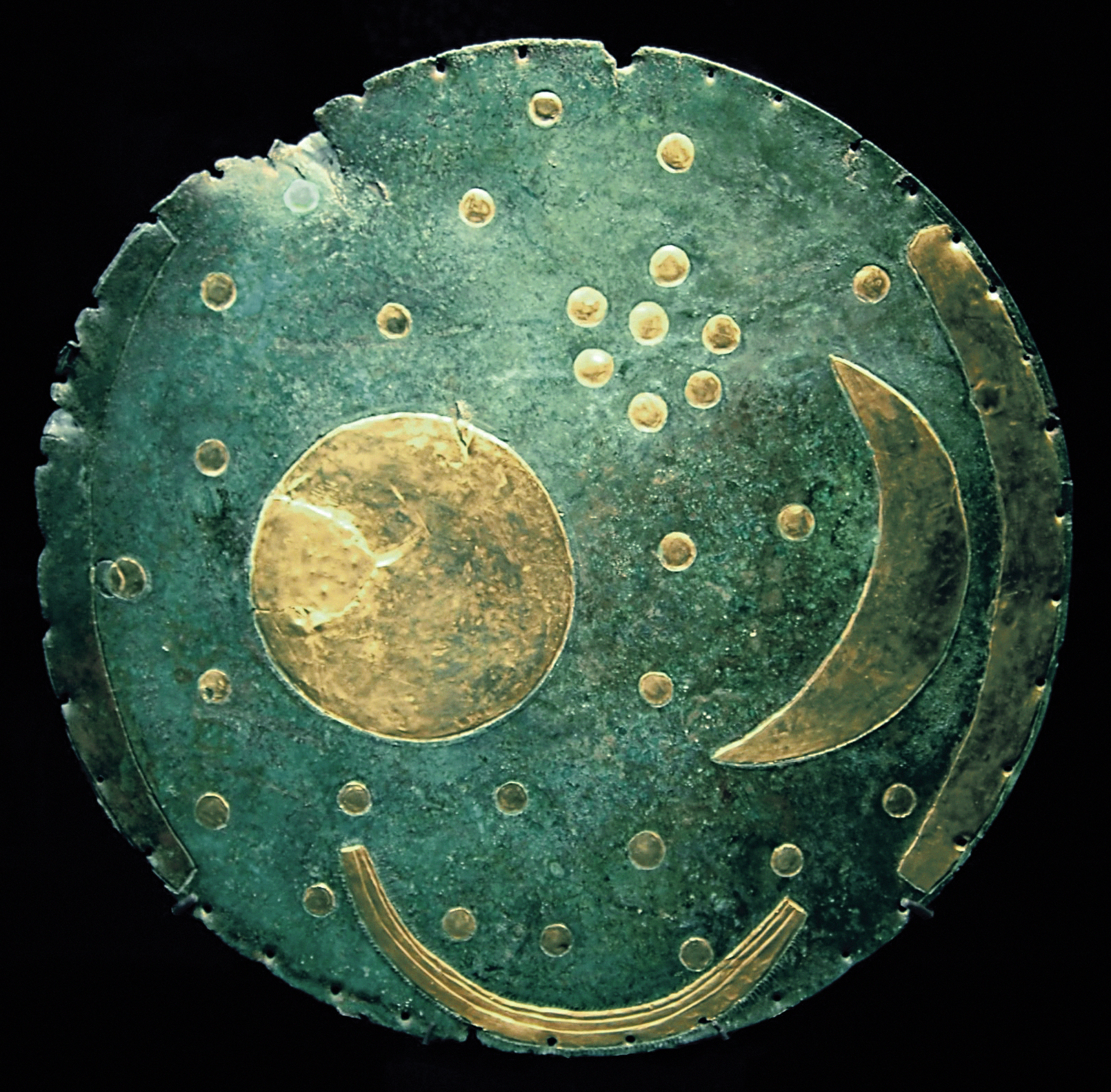
“The Nebra sky disk is a bronze disk of around 30 centimeters (12 in) diameter and a weight of 2.2 kilograms (4.9 lb), with a blue-green patina and inlaid with gold symbols. These are interpreted generally as a sun or full moon, a lunar crescent, and stars (including a cluster interpreted as the Pleiades). Two golden arcs along the sides, marking the angle between the solstices, were added later. A final addition was another arc at the bottom surrounded with multiple strokes (of uncertain meaning, variously interpreted as a Solar Barge with numerous oars, as the Milky Way, or as a rainbow).”
“The disk may be an astronomical instrument as well as an item of religious significance. The blue-green patina of the bronze may have been an intentional part of the original artifact. The find is regarded as reconfirming that the astronomical knowledge and abilities of the people of the European Bronze Age included close observation of the yearly course of the Sun, and the angle between its rising and setting points at summer and winter solstice. While much older earthworks and megalithic astronomical complexes such as the Goseck circle and Stonehenge had already been used to mark the solstices, the disk is the oldest known “portable instrument” to allow such measurements. Pásztor, however, sees no evidence that the disk was a practical device for solar measurements.”
via trixietreats
Falling from Space.
A camera strapped aboard a Space Shuttle booster rocket.
Listen to the sound on this one, you won’t regret it.
Things start happening about 2 minutes in.
via @girlonetrack
The Earth together with the Moon, as seen from the Messenger spacecraft to Mercury, May 2010.

via Bruce Sterling
“Sensology” by Michel Gagné (2006)
“The creation of this film was a true spiritual and artistic journey. Sometimes, I felt like I was channeling the images. I did no storyboards and virtually no preliminary work. I animated in a stream of consciousness, one frame at a time at a rate of 30 frames per second. The shapes revealed themselves as I listened to the music over and over again. The process was intensely focused and required large amount of concentration. I was becoming part of the music and expressing my creativity at its rawest and most primal. Like Kandinski tought us, every shape and sound has a equal vibration in the soul. When Paul Plimley saw a portion of the film for the first time, he said to me with tears in his eyes, “It’s like you read my soul.””
— Michel Gagné
“Alone Again Or” – Love (1967)
This came on the radio when I was out driving the other night. It was a damp, english summers evening and half the sky was black.
It’s a track you’ve probably heard a thousand times.
But listen to it again.
(shh)
(T)
“You know who seems like a genuinely nice citizen of the internet (and likely of the world)? Paul Greer aka burningfp aka electronicalrattlebag. I follow him because he creates lovely things, and is a curator of quality stuff. I would say “follow him”, if I had any influence.”

