
Director Irvin Kershner’s notes and revisions (basd on conversations with Lucas) from Aug. 24, 1979, on a script page from scene S368
“Never imagine yourself not to be otherwise than what it might appear to others that you were or might have been was not otherwise than what you had been would have appeared to them otherwise.”
— Duchess
“It was kind of cool how each tape sounded different depending on what cassette deck you used.” Bjornaa even reuses old cassettes as well as fresh blanks. “You can sometimes still hear the original music playing behind the new tracks. It adds a certain something that makes each cassette unique.”
“The union of the mathematician with the poet, fervor with measure, passion with correctness, this surely is the ideal.”
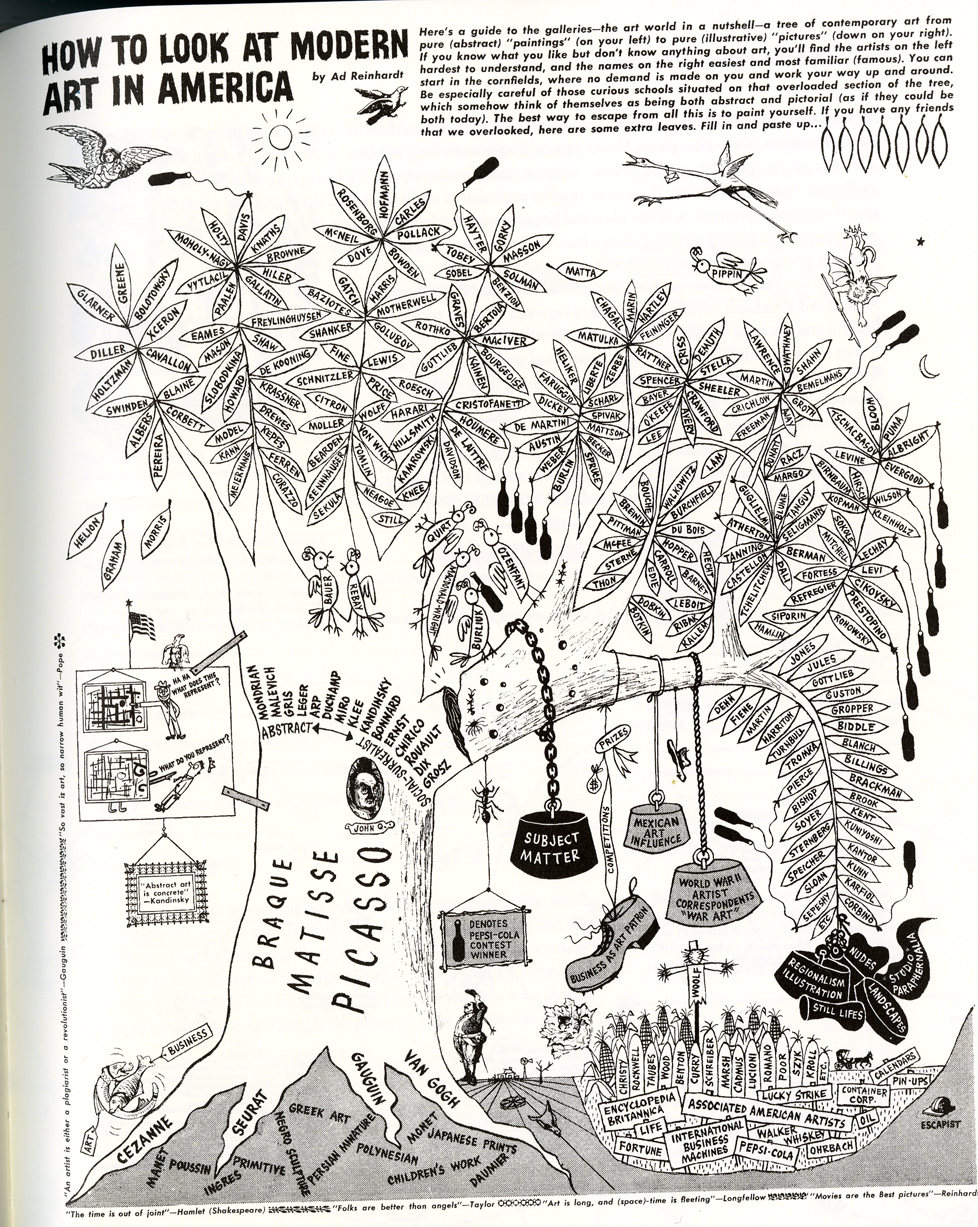
“In this famous cartoon of 1946 Ad Reinhardt tried to encapsulate the essence of the artistic modernism with its history and inherent conflicts within the American context. The tree of modern art has its roots deep in history – the Greeks are here, and so are Persian miniatures and Japanese prints. The roots represent the four pillars of Post-Impressionism: Vincent Van Gogh, George Seurat, Paul Cezanne, and Paul Gauguin. The tree is burdened by the weights of “subject matter” and “business as art patron,” and a cartoon within the cartoon mocks the perpetual debate of representation versus abstraction. By juxtaposing business and art, Reinhardt aptly comments on the situation of the avant-garde in the United States, where the public and, more importantly, the patrons were rather biased against the abstract art, often calling it “degenerate” and “subversive.””
— (via)


