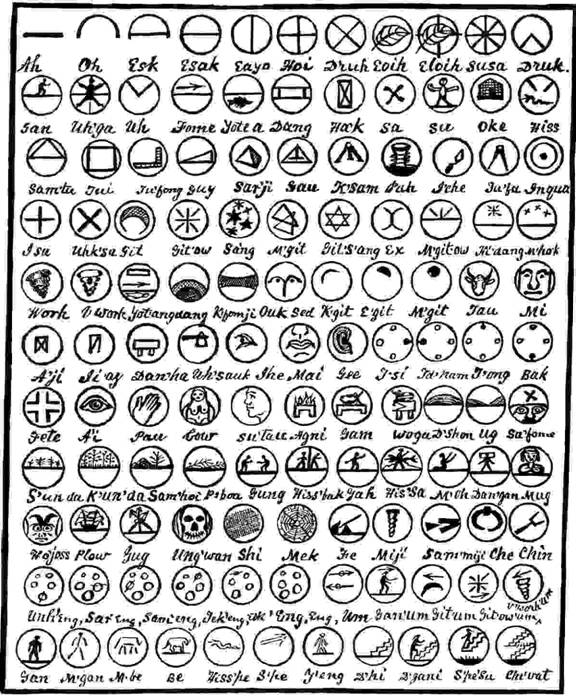
“i033 Tablet of Se’moin. Panic language means earth-language; things were named after the sounds they uttered; thus, the soul of each thing spoke, and that which was voiced was called the Panic language. Panic was the first language on earth but was not written until Se’moin, given in the time of Sethantes, being the first written language given to I’hins. As such, Se’moin represents the first explanation of creation ever given to man.”
“I think it was the late sixties, and I saw this wonderful production of Ubu on at the Royal Court, and Max Wall was playing his Royal Highness. And it was just astounding, I mean, that was my initiation with Alfred Jarry, I mean, he was quite an extraordinary man. I thought at that time, if I ever got the chance to do it, Ubu would just be the most natural animated picture. I related it to Jarry in terms of animation initiallybecause it was originally a marionette play that he put on at school as a boy, and then he placed it a little bit later in the theatre. And I think it’s part of anyone that works in the theatre, it’s part of their curriculum, you know, you come across Ubu, you come across the importance of Ubu in breaking the traditions.
…So we developed that style, you know, literally it was blobbing ink. And when we were doing some of the backgrounds – you know, they were very simple, we just drew them in like this, and then I would take a bottle of ink with those plunger things, just squeeze it, and then just whack it right across it, and you’d just let the blobs go.
I remember, it was in the BAFTA theatre, and it was a full house, a lot of people had turned up to see this piece. And it did the job, it broke the mould, I think, of people’s conception of animation. I mean, there it was: suddenly there was something else happening on the screen. And it was the most marvellous feeling when it finished, there was a little pause. And tremendous applause, I was really moved by that. I did, at another screening, overhear some people walking out saying it was the most revolting and disgusting film they’d ever seen, and they didn’t know what animation was coming to. At which I thought, well, I don’t know, I mean, it can’t always be little cutie characters.”
“What made me decide to make [Spirited Away] was the realisation that there are no films made for that age group of ten-year old girls. It was through observing the daughter of a friend that I realised there were no films out there for her, no films that directly spoke to her. Certainly, girls like her see films that contain characters their age, but they can’t identify with them, because they are imaginary characters that don’t resemble them at all. With Spirited Away I wanted to say to them ‘don’t worry, it will be all right in the end, there will be something for you’, not just in cinema, but also in everyday life.”
“When we realize that coding is a creative act, we not only value that part of the coder’s labor, but we also realize that the technologies in which we swim have assumptions and ideologies behind them that, perhaps, we should challenge.”
At BDH we have been intensely working on the compositing and enhancement for the new BBC wildlife series Hidden Kingdoms, which starts tonight at 8pm on BBC 1.
This was a very much more “enhanced” version of Natural History, telling many stories that would go unexplored in more “traditional” forms, this has raised a certain amount of media debate already.
“For me, it’s always been a process of trying to convince myself that what I’m doing in a first draft isn’t important. One way you get through the wall is by convincing yourself that it doesn’t matter. No one is ever going to see your first draft. Nobody cares about your first draft. And that’s the thing that you may be agonizing over, but honestly, whatever you’re doing can be fixed.”
 Paul Greer