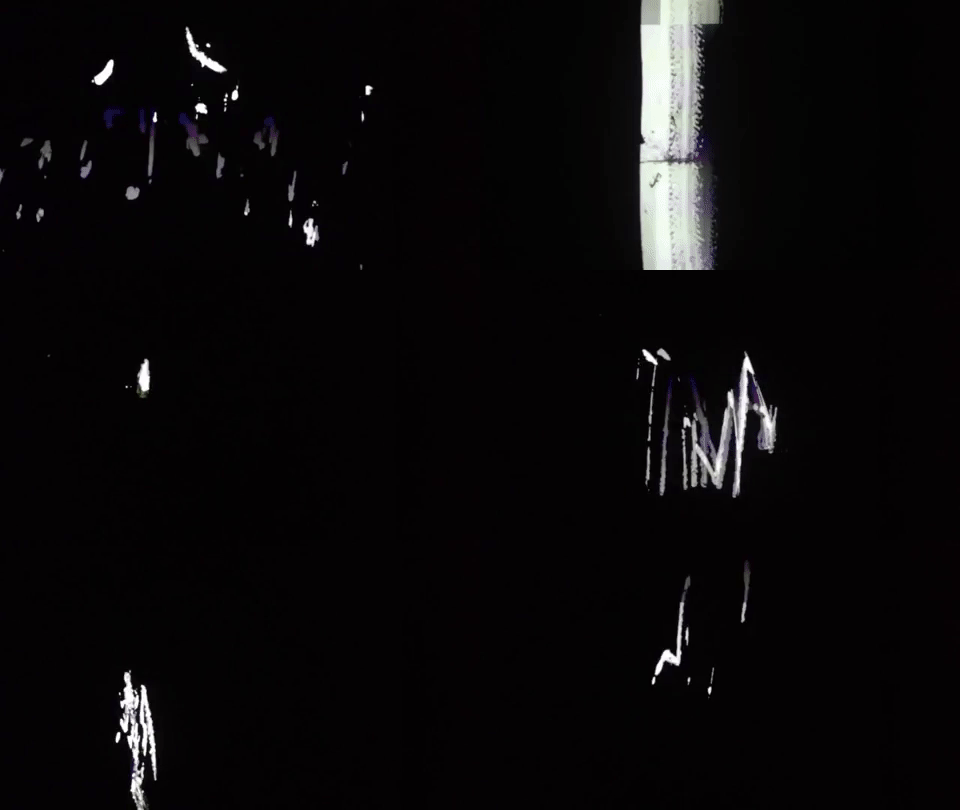
George Dunning – The Tempest (unfinished) (1978)

After Damon, Dunning began to lay plans for a feature based on Shakespeare’s The Tempest. Dunning had been unwell throughout the production of Yellow Submarine, and poor health continued to dog him. When he died in London on 15 February 1979, The Tempest remained sadly unfinished. The collated surviving material – black-and-white pencil tests, pose sketches, a few full-colour animation sequences – hints at a bold expansion of past techniques, with figures, landscapes, even the Shakespeare text, in perpetual flux.”

see also: Ubu

“Free Radicals” by Len Lye (1958)

“Created in 1958, Free Radicals is arguably one of American avant-garde artist Len Lye’s greatest film works. ‘Every film [I made], I tried to interest myself in it by doing something not previously done in film technique’, said Lye. Working across the mediums of painting, poetry, and film, Lye was a prolific and important kinetic artist. With a maverick character and obsession with movement, Lye pioneered experimental film and animation techniques with his influential invention of direct (camera-less) film-making as early as the 1930s. Though never associated solely with one movement, Lye’s work merged aspects of Surrealism, Futurism, Constructivism and Abstract Expressionism into his own breed of moving art.”

Sophie Pinchetti

Watch here.

“I, myself, eventually came to look at the way things moved mainly to try to feel movement, and only feel it. This is what dancers do; but instead, I wanted to put the feeling of a figure of motion outside of myself to see what I’d got. … I didn’t know the term ‘empathy’ – that is, the psychological trick of unconsciously feeling oneself into the shoes of another person – but I was certainly practising it. I got so that I could feel myself into the shoes of anything that moved, from a grasshopper to a hawk, a fish to a yacht, from a cloud to the shimmering rustle of ivy leaves on a brick wall. Such shoes were around in profusion. …”

Len Lye


see also:

On Ditko and Abstraction


The script is dominant, the story is what matters, images are subservient. This is what I would call–to borrow a term from deconstruction–the logocentric view of comics. “Logocentric” as centered upon the logos, which means not only “speech” or “discourse,” but also meaning, as in a verbalizable meaning.”


“Obviously, I’m a proponent of an anti-logocentric view of comics. Ditko and Kirby, in this view, only achieve their heights of artistry when they reverse that hierarchy, when the script becomes subservient to the art, rather than the reverse. Is this such a novel view of art? Not at all. As a matter of fact, the reversal has happened repeatedly in one of our most popular arts, or forms of entertainment, which most of the time is enjoyed precisely from this perspective: specifically, music.”

Andre Molotiu

Hilma af Klint (1862 – 1944)

Hilma af Klint was a Swedish artist and mystic whose paintings were amongst the first abstract art. She belonged to a group called ‘The Five’ and the paintings or diagrams were a visual representation of complex philosophical ideas.”

SERIES VII - NO. 5 - 1920
SERIES VII – NO. 5 – 1920

“At the Academy of Fine Arts she met Anna Cassel, the first of the four women with whom she later worked in “The Five” (de Fem), a group of artists who shared her ideas. The group of female artists The Five was engaged in the paranormal and regularly organized spiritistic séances. They recorded in a book a completely new system of mystical thoughts in the form of messages from higher spirits, called The High Masters (“Höga Mästare”). One, Gregor, spoke thus: “all the knowledge that is not of the senses, not of the intellect, not of the heart but is the property that exclusively belongs to the deepest aspect of your being…the knowledge of your spirit”.”


Booklet with drawings by Hilma af Klint.

Booklet with drawings by Hilma af Klint.

The pictures were painted directly through me, without any preliminary drawings, and with great force. I had no idea what the paintings were supposed to depict; nevertheless I worked swiftly and surely, without changing a single brush stroke.”


Svanen (The Swan), nr 17, Group 9, Series SUW, October 1914 – March 1915. This abstract work was never exhibited during af Klint's lifetime.

Svanen (The Swan), nr 17, Group 9, Series SUW, October 1914 – March 1915. This abstract work was never exhibited during af Klint’s lifetime.

via