Very pleased to announce that the work I did at BDH on the viral for “Without You” has been featured on Cartoon Brew. They published my short description of the methods used to make it.
Some nice comments too.
anɪˈmeɪʃ(ə)n/
noun
1. the state of being full of life or vigour; liveliness.
2. the technique of photographing successive drawings or positions of puppets or models to create an illusion of movement when the film is shown as a sequence.”a combination of live action with 3-D animation”
Very pleased to announce that the work I did at BDH on the viral for “Without You” has been featured on Cartoon Brew. They published my short description of the methods used to make it.
Some nice comments too.
Water for Maya is a hand-painted work which came into being during a film interview with Martina Kudlacek about Maya Deren. There was a sudden recognition of Maya’s intrinsic love of water and thus of all Mayan liquidity in magic conjunction, reflection, etc.
see also: Comingled Containers and Mothlight
by Edouard Salier & Fred Pruchon /// Images Flip Book : Université Rennes 2 CREA-CIM & LENDROIT Galerie
(via TheReplicants)
via Bel
“I was inspired to make Neighbours by a stay of almost a year in the People’s Republic of China. Although I only saw the beginnings of Mao’s revolution, my faith in human nature was reinvigorated by it. Then I came back to Quebec and the Korean War began. (…) I decided to make a really strong film about anti-militarism and against war.”
—NM
“The term ‘pixilation‘ was created by Grant Munro, who had worked with McLaren on Two Bagatelles, a pair of short pixilation films made prior to Neighbours. While Neighbours is often credited as an animated film by many film historians, very little of the film is actually animated. The majority of the film is shot with variable-speed photography, usually in fast motion, with some stop-frame techniques. During one brief sequence, the two actors appear to levitate: this effect was actually achieved in stop-motion; the men repeatedly jumped upward but were photographed only at the top of their trajectories. Under the current definition of an animated short, it is unlikely that Neighbours would qualify as either a documentary short or an animated short.”
See also: Pen Point Percussion
Norman McLaren explains how he makes synthetic sound on film. With an oscilloscope he first demonstrates what familiar sounds look like on the screen; next, how sound shapes up on a film’s sound track; and then what synthetic sounds sound like when drawn directly on film. This technique is also demonstrated in Dots and Loops.
“Want to understand why entertaining cartoons are all but impossible to produce nowadays? You can have the answer in just two short minutes by watching the first part of this interview with Frank Zappa. Though Zappa is explaining the decline of the music business, everything he says is applicable to the animation world as well.”
(via CartoonBrew)
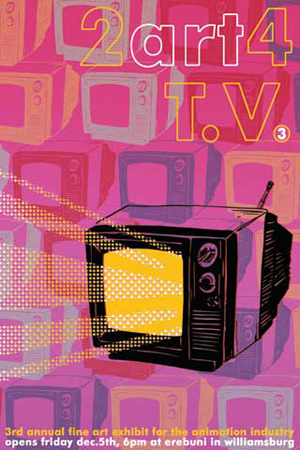
I’m having some work shown at the excellent “Too Art For TV” exhibition held at Erebuni, 158 Roebling Street, Williamsburg, New York.The opening is a week today (6-9pm 5th Dec)and the exhibition runs from 5th until the 15th Dec. The idea is to show work by industry animators who do art on the side:
“Erebuni is pleased to present Too Art for TV 3, the third annual group exhibition showcasing the fine art expressions of the animation industry. Twice before, this show has drawn in excited, elbow-to-elbow crowds of artists, illustrators, filmmakers, animators, and fans of animation. This year’s exhibit, now the biggest one in Too Art for TV’s history, features 36 artists who- by way of toys, prints, paintings, sculptures, and experimental film- will set free their skills otherwise “owned” by television networks bosses.”
If you’re in town please check it out. You can see from the website that there’ll be lots of exciting stuff to see, made by people far more talented and interesting than myself.

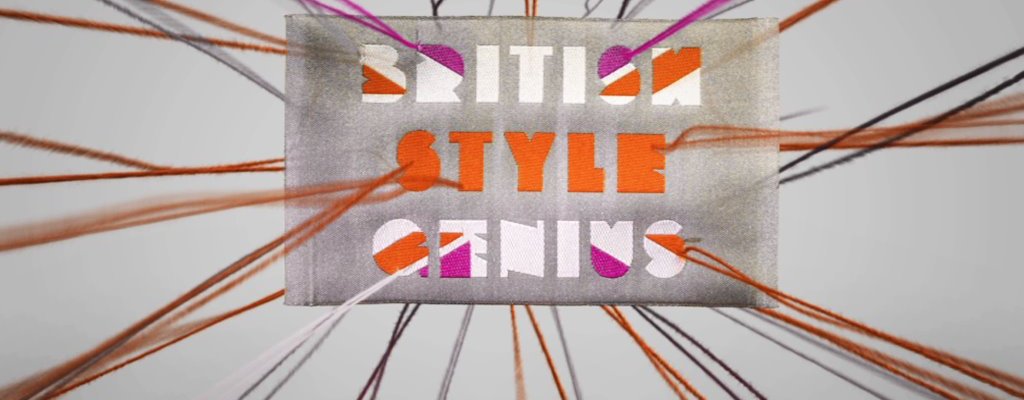
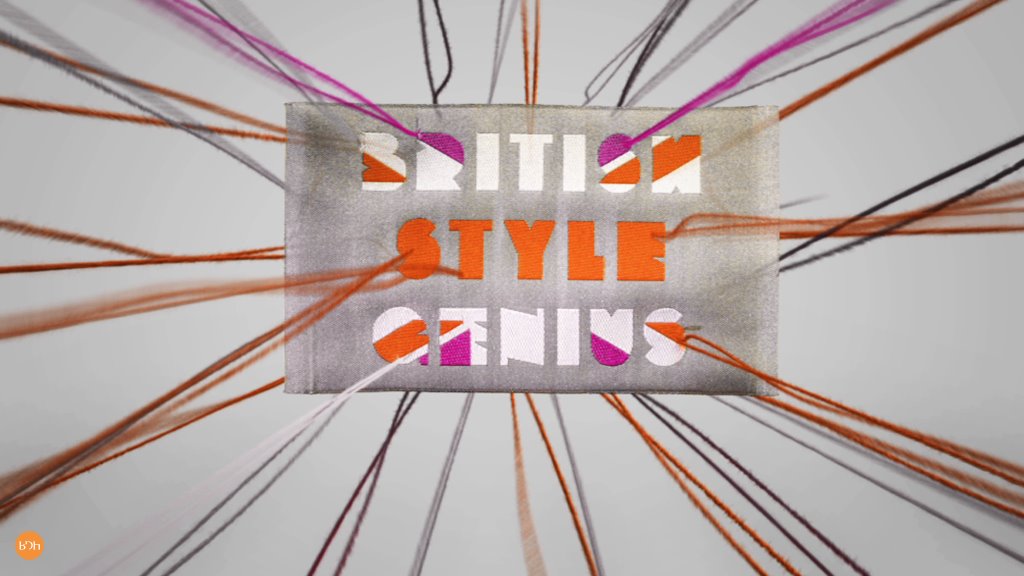
Recently at BDH, myself and the very clever and splendid Orla Handley made the titles for the up coming BBC series “British Style Genius“. The first episode of which goes out 21:00hrs, 7th October on BBC TWO (that’s in the UK only as far as I know).
Handley did the designing, editing, crazy-bonkers stop frame animation etc. I made CGI threads, worked out how to fit them with the stop frame, some compositing, a bit of camera holding, frowning, pointing, and occasional fetching stuff.
After the initial building of the sequence Handley went on to produce five separate colorways, to match the style of each episode of the series, which all deal with different sections of British fashion history.
This means everyone must watch all five episodes to fully appreciate the total awesomeness of this title sequence.
Update 1: BSG Featured in Broadcast
Update 2: On Cartoon Brew (Thanks Amid)
Update 3: YouTube Link
Update 4: British Style Genius wins the RTS
“…One is like bright light. Two is a movement from left to right. Five is like a clap of thunder or the sound of a wave against a rock.”
Daniel Tammet is known as an “autistic savant” and has often written about his life with high-functioning autism and savant syndrome, this film aimed to illustrate his mental process and synaesthetic mental process with numbers.
“Daniel can do calculations to 100 decimal places in his head, and learn a language in a week. ‘The Boy With The Incredible Brain’ follows Daniel as he travels to America to meet the scientists who are convinced he may hold the key to unlocking similar
abilities in everyone. He also meets the world’s most famous savant, KIm Peek, the man who inspired Dustin Hoffman’s character in the Oscar winning film ‘Rain Man’”
At BDH we were challenged to find a visual language to illustrate Daniel’s thought patterns for this, and my contribution were the numbers themselves.
 Paul Greer