1. the state of being full of life or vigour; liveliness.
2. the technique of photographing successive drawings or positions of puppets or models to create an illusion of movement when the film is shown as a sequence.”a combination of live action with 3-D animation”
As you’d know if you followed my Instagram stories or Snapchat I am always looking for these kind of animatable repetitive elements in the world. Modern technology is a wonderful thing with regards to making that kind of capture possible and putting straight out into the world in a matter of moments.
This is a great example of applying animation to a great piece of architecture.
I came across this tumblr post from stil a few days ago that sent me down a rabbit hole.
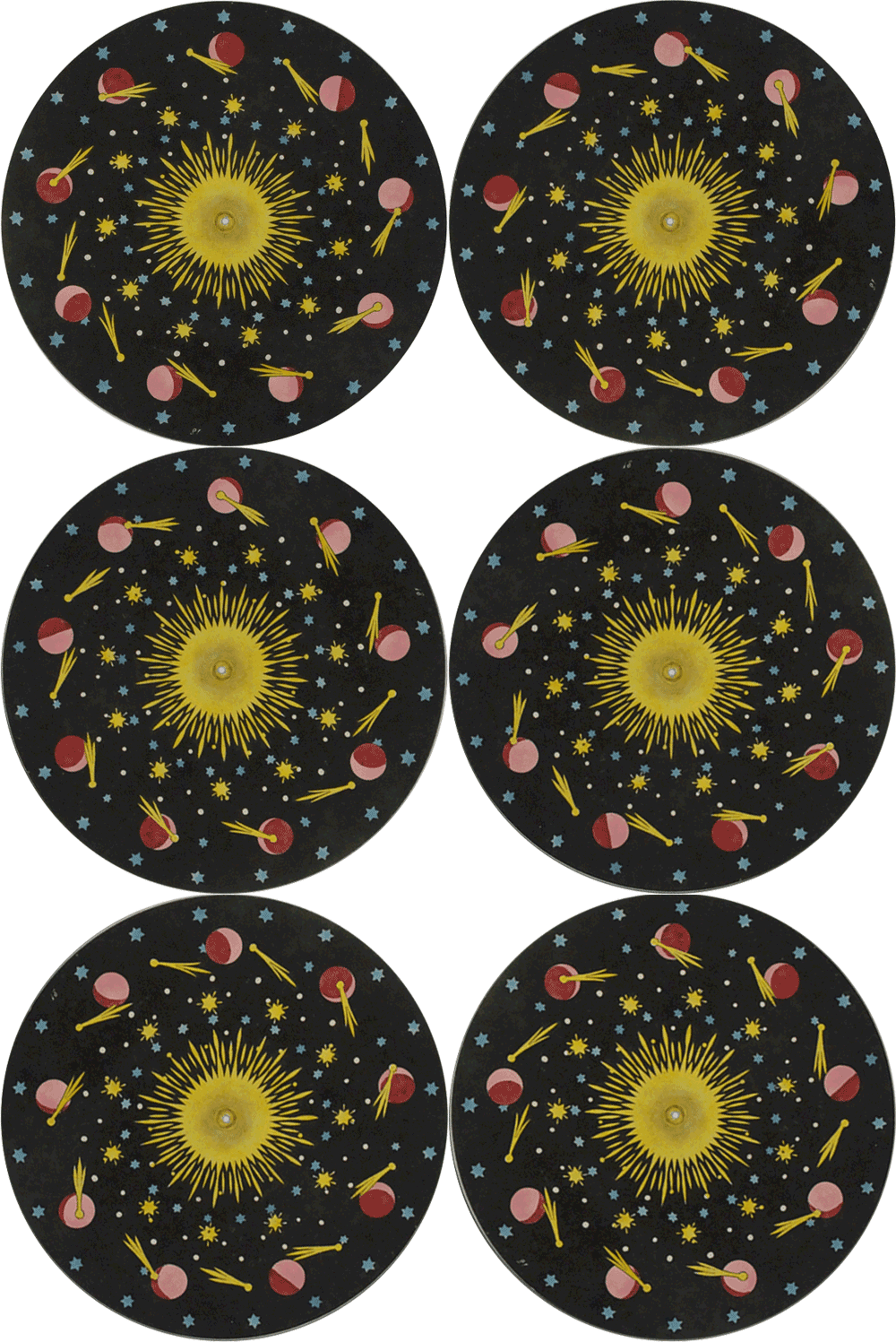
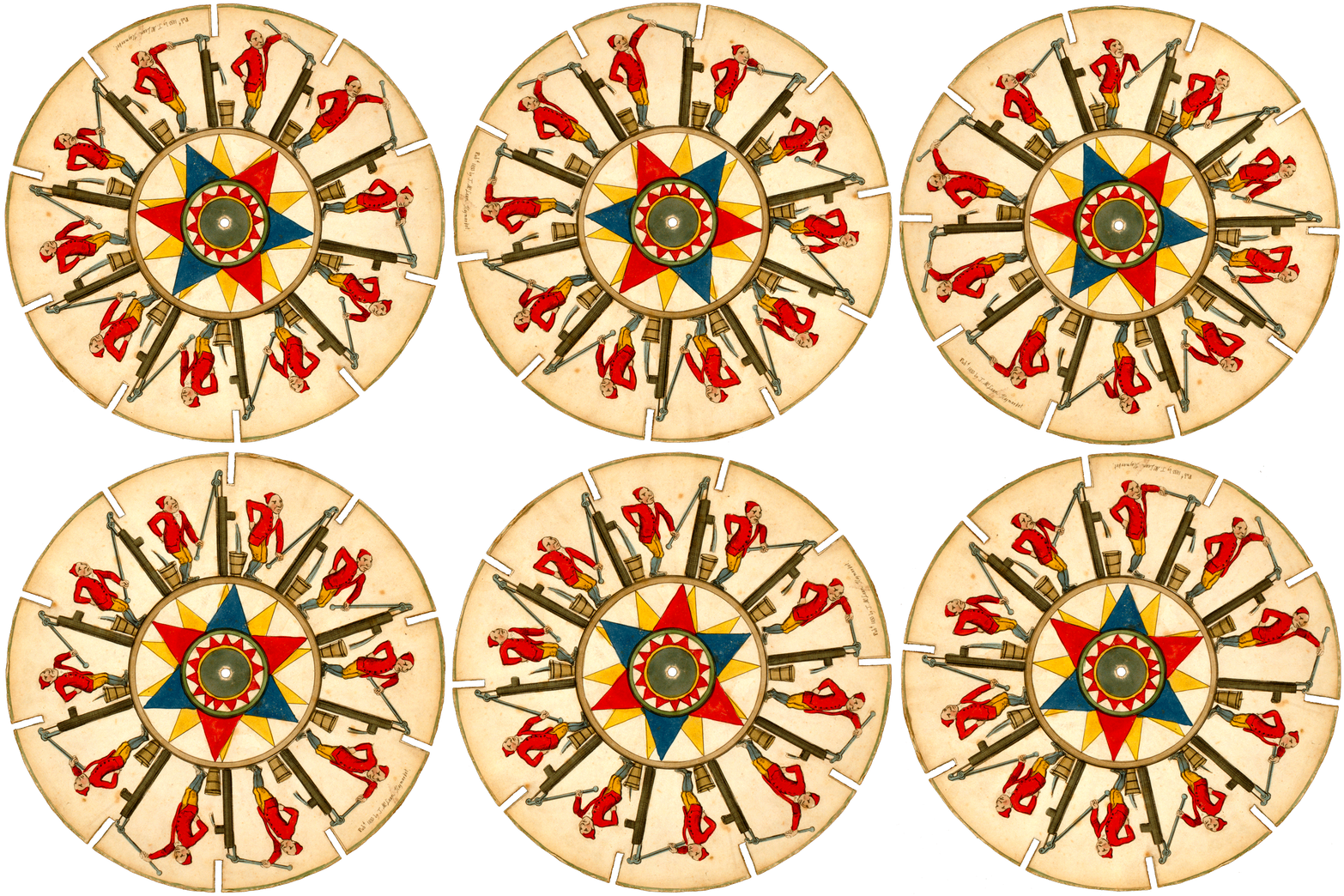
Invented in 1832 by Joseph Plateau, the phenakistoscope was an early animation device that used the persistence of vision principle to create an illusion of motion.
Here follows a few links and gifs collected from various posts around the net.
Stand up, ye spellers, now and spell;
spell phenakistoscope and knell:
Or take some simple word as chilly,
Or gauger Or the garden lily…
The phenakistiscope and ‘stroboscopic disc’ of the 1830s were the first instruments to create an illusion of movement based on rapidly changing sequence pictures; the basic technique used subsequently in one form or another by the zoetrope, the Zoopraxiscope, cinematography, television, video, and digital motion pictures. These intriguing spinning-disc toys and the sequence drawings produced for them have not been adequately investigated.
A variant of it had two discs, one with slits and one with pictures; this was slightly more unwieldy but needed no mirror. Unlike the zoetrope and its successors, the phenakistoscope could only practically be used by one person at a time. – (Juxtapoz)
Faulty animation from an 1833 McLean’s Optical Illusions, or, Magic Panorama disc (slits appear still when viewed through a phénakisticope) – wiki
On 10 December 1830 Michael Faraday presented a paper at the Royal Institution of Great Britain called On a Peculiar Class of Optical Deceptions about the optical illusions that could be found in rotating wheels. He referred to Roget’s paper and described his associated new findings. Much was similar to what Plateau had published and Faraday acknowledged this publicly but also wrote to Plateau personally and sent him his paper. Some of Faraday’s experiments were new to Plateau and especially the one with a fixed image produced by a turning wheel in front of the mirror inspired Plateau with the idea for new illusions. In July 1832 Plateau sent a letter to Faraday and added an experimental disc with some “anamorphoses” that produced a “completely immobile image of a little perfectly regular horse” when rotated in front of a mirror. After several attempts and many difficulties he constructed a working model of the phénakisticope in November or December 1832. Plateau published his invention in a 21 January 1833 letter to Correspondance Mathématique et Physique. He believed that if the manner of producing the illusions could be somehow modified, they could be put to other uses, “for example, in phantasmagoria“. – wiki
Phenakistoscope, Great Britain, 1833 Courtesy of the Richard Balzer Collection
The fame of the phenakistoscope lasted only two years, due to the rapid progression of science in the era, but fortunately certain historicists have devoted their careers to sourcing and celebrating these forgotten objects. Collector Richard Balzer is one such person – an aficionado of zoetropes, dissolve slides, vue d’optiques and other such illusory devices – and since stumbling upon his first 40 years ago he has established an admirable and ever-growing collection. Here, AnOther selects a tiny fraction of his archive, from softly rippling foliage to pirouetting ballerinas and galloping horses, for your delight. – (anothermag)
Phenakistoscope, circa 1860 Courtesy of the Richard Balzer CollectionPhenakistoscope, England, 1833 Published by Thomas McLain, London, courtesy of the Richard Balzer Collection
There is some cool posts here and there on how to make your own. Like this from MakeZine, another from Instructables, and for good measure here is a video on it’s construction.
Re-animation from a paper disc by Eadweard Muybridge and his own version, the zoopraxiscope. (1893)
“Orphanages are dense and harmonious living spaces housing hundreds of children under same roof simultaneously. Abandoned Jewish Orphanage Building in Ortaköy (OHR-tah-keuy) Istanbul (also known as El Orfelinato) has been home for thousand lives during its century old history. It holds the memory of the past in worn stairs and layers of paint.
“El Orfelinato means ‘The Orphanage’ in Spanish. The name has been used by Sephardi Jews (Jews from Spain) community in Istanbul for decades. Sephardi Jews have a 500 year history in Istanbul since they were forced to migrate with mass conversions and executions by Catholic Monarchs in Iberia in 15th century.
“oddviz sheds light upon the visual and spatial memory of El Orfelinato, documenting it as it is with photogrammetry and presenting it in doll house view.”
I made a very short video to encourage people to vote in the General Election tomorrow.
There is a lot at stake and this time it can really make a difference.
I can’t post video directly here, but I have so far posted it to YouTube, Instagram, Facebook and Twitter (all embedded below), so please share on your favourite platform, if you know someone who you think might need some encouragement.
“I became fed up with animation for several reasons. Even though my work had a big impact, I kept going broke making film after film, and even doing high profile jobs was not very sustainable for the kinds of projects I wanted to do. In animation you tend to always be getting shafted by people. People just love shafting animators all day long for some reason. And very few really appreciate what you’re doing.
I also know many people who direct animated features or have their own TV shows and they’re not exactly happy people, which is to say, most of them are miserable. So it started feeling like a dead end. At the same time I started playing with game engines and getting ideas in that direction, so I just followed that.”



 Paul Greer